

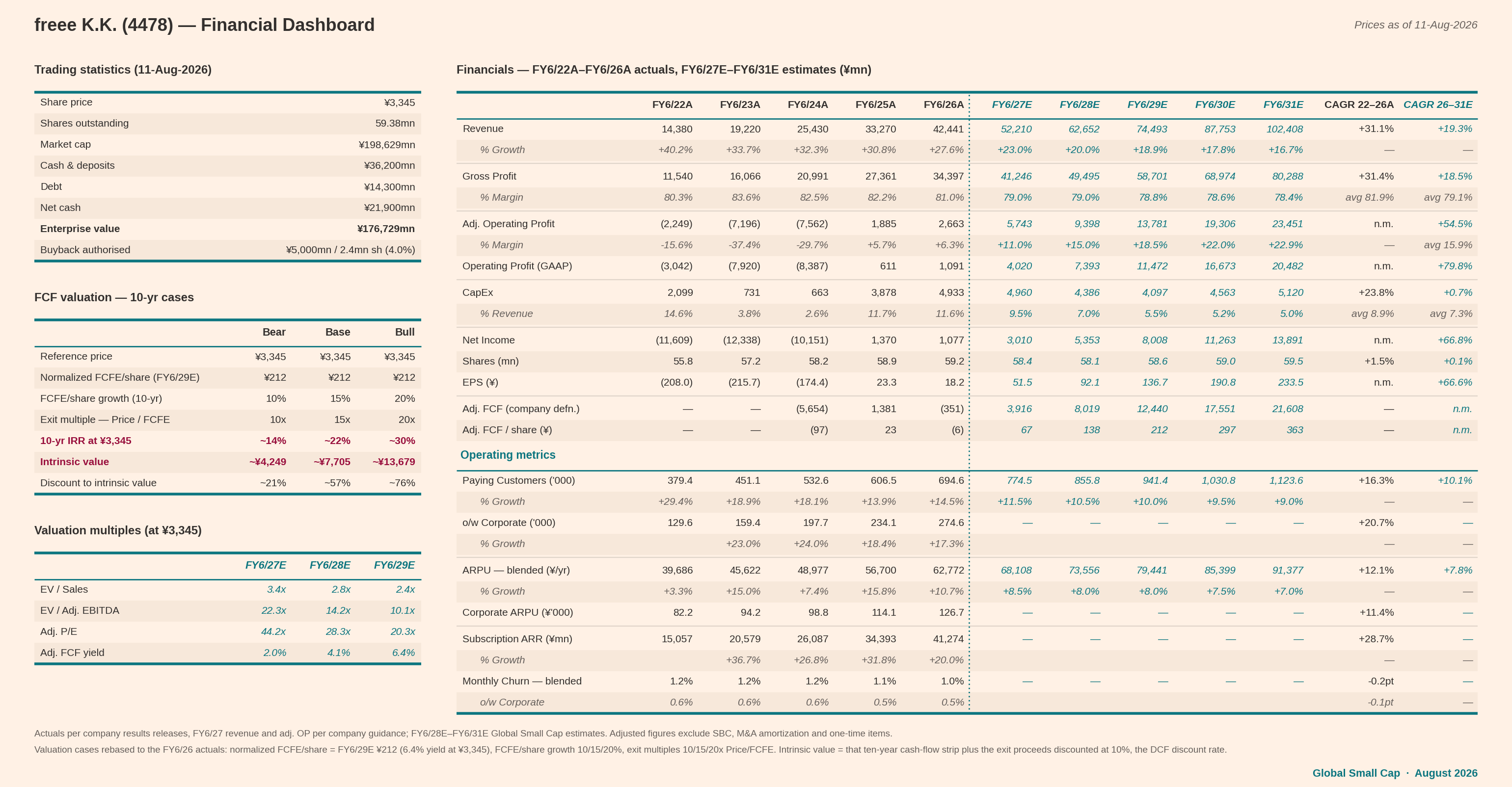
freee is a Japanese provider of cloud accounting and HR software to Japanese SME’s. freee’s software was built as a single integrated system on a common database using modern architecture allowing for greater efficiency and a “single source of truth” across multiple modules, which freee calls “Togo Flow”. This has allowed freee to expand from its accounting routes into HR, payroll, expense management, sales management, etc. with seamlessly integrated modules. Today, Freee holds ~56% share of cloud SME but cloud holds <40% of the SME market implying Freee has just 17% of the total SME market (with an ambition to 30%). As of June 2026, freee had 694k paying customers on the Platform at an ARPU of ¥62.7k. freee IPO’d Dec 2019 near ¥3,000, ran past ¥12,000 in the 2020–21 SaaS bubble, then fell to a 52-week low of ¥1,831 before recovering to ¥3,345 today.
Investment Case
What is the Moat?
Architecture. freee works on a single database across multiple business functions including HR, payroll, and finance. Because invoices, salaries, expenses, forecasting, and planning all run on a single database, freee can drive efficiency and automation and in-fact, freee is best-placed to leverage the agentic capabilities of AI. Having a seamless integrated architecture also makes customers stickier as customers need to migrate from one to multiple databases if they were to switch to a modular vendor. Having an integrated system also means there are fewer customer issues and to the extent an issue arises, freee has access to all the modules so can resolve them quickly. Case in point, AI chat support handled over 90% of customer inquiries end-to-end.
Packaged Philosophy. freee offers a single solution to all customers and does not do bespoke customizations. While this strategic decision may result in less adoption from large businesses who require customization, it also means freee’s R&D is scalable to every customer it acquires which speeds up innovation. To compound this R&D advantage, freee overspends on an absolute and relative basis on R&D, upwards of 25%+ which is higher than competitors.
Culture. freee runs an entrepreneurial, product-led culture led by founder Sasaki, a Google alum that built the company with digital-first acquisition and engineers at the center which has allowed it to innovate faster and attract talent. Competitors are often more “traditional”, bureaucratic, and often lag in innovation. Case in point, freee productized an open-source MCP server within months of the AI agent wave. freee has ranked in the top 10 of Great Place to Work Japan for eight consecutive years.
Bull Case
Despite concerns over AI, freee is now at a point where profitability will inflect.
Large Penetration Opportunity. Cloud accounting is <40% of the Japanese SME market versus 80% in Australia/NZ and 60%+ in the UK/US. While freee holds 50%+ share in SME cloud, cloud has significant room to take share of the total market. The migration from on-prem to cloud provides freee with a structural growth tailwind. Based on MM Research’s annual survey, cloud share of accounting-software users has climbed from 13.2% in 2017 to 26.3% in 2021 to 38.4% in 2026 — roughly +2.8 points per year, a ~13% CAGR. MM’s data is for the total market but the SME market is even less penetrated so has more room to run.
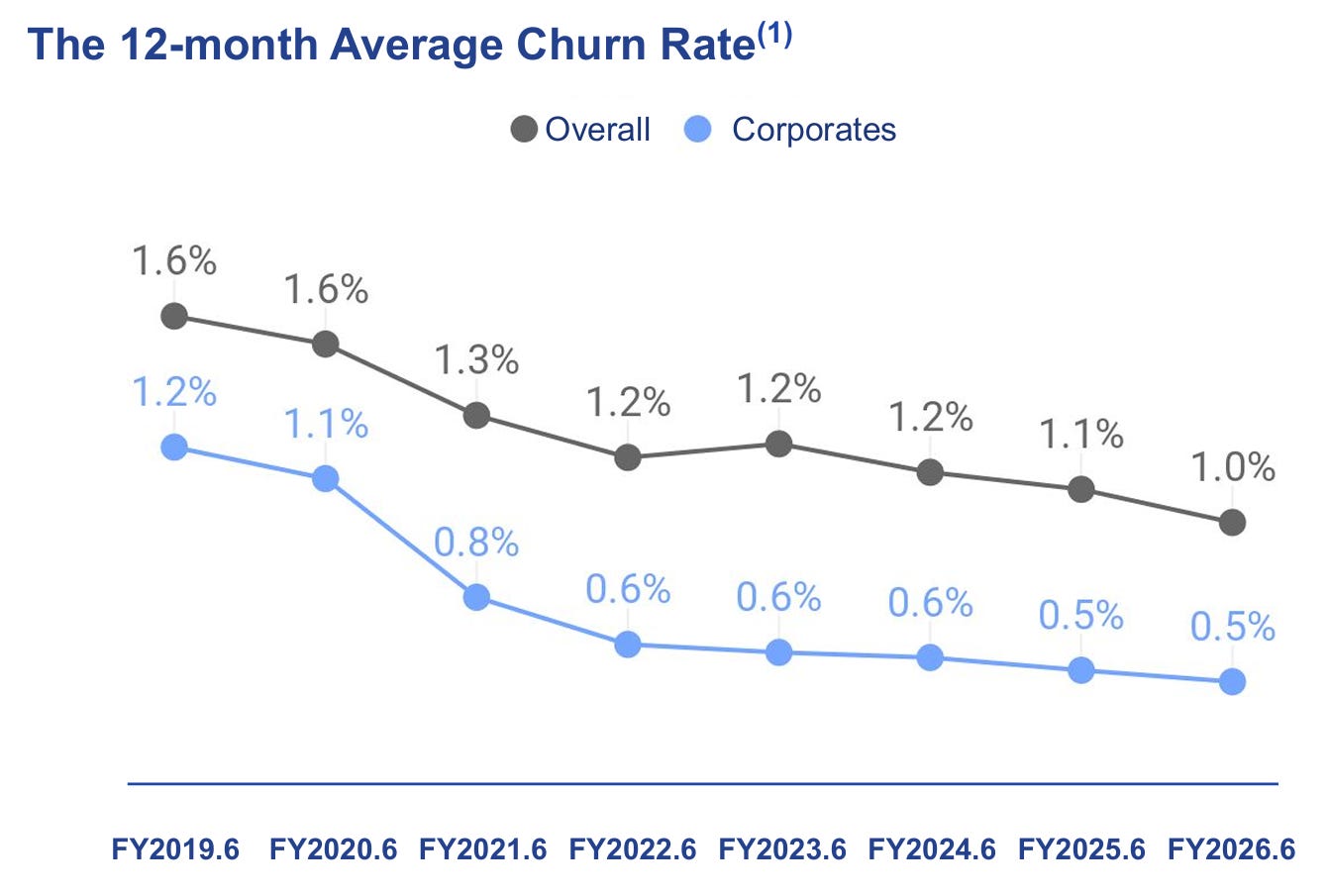
Opportunities for cross-sell and up-sell. freee’s single database approach is inherently sticky with monthly churn sitting at 0.5% (for corporates, higher if you include sole proprietors who use it for tax filings) despite freee playing in the higher-churn SME space. As freee gains a toehold with new customers and as freee develops new modules including AI-native modules, it can drive cross-sales: HR attaches at 50% of those that sign-up for accounting and those with the full line-up can generate 6x the ARR versus accounting-only customers.
Rule of 40. Since going public, freee has invested heavily into R&D and S&M running at or below breakeven. freee is now in a position to start driving significant margin expansion. freee explicitly targets rule of 40 on an adj. EBIT basis (to be fair, this used to be adj. FCF) by FY2028. Rough math, at 20% normalized EBIT margins on next year’s revenue of roughly ¥52bn (a margin rate at-which freee believes it can grow 20%), freee is trading at ~15x normalized EBIT which falls to a single digit EBIT multiple within 2 years with plenty of runway for both double digit top-line growth and a doubling of margins.
Untapped Pricing. Untapped pricing is most evident by the fact that freee pushed a major pricing revision in July 2024 for the main Accounting for Corporates module where base fees rose 38–127% with no discernable increase in churn. In fact, monthly churn is 0.5% today (for corporates), the lowest its ever been, illustrating the stickiness of the solution and the power of freee’s model.
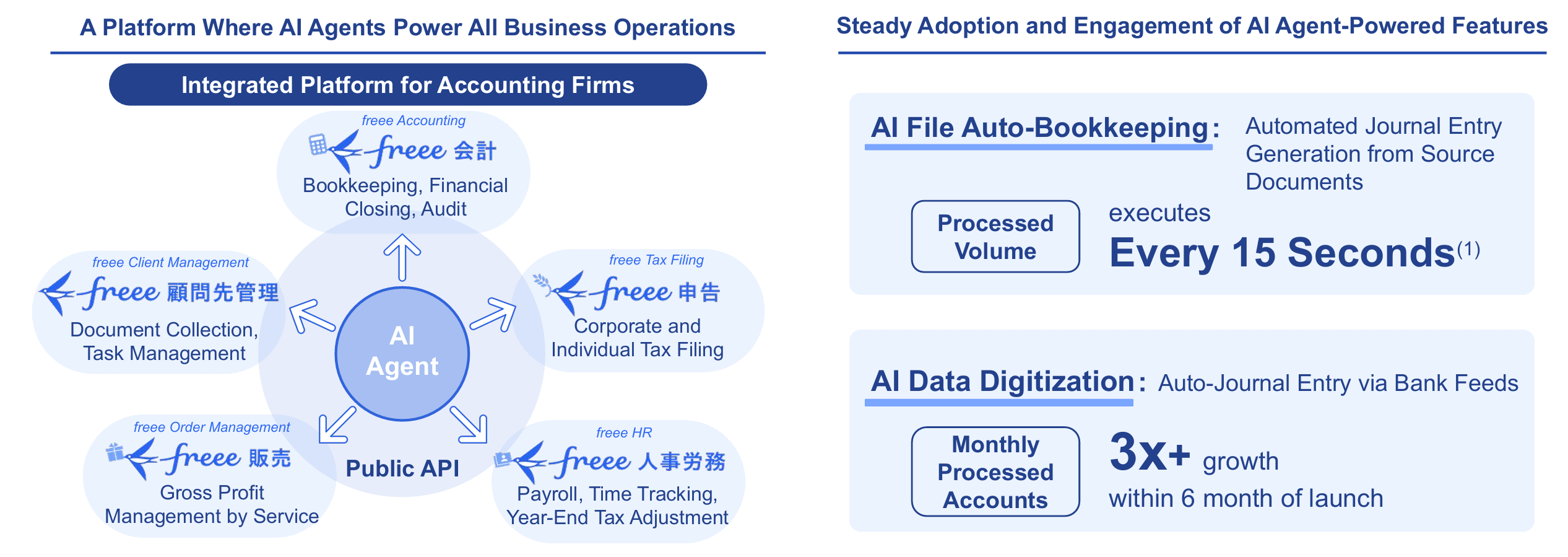
AI Beneficiary. To leverage AI, you need clean and auditable data which favors freee’s single database architecture which allows agents to confidently “act”, something that already happens naturally as an action in one area (say payroll) automatically updates another (finance). Companies on competing solutions have to invest heavily on upfront data clean-up and database integrations, which could potentially create an excuse to simply switch to freee. freee-mcp was launched March 2026 and exposed freee’s 380 public APIs to AI models. AI chat support now supports 90% of customer inquiries end-to-end. Further in Feb 2026, freee launched several AI-powered apps including end-to-end AI bookkeeping, ChatGPT tax filing, AI-OCR, and AI expense automation. These modules are only feasible because freee has access to clean customer data via its single database architecture.
Bear Case
freee has to move upmarket to expand. freee has had to compete against Yayoi (legacy on-prem, focused on sole proprietors) and Money Forward (cloud-based but modular) but freee also benefited from mom-and-pops using no solution at all (Excel, paper). As this low hanging fruit goes away, incremental share will be harder.
freee has product gaps in the mid-market. As freee move up market, it will run into OBC, the established mid/large-player with a true ERP that can handle inventory and logistics. freee’s capability gaps have meant their larger-customer wins have been limited to services businesses. freee has tried to close this gap with the 2026 acquisition of Logikura, which was rebranded freee inventory management. Gaining real traction may imply a heavier than expected R&D lift.
AI could have the opposite impact. While I expect integrated systems of record on modern architectures to be an AI beneficiary, it could also have the opposite impact. SMEs may be more empowered to try building in-house custom solutions. Competitors may be able to revamp or modernize their systems quicker to catch-up to freee. My view is that freee’s verticals (accounting, payroll, HR) are not natural verticals to vibe-code. Moreover, freee’s competitors are not necessarily “innovative” to the extent as freee suggesting freee will be the fastest to leverage AI for both internal efficiency and new AI-native products.
Valuation
There is plenty of precedent for sticky systems of record to achieve Rule of 40. In fairness, freee cited the prior rule (based on FCF) too restrictive in terms of growth and contract terms so switched it to Rule of 40 on EBIT in FY6/26, which in my view is fair at this stage of the growth evolution but also points to poor planning.
Assuming a 20% adj. EBIT margin, freee’s EBIT should be in the range of ¥11bn today and ¥15bn+ within the next 5 years implying freee is will trade at a single digit EBIT multiple in the next 2 to 3 years. Even if growth slows, freee has room to potentially double EBIT margins. For context, freee has run S&M expenses past 50% of sales with a significant portion of this spent on Google ads so to the extent growth comes down, S&M scales down alongside it. My view, however, is that high-teens growth is sustainable for 5+ years with nearer term growth in the mid-20%’s.
Assuming you are paying 15x normalized EBIT and you underwrite to a 15x exit-multiple and 15% EBIT growth, it is not hard to get to a 20%+ IRR (~5% FCF yield + 15% FCF growth). The upside scenario is 15% top-line growth combined with EBIT margins going from 20% to 30%+ over-time which, with multiple expansion, could drive returns as high as 30%. The bear case is a “disruption” scenario, and it’s hard to see unless we truly do see barriers to entry and switching costs erode significantly as a result of AI. I arrive at an intrinsic value of ¥7,705 leaving plenty of upside, even after today’s move.
Industry Primer: Japanese Cloud Accounting Software
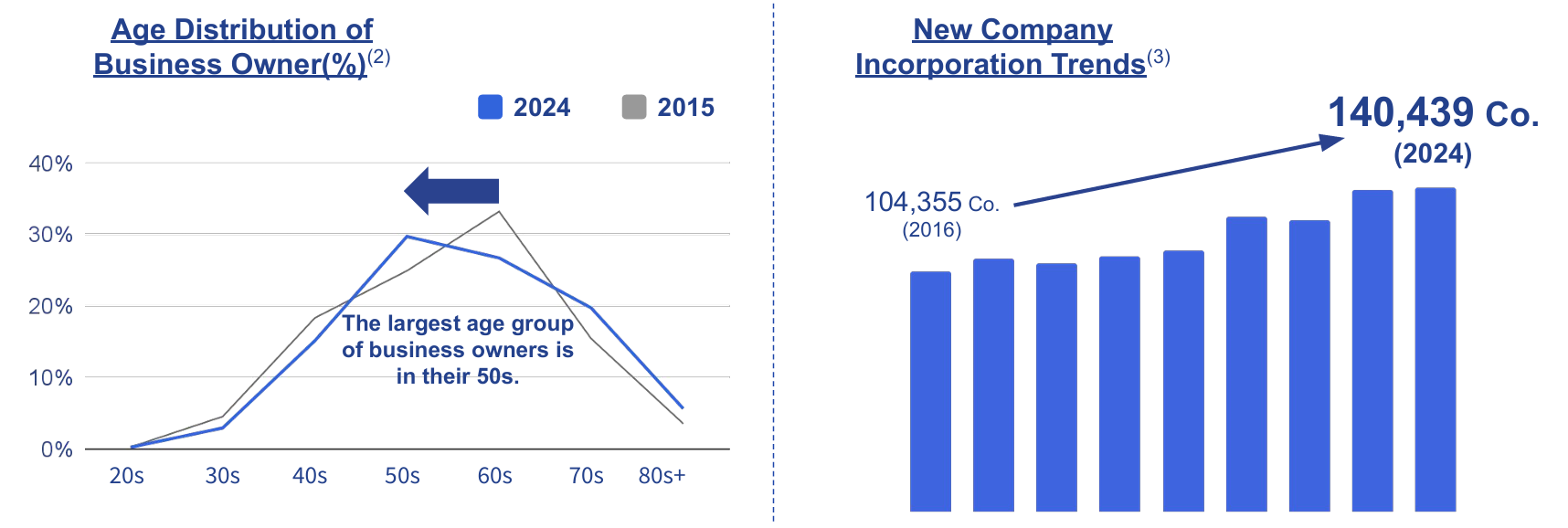
Japan has a massive albeit shrinking SME base. SMEs account for 99% of all enterprises and a massive 70% of employment. With the aging population, new business formation is weak with the new business growth at 3.8% with the implied business closure rate higher than that. This new business formation is roughly 1/3rd of US/UK levels. To put some context, approx. 67k businesses closed in 2025 and not due to failure: most closed due to demographics. An interesting stat: the average company President in Japan is 61 years old.
For freee, this demographic environment cuts both ways. Every small business needs accounting and HR software. On the one hand, new business formation is weak so there is no structural tailwind of new businesses to adopt innovative cloud-accounting software. On the other hand, due to demographics, automation is key to achieving higher labor productivity and the need to automate has only gotten more intense due to new regulations (Invoice System, e-books). freee does point to the fact that the average age of business owners is getting modestly younger and that new incorporations (even if it gets offset by closures) is growing with the newer cohort more likely to adopt cloud-software.
TAM
freee sizes the market in roughly similar terms to the census: 4.5m sole proprietors, 1.8m small businesses (1-19 people), and 0.3m mid-sized businesses (20-1,000). The TAM in revenue is 8% sole proprietors, 30% small, 45% mid, and 17% large businesses. freee calls small and mid “corporate” but I use the term SME throughout the report.
freee’s traditional strengths has been in small but it is pushing into mid. Within this, cloud is roughly <40% of the SME market. Another 15% of this market still has no software at all. Within cloud, freee has an estimated 56% share which backs out to roughly 17% of the total SME market. IDC estimates cloud penetration in accounting to be in high-20’s in Japan (including Enterprise), 50%’s in the UK/US and 70%/80% in Australia/NZ indicating Japan had one of the lowest penetration rates in the developed world.
The Regulatory Demand Drivers
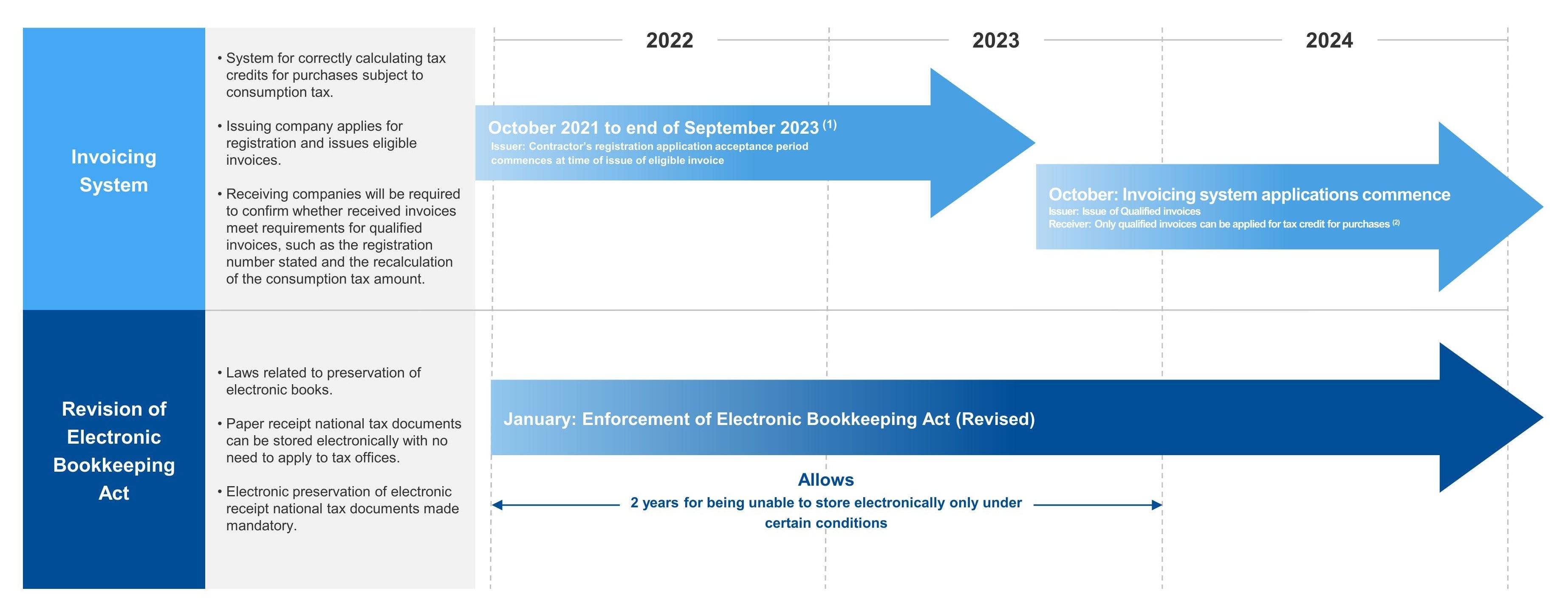
Japan’s Invoice System (effective Oct 2023). To claim a consumption-tax input credit, a business must now retain a qualified invoice from a tax-registered vendor. This regulation sharply increased back-office work to both issue and collect invoices. freee estimates collecting, sorting, bookkeeping and checking 50 pieces of evidence takes 2 hours, which software can cut by 80%. This change has driven increased software adoption by SMEs previously using manual processes. freee grew S&M to 69.4% of revenue in FY23 and 66.7% in FY24 (vs 53.9% in FY22 and 50% in FY26) to run an invoice-system marketing blitz.
Electronic Books Maintenance Act (effective Jan 2024). This regulation made electronic storage of electronic transaction data mandatory following a 2 year grace period (enacted Jan 2022), basically banning paper-only records. Combined with the invoice system, this helped drive penetration, especially for freee’s AI-OCR document capture feature (documents photographed or emailed in are digitized, classified and stored compliantly).
Work-style Reform Legislation. Japan has made several regulatory changes related to paying overtime and these rules started with large corporates but have moved down to SMEs. From April 2023 the 50% overtime premium (for hours above 60/month) was extended to SMEs, forcing SMEs to actually track hours and calculate premiums correctly.
Business Overview
freee was founded by Daisuke Sasaki in 2012 (current CEO and Director) under the mission to “Empower Small Businesses to Take Center Stage.” Sasaki’s background traces to Google where he led search-ads for Google in Japan. Before going into each product, it is worth repeating the architectural underpinnings of freee.
Database Design. freee uses a single database or shared master which it calls “Togo Flow”, for all of its modules. This single source of truth means change to one area seamlessly updates others. freee offers 380 public APIs allowing third parties to query the data. there is an additional app store that connects freee to banks, credit cards, and online-seller accounts which in-turn allows freee to automatically capture transactions into their system from these accounts (i.e. a corporate credit card) positioning freee as seamless system of record where expenses charged to the corporate card get automatically processed.
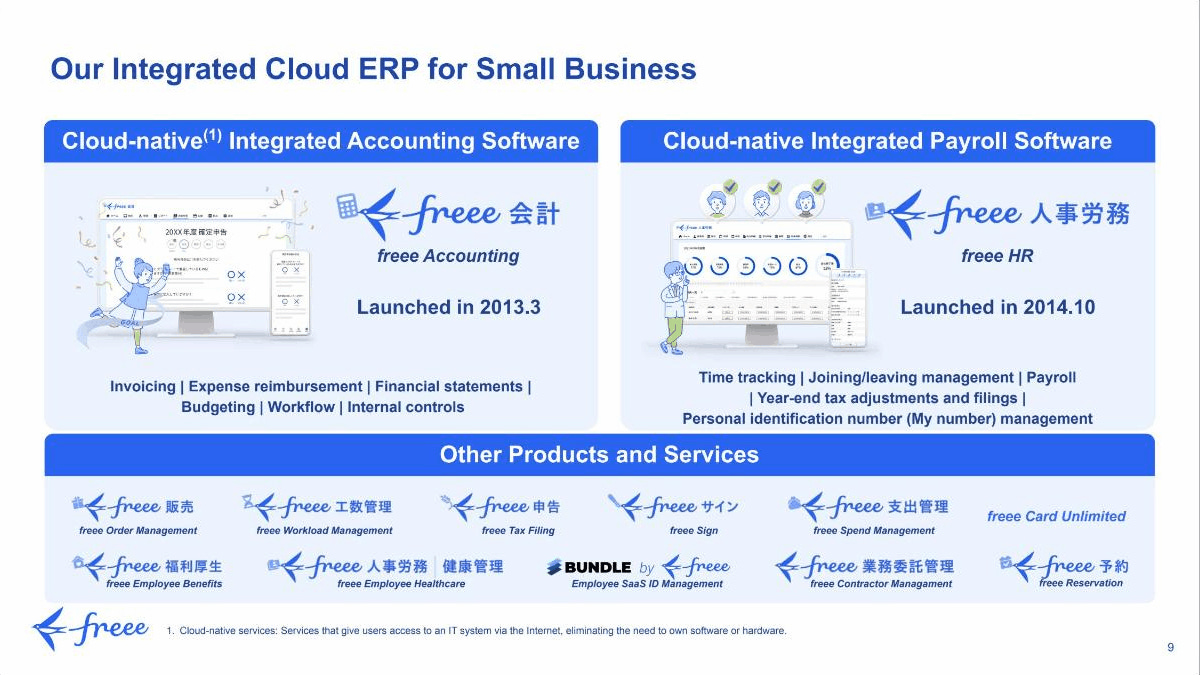
freee’s original heritage was accounting software but today, freee has roughly a dozen core products across accounting, HR, payroll, expense management, and financial services, which all run on the “Togo Flow” database.
freee Accounting. freee Accounting was launched at founding in 2012. The software covers financial accounting, receivables/billing, invoicing, and expense settlement. freee Accounting automatically produces the ledger, financial statements, tax returns and even MD&A. freee has recently added AI enhancements including AI-OCR (document reading) and as of Feb 2026, an end-to-end feature that automates collection, classification, bookkeeping, verification, finalization all the way through to tax filing, with humans only required to check the edge cases. freee has not disclosed official adoption rates of the end-to-end solution.
freee HR. In the US, payroll (say Paycom, Paylocity) and accounting (Intuit, bill.com) are separate but freee does both. freee HR, launched 2014, bundles payroll, time & attendance, social-insurance and year-end tax, all on a shared database. Logged overtime auto-posts into freee Accounting and auto issues the revised pay slip. Workstyle reforms and the associated rules around tracking overtime pay and meeting labor compliance is a structural demand driver.
Invoicing, ordering and billing. freee Invoice (launched Dec 2022) lets small corporations issue Invoice-System-compliant invoices. freee Order Management centralizes order operations. freee A/R & A/P handles receivables and payables.
Tax filing (corporate and individual). freee Tax Return (launched Oct 2016), lets companies file taxes without an accountancy firm, and its 2022 acquisition of Mikatus added additional capabilities around cloud tax/accounting/payroll system used by accounting firms. For self-employed tax, freee built a hybrid AI-plus-human “Automated Data Entry Plan” and a “freee Tax Filing” ChatGPT app.
Electronic signing (freee Sign). freee entered e-contracts via “NINJA SIGN by freee,” rebranded freee Sign, essentially a DocuSign for Japan.
Company establishment, project management and other verticals. Modules include company-establishment support, project management, employee benefits, employee healthcare, and freee Reservation for businesses like salons and trainers. More recent additions include freee for Medical (March 2026) and freee Inventory Management (via Logikura acquisition), aimed at healthcare and retail/distribution.
Financial services (cards and financing). freee Card Unlimited is a corporate card (launched Jan 2022) which offers credit lines up to ~¥50mn underwritten off real-time freee Accounting and bank-balance data, with usage synced back into the books. It is the fastest-growing driver of Transaction ARR (transaction ARR is still <5% of total ARR). freee also offers invoice financing/factoring — expanded via the FY6/26 acquisition of FREENANCE from GMO Creators Network — plus loan-support consulting and a new bank-transfer payment service.
The portfolio balance of card advances have grown from ¥1.0bn (June 2023) → ¥2.3bn (June 2024) → ¥4.0bn (June 2025) → ¥7.2bn (June 2026). freee fronts the merchant settlement and collects from the customer, so the book turns quickly but sits on freee’s balance sheet.
freee carried ¥1,063mn of provisions at June 2026 against receivables of ¥1,537mn and card advances of ¥7,158mn — roughly an 8% allowance against the total receivables book. freee does not disclose loss rates for the card business specifically. It is a concern that a software company carries a credit book, but at ¥7.2bn (~12% of assets, <5% of ARR), this is manageable risk
In terms of revenue mix, while not explicitly disclosed, we know that roughly 40% of freee Accounting users also use HR and another 10% have adopted the card (the second most common cross-sell). Based on this, we can roughly estimate that the mix by module is 50% accounting, 20% HR, 5% card and 25% everything else (mostly accounting related). Within small businesses and sole proprietors, the HR attach rate is a lower ~20% but higher amongst medium- to large businesses.
AI Integrations. In March 2026, freee launched freee-mcp, an open-source MCP server that makes the platform accessible to AI models, which had 18k users as of June 2026. Agents can now run on an authoritative dataset to spot things like opportunities to automate entire processes (i.e. automate bookkeeping tasks with agents), identify efficiency opportunities (multiple departments are using the same supplier but are currently unaware) or detect anomalies in the books. A competitor may have to have multiple mcp integrations potentially across multiple vendors leading to data issues.
freee has done 2 to 3 small bolt-on deals per year, normally to acquire a very specific capability.
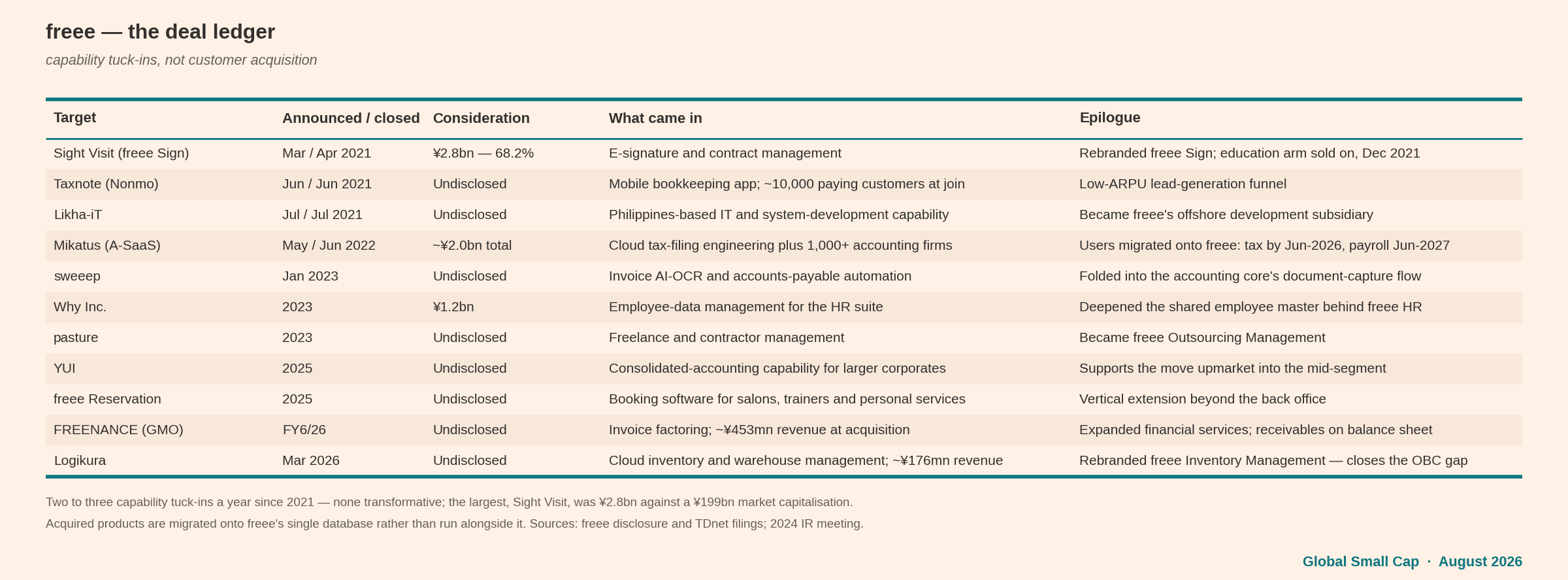
When freee does M&A it typically integrates everything onto freee’s stack and forces existing customers to migrate onto freee rather than carry a separate database/product. M&A is designed to acquire capabilities, not customers.
Customers and Sales Channels
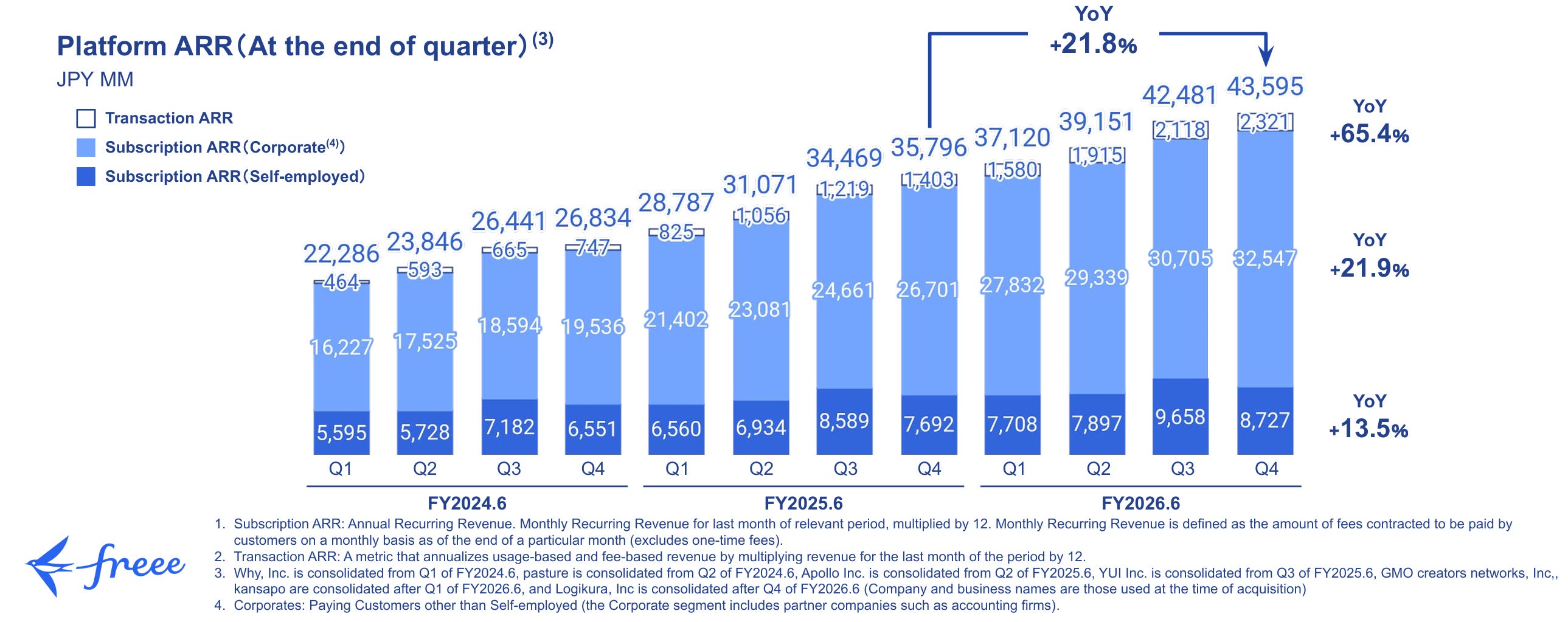
As of June 2026 (FY6/26), Platform ARR of ¥43.6bn is broken as:
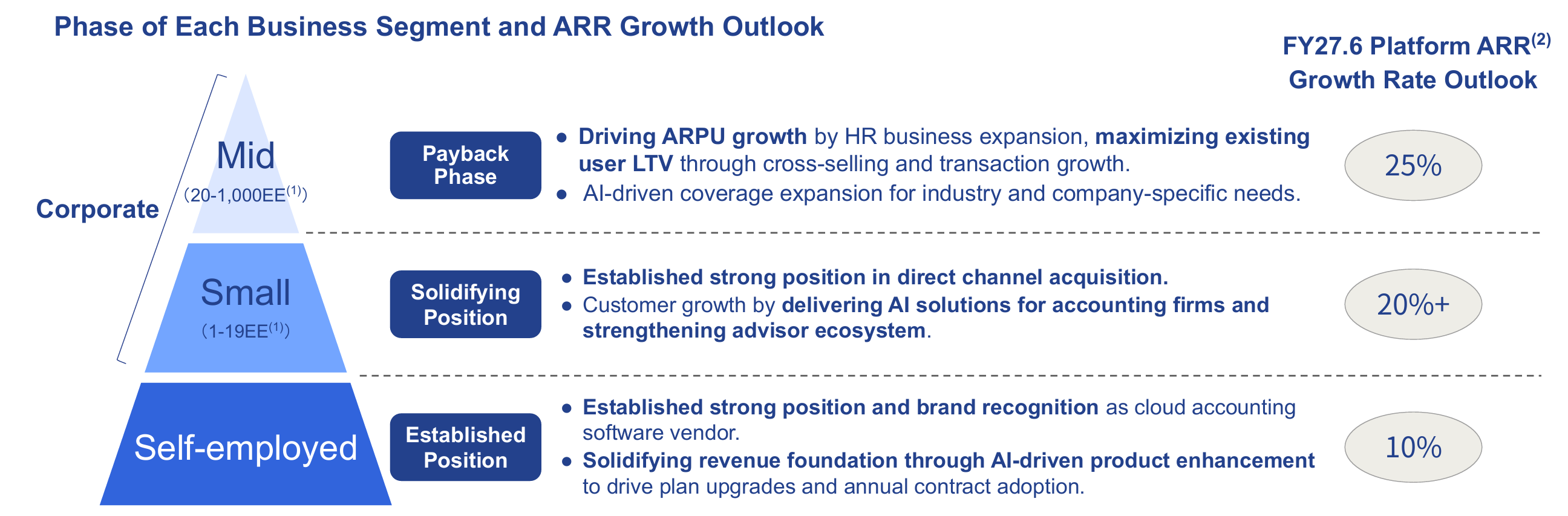
Corporate ¥34.8bn — 80% of ARR across 275k corporate customers
o/w Mid-segment ¥16.8bn — 38% of ARR
o/w Small business ¥18.0bn — 41% of ARR
Sole proprietors ¥8.8bn — 20% of ARR across 420k customers
Geographically, freee is 100% Japanese and management has not expressed an interest trying to expand oversees which makes sense as Japan has unique business regulations and customer behaviors and usage patterns relative to almost any market (US may be able to expand to Europe but much harder for Japanese SaaS).
The sales approach differs by channel. For sole proprietors and small businesses, sales is done via direct online marketing supplemented by online webinars. As you get into the mid-segment, sales moves to a hybrid of online and in-person sales. freee’s field sales teams are based in offices in Tokyo, Kansai, Kyushu, and Chubu.
Indirect sales accounts for another 20% of sales, primarily via accounting firms but also local banks and retailers like Softbank and NTT. Accountants are an important channel as sole proprietors and smaller businesses often outsource accounting function to an accountant rather than do it themselves so selling via accounting firms can be a means to reach these smaller businesses.
As part of this accounting firm strategy, freee has modules specifically designed for accounting firms including document collection, bookkeeping, checking, tax-filing, and management support. Commissions are directionally 20% of ARR with those performing better on metrics like churn getting higher commissions and vice versa. Accounting firms benefit from synergies interacting with their end-customers data if that customer is also using freee.
Japan has roughly 82k licensed tax accountants across 30k offices (2021 census). freee counts ~5.5k freeee certified-adviser firms equal to 18% of accounting offices and counts 81 of the top 100 firms. freee is arguably behind on the accounting channel side compared to competitor Money Forward which generates a much higher percentage (perhaps up to 50% as they disclose 80% of the top 100% accounting firms use the Money Forward products) via the accounting channel, but there are some trade-offs. Accountants are not systems-integrators and may not think strategically about cross-selling HR and other modules, limiting the ability to drive cross-sales. For freee, cross-sales to existing customers are 1.7x more efficient to acquiring a new customer.
Competition
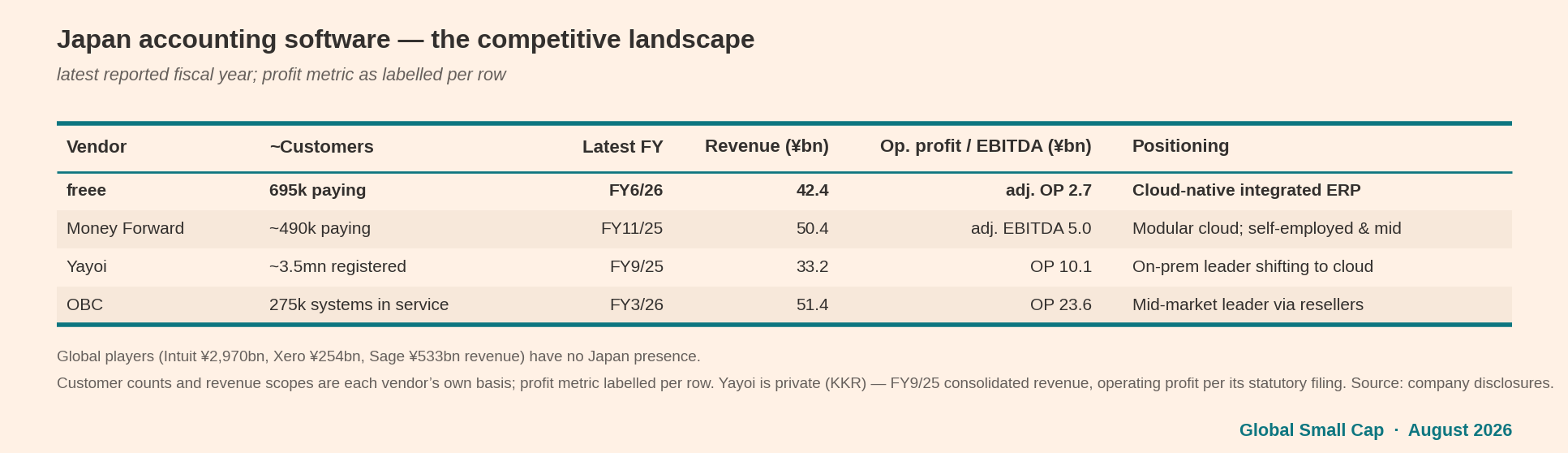
Money Forward
Money Forward is freee’s most direct competitor. Similarly founded in 2012, Money Forward is also a cloud-native (albeit modularized versus integrated) solution with similar functional coverage across accounting, HR, expense and invoicing. Each module has its own database and is designed to work as a standalone solution, linked together via APIs. Functionally, this is worse, but practically, it allows customers to migrate to cloud one module at a time without doing a large migration and also means accountants are more likely to recommend Money Forward versus freee where the accountant may be hesitant to also hand-hold their end-customer through an HR software migration.
Money Forward targets the same SME-sized businesses as freee, particularly those preferring a modularized solution. Money Forward’s background is actually as a personal-finance management app and this background makes it particularly strong in budgeting as well as credit card and bank integrations. Money Forward’s consumer app has 18.3m app users and strong brand awareness that has translated to strong B2B awareness, which has translated to 442k customers (vs. freee’s 694k). You can roughly back-out that freee has 55% and Money Forward ~35% share of the SME cloud accounting market.
Given Money Forward’s retail heritage, Money Forward looks to have a strong UI and mobile apps and they look to be stronger with sole proprietors. freee looks to be stronger with SMEs. freee is also known to innovate faster as evidenced by quick releases of AI-powered products, something Money Forward has only recently started to do via product announcements although it is unclear if real features have shipped. Evidence points to Money Forward losing incremental share. With that said, both companies are cloud native with strong functionality so are likely to continue splitting the SME market ~2/3rd and ~1/3rd going forward.
Yayoi
Founded in 1978, Yayoi is the incumbent in the sole proprietor and small-business (<20 employees) market with an estimated 63% share and 2.5m+ registered users on an on-prem system. Yayoi’s customer base tends to be older sole proprietors and accountants who have used the system for decades and have chosen not to upgrade to a modern system. Yayoi was owned by ORIX but was sold to KKR in March 2022 for a reported ¥240bn. Two-plus years on, freee reports no discernible change in the competitive landscape, pricing or product from Yayoi. In my view, Yayoi’s share will gradually decline with incremental share likely significantly lower to both Money Forward and freee.
OBC
OBC, a subsidiary of listed OBIC, is the mid-market leader with a real presence in enterprise. OBC is larger than freee, holding 40% of the total accounting-software market. OBC also has a modular-based architecture. OBC has traditionally offered an on-prem product but its Bugyo Cloud franchise is migrating these clients to a cloud-based system. OBC’s strengths include strong reseller reach and heavy brand advertising of ¥700–800m a year. OBC is also known to have superior handling of physical-goods and inventory workflows, areas freee historically lacked but on the flip side, their system “heavier” and less suitable for SMEs.
In order to beef up its physical goods and inventory workflows, freee acquired logistics platform Logikura in April 2026 and rebranded it to freee Inventory Management. Logikura is a cloud-based inventory and warehouse-management software (stock tracking, receiving/shipping workflows, warehouse ops) aimed at small distributors and e-commerce sellers — precisely the physical-goods workflow layer freee lacked. Logikura was a relatively nascent business with FY25 revenue of ¥175.9mn. After closing March 2026, Logikura was rebranded freee Inventory Management and folded into the integrated lineup so inventory movements post into freee Accounting on the shared master.
Global Players
QuickBooks, Xero and Sage have no meaningful Japan presence. Japan’s local environment is unique in terms of business culture, language, and regulatory and tax complexity. The main foreign operators are large enterprise players like NetSuite and SAP, not SMB cloud vendors. freee benchmarks itself against Xero and Intuit but views overseas expansion as difficult for the same language-and-regulation reasons that keep those players out of Japan.
Moat
As I described in the Investment Case, freee’s moat is underpinned by architecture, its packaged philosophy, and its culture.
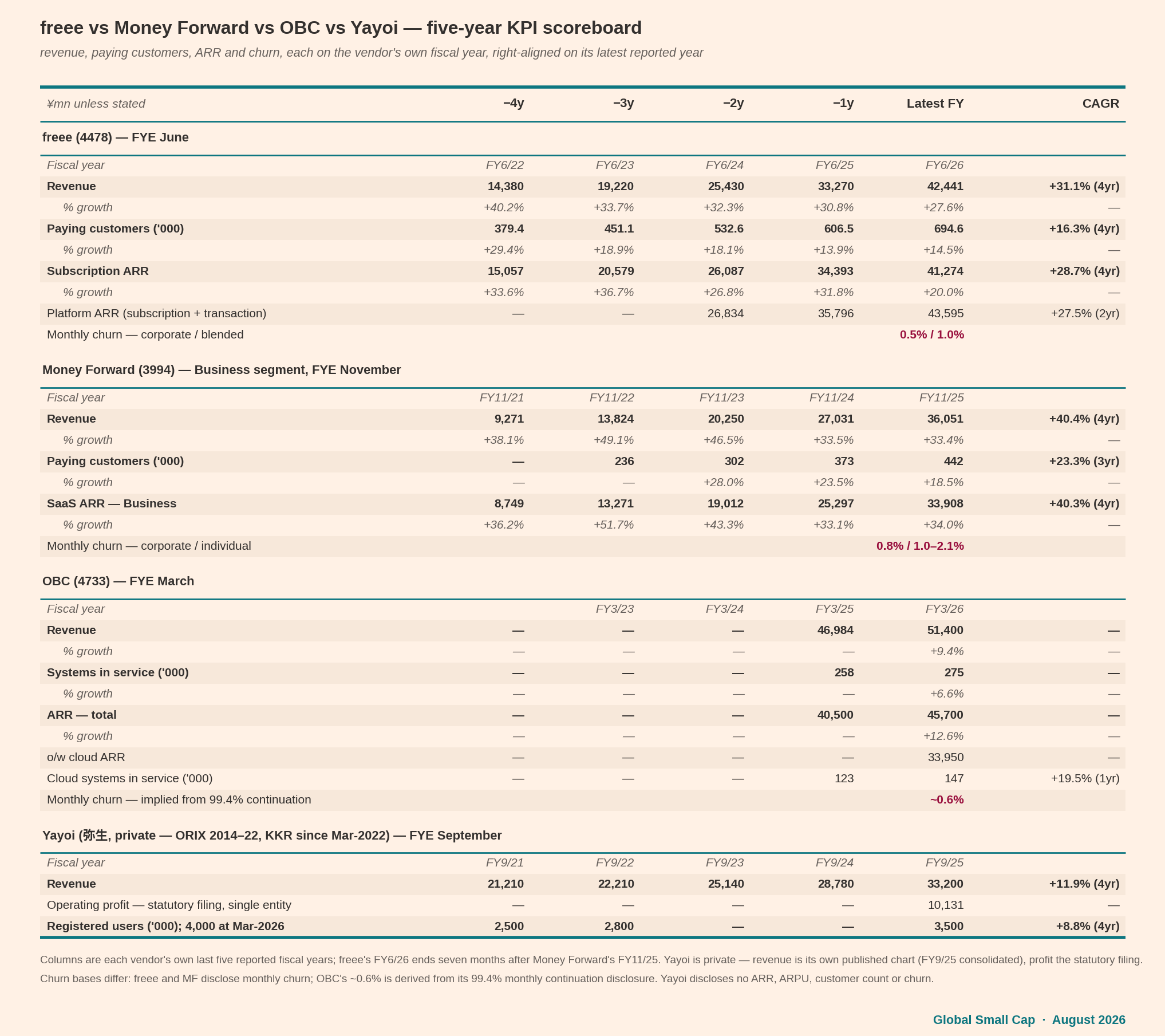
In fairness, Money Forward is a formidable competitor. Money Forward is seeing faster growth off a lower revenue base with comparable churn statistics so while cloud is secularly growing, there is no clear preference for modular cloud versus integrated cloud: both are doing well.
However, when you compare this against Yayoi and OBC, you can see the moat shine through. Both businesses are growing at half the rate with far lower growth in terms of paying customers, suggesting even lower incremental share. In both cases, the software is not cloud-native.
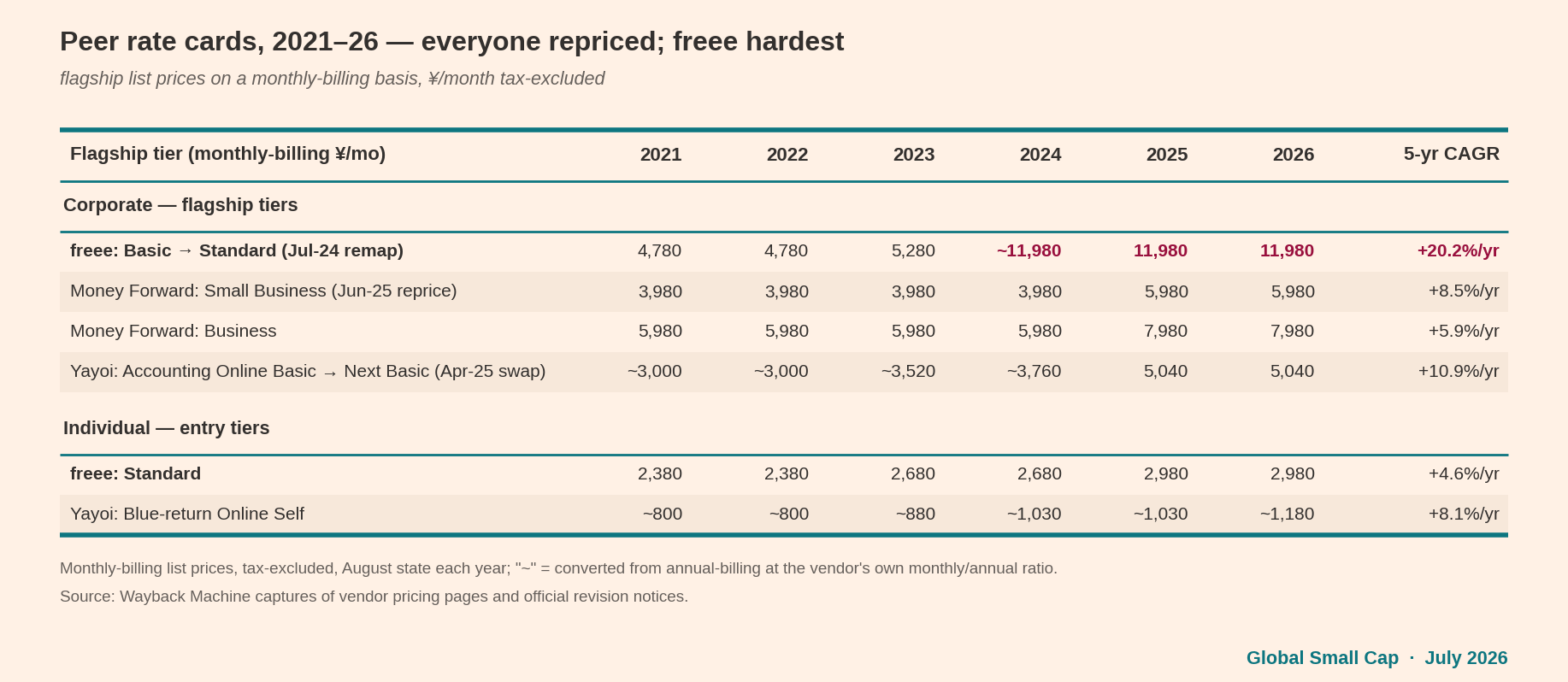
Interestingly, freee’s growth is coming despite being on the high-end in terms of pricing, which is indicative of the feature-rich products freee ships. This is all happening whilst churn is actually falling.
Economics
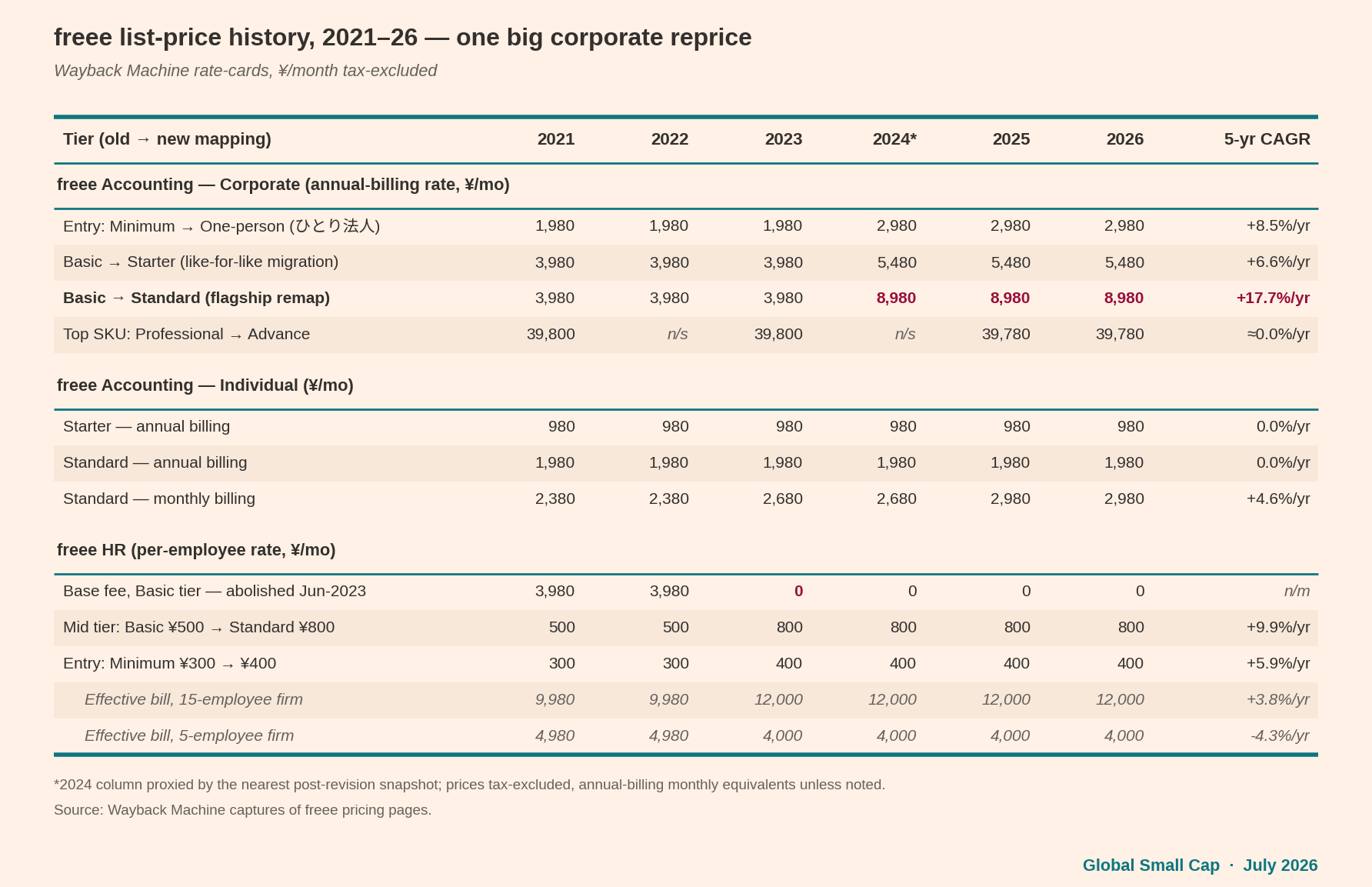
freee sets lists prices on its website and does not have individually negotiated rates for most SMEs. Larger customers serviced by field-sales have access to enterprise pricing, but there isn’t significant price adjustments. The rate card has four components. Below is a breakdown per the actual customer lists disclosed on the website.
Below is a breakdown of how that price list has translated to subscription and transaction ARR. Transaction ARR is <5% of total ARR.
The July 1, 2024 price revision of freee Accounting for corporates was the first major increase in six years, motivated by a widening gap between the product’s value and its price as multiple features including Invoice-System and Electronic-Book-Maintenance-Act features were added. The prior Basic plan at ¥3,980/month annual moved to the new Starter at ¥5,480/month annual — a 37.7% increase. Some tier transitions were steeper. The realized figure added ¥1.7bn to ARR all while churn remained stable.
Gross margins have averaged a healthy 82% over the last 5 years. Below is a summary of the operating expenses.
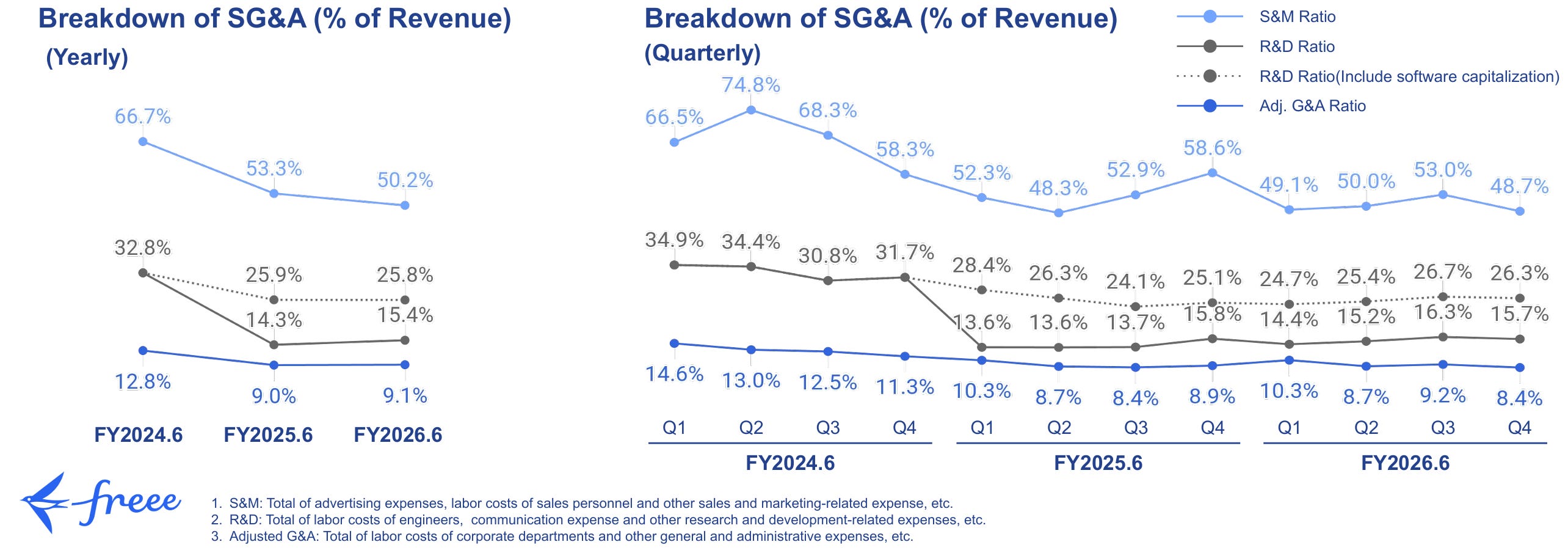
In terms of R&D, assuming you expense capitalized R&D, freee spends roughly 26% of revenue on R&D versus 20% to 25% for Money Forward and likely a much smaller ratio for Yayoi (not disclosed but they ran at 30%+ EBIT margins when they were public). Importantly, that R&D spend is potent as every new feature is available to all customers with limited customizations. Both freee and Money Forward have very similar economics today while Yayoi unsurprisingly is operating at a much higher margin whilst not reinvesting into S&M or R&D.
freee’s financial-services revenue is captured in Transaction ARR, most of it from the freee Card Unlimited corporate card. freee does not disclose the take-rate on card balances or the default rate, but the card monetizes through processing and usage-volume fees that annualize into Transaction ARR. The financing side was expanded via the FY2026 acquisition of FREENANCE (factoring), and freee’s adjusted-FCF definition explicitly excludes fluctuations in advances paid for the card business and purchased receivables for factoring.
freee does not explicitly disclose an LTV/CAC but on FY6/26 actuals — 0.5% monthly corporate churn, 1.0% blended, and an 81% gross margin — the corporate cohort works out at roughly 7.5x with a 27-month payback, against 3.3x blended. This is attractive especially as corporate is growing more than double sole proprietors. Segment ARR growth guidance is Mid 25%, Small 20%+, self-employed 10%
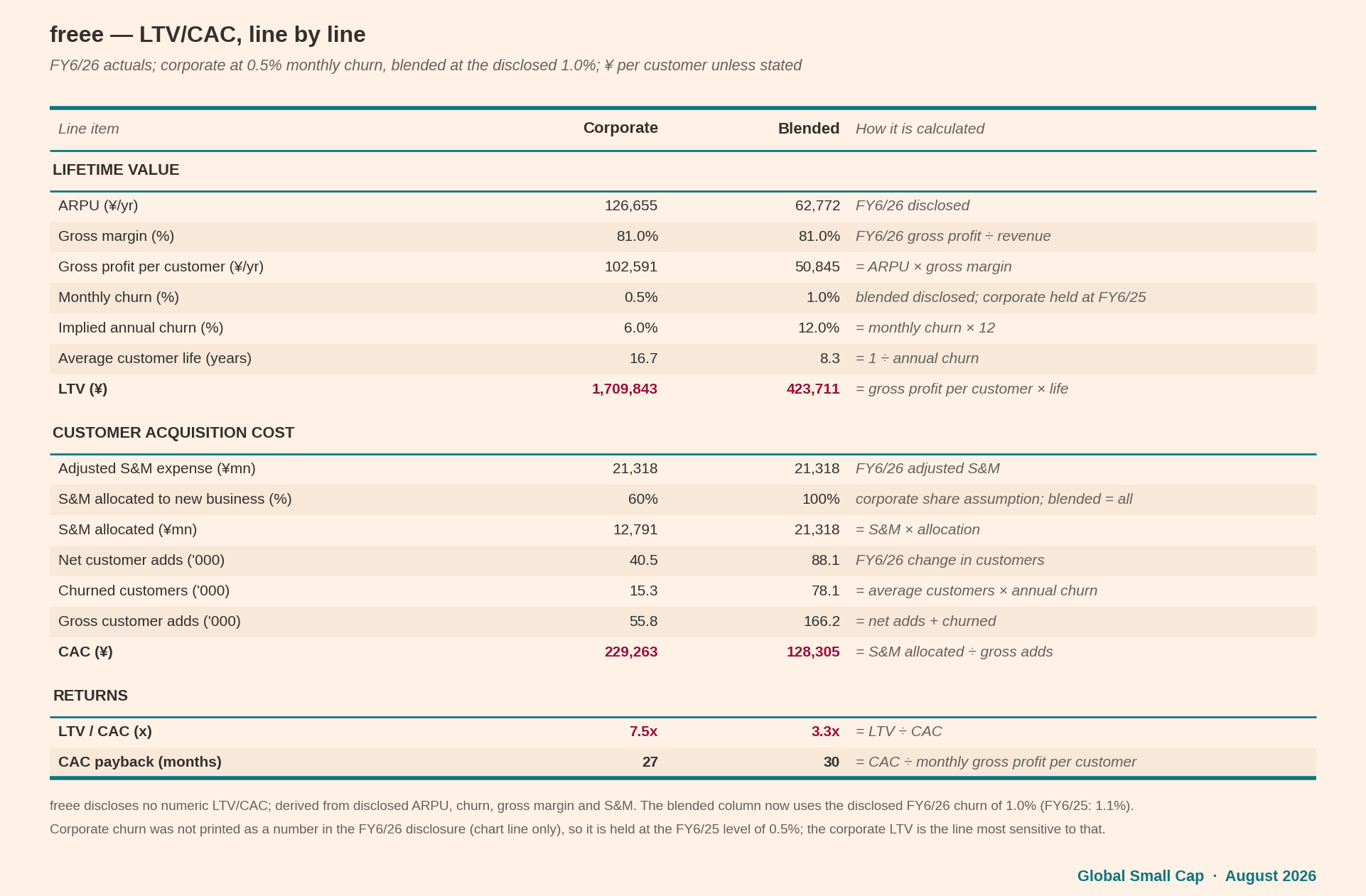
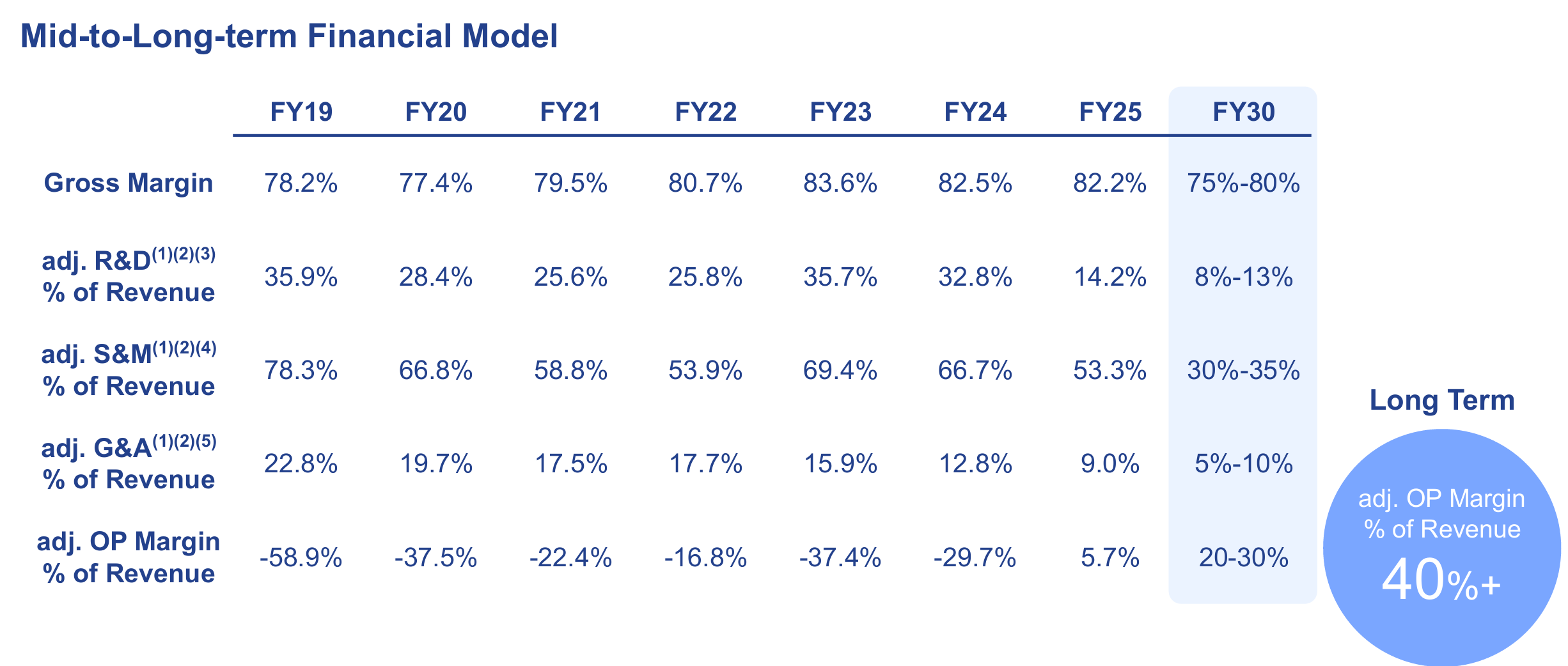
Based on a healthy LTV/CAC and stable churn despite significant price increases combined with Yayoi already operating at 30%+ EBIT margins at maturity, it is not hard to see freee comfortably normalizing to 30% EBIT margins and 40% over time, in line with their stated goal.
Management
freee has an entrepreneurial and product-led management with diverse and international backgrounds in contrast the more “traditional” backgrounds of executives at peers. The co-founder and CEO, Daisuke Sasaki, previously led search marketing for Google in Japan. The CFO, Ami Tsuboi, appointed April 2024 came from McKinsey and previously worked within freee’s data analytics, Sales Operations & Enablement and business/corporate planning teams. While individual compensation plans are not disclosed, PSUs are tied to internal ARR growth, customer counts, and achieving explicit rule-of-20 metrics of 20% revenue growth at 20% FCF margins. Management has significant skin in the game with 20% ownership of the company. In the latest FY6/2026 results, freee announced a share repurchase of up to 2.4m shares (offset by 1m shares contribution to the employee share purchase plan) via open market purchases.
Key Assumptions
You can decompose growth into customer growth and ARPU, with ARPU driven by penetration and pricing.
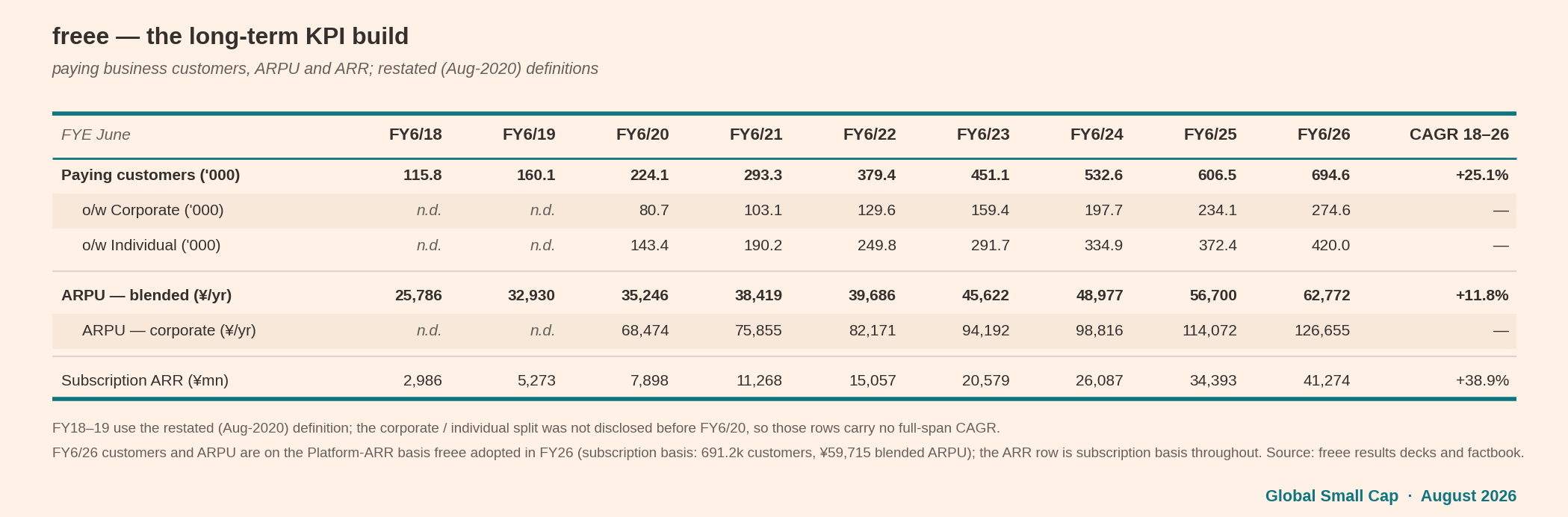
From FY18 to FY26, customers compounded at 25.1% a year and blended ARPU at 11.8%, driving subscription ARR of nearly 40% CAGR. There are a few drivers.
1. Cloud taking share from on-prem. Cloud has gone from 13.2% of sole-proprietor in 2017 to 38.4% in 2026 — roughly 2.8 points a year, with no sign of saturation. As demographics necessitate efficiency and as the average new business owner trends younger and using other developed markets as comparable where penetration can be more than double, this trend should continue driving secular growth in the market
2. New customer growth. While there are concerns that freee will have to move up-market and compete against other competitors, the inverse argument is that freee’s capabilities have now caught up so much that growth amongst larger mid-sized businesses could accelerate. The corporate cohort grew 18.4% last year to 234k and carries twice the ARPU at lower churn.
3. Pricing, new modules and cross-sell. ARPU has compounded at 11.9% a year. Pricing has shown to be a proven lever as the June 2024 massive increases demonstrate. New module growth should also continue and to the extent its a cross-sell, drive S&M leverage. Further, as freee’s average customer size increases, attach rates also increase. HR attaches to at 40% of accounting customers for corporate.
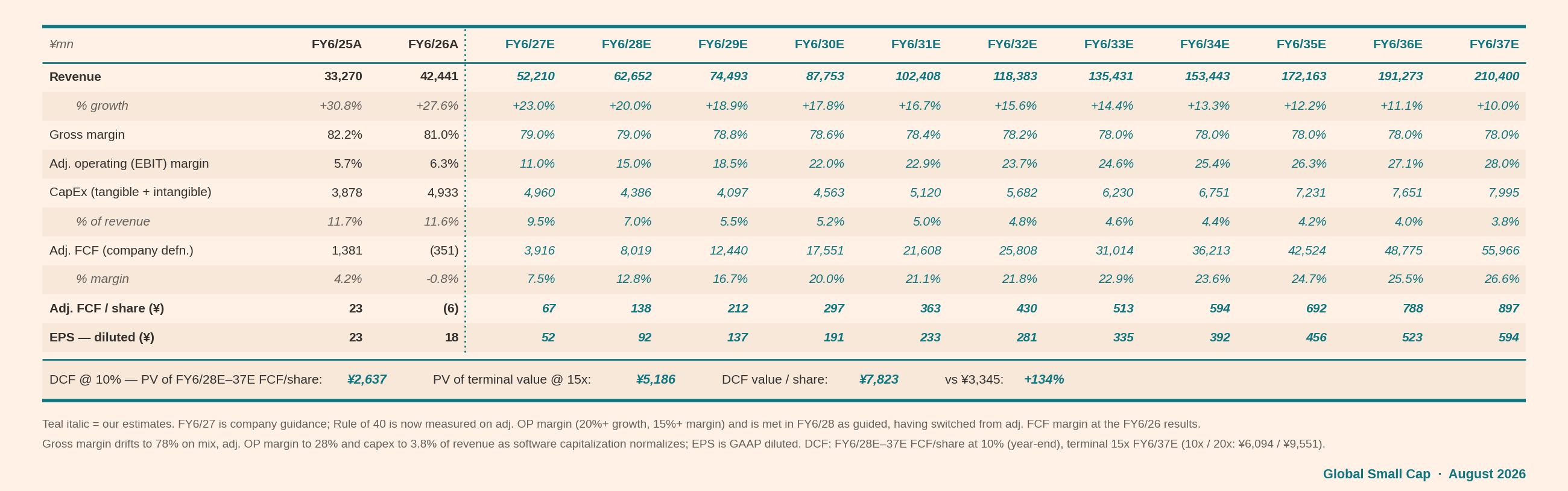
I believe consensus estimates are reasonable and the shares are cheap off consensus.
Revenue. I assume growth of low-20% scaling down to 10% by the 2030’s. If you assumed the accounting market just grew 2% and cloud penetration went from 40% to 60%, that itself would drive 6% growth so when you layer historical customer growth in the 20% and ARPU growth in the 10%’s, getting to mid-teens is very achievable.
Margins. Important thing is that you don’t need significant revenue growth for the investment to work. Rule of 40 is now measured on adjusted operating margin and I take management’s rough guidance of hitting 15%+ by FY6/28. From there the margin climbs to 22% by FY6/30 — the low end of the company’s own FY2030 model — and to 28% by FY6/37.
Tax. freee still has some tax-loss carry forward but tax rates should normalize to ~30% by the 2030s once freee reaches normalizes run-rate profitability, Japan’s statutory rate.
Free cash flow, which was negative in FY6/26 on one-time working-capital and consumption-tax items, converges back to roughly 90–95% of adjusted operating profit from FY6/29 helped by negative working capital.
Dilution. Shares grow 0.8% a year, but the newly announced ¥5.0bn buyback (up to 2.4mn shares, 4% of the company, running to February 2027) more than offsets that in FY6/27. Management framed the buyback as opportunistic given a “significantly undervalued” share price, not as a standing policy.
If you look at the key assumptions, the model basically breaks down to 1) whether growth can sustain into at double digits past the next 3+ years and 2) whether margins can increase. I think using a very conservative 20% EBIT margin implies you are paying a mid-teens multiple of FCF. I think 20% leaves the potential for a doubling of margins longer-term. Moreover, penetration rates are still low and freee continues to aggressively innovate without any signs of churn, suggesting that the growth rate should remain double digits for the foreseeable future. Cloud penetration alone can drive 6% total growth in the cloud accounting market before ARPU or new customer wins. As a result, I arrive at a conservative intrinsic value in the ¥7,705 range with plenty of upside optionality.