

I tend to study serial acquirers as they are a variant of a compounder: most compounders have high returns on capital and a long-runway to redeploy capital at those returns. Serial acquirers are a variant where they don’t have internal opportunities to deploy capital but for structural reasons, have an inorganic runway.
Background
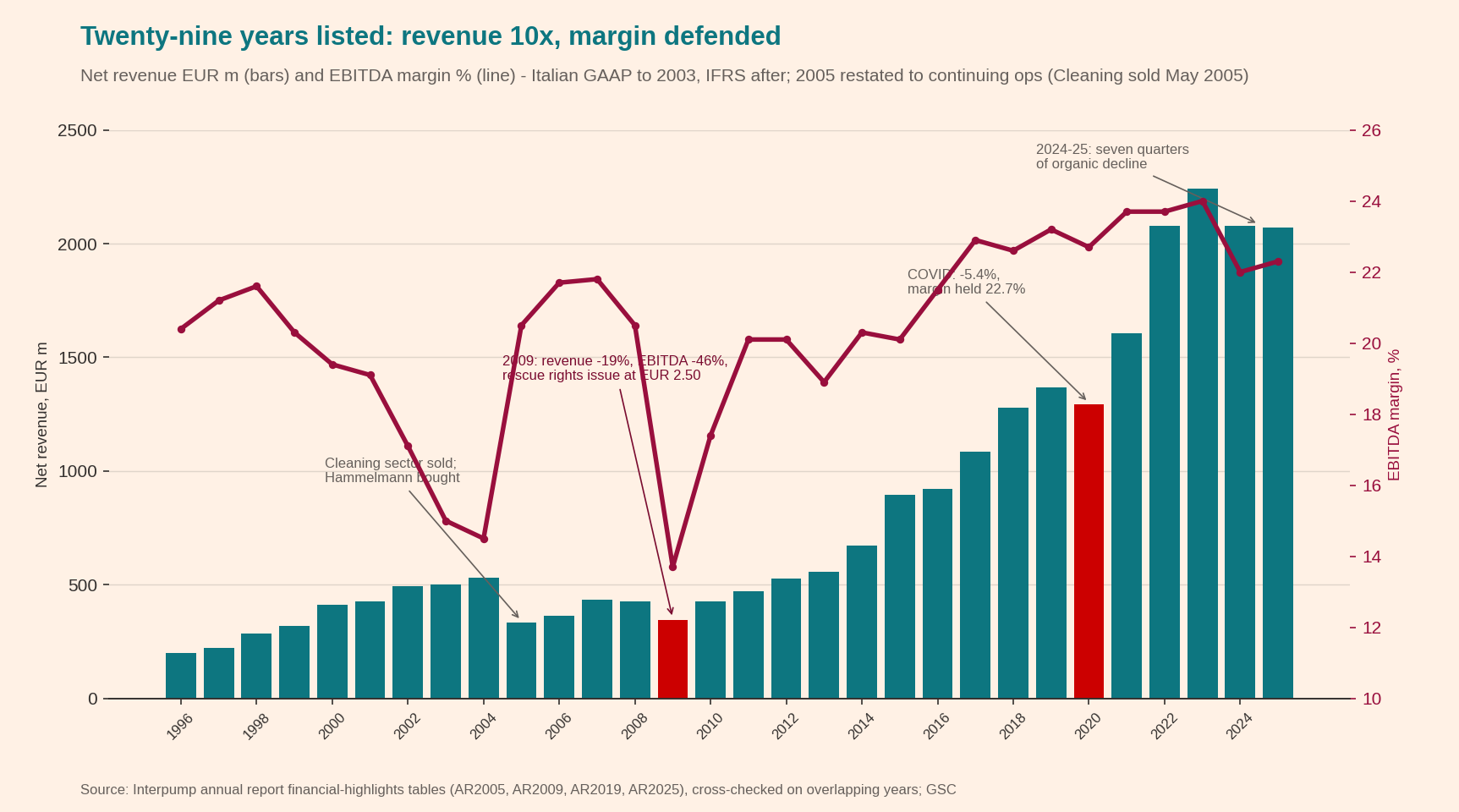
Interpump Group is an Italian serial acquirer of niche fluid-power components. Interpump was founded in 1977 in Sant’Ilario d’Enza in Italy’s Reggio Emilia mechanical district. Since going public in 1996, Interpump has grown revenue by 8.4% (3% to 4% organic) and EPS by 9% CAGR whilst redeploying ~50% of FCF into M&A whilst sustaining a low- to mid-teens ROIC on total capital. Interpump has done ~40 acquisitions over the last 30 years.
Interpump has run itself as a decentralized group of ~120 operating companies — mostly bought at 4–8x EBITDA from family owners and mostly left un-integrated in a decentralized operating structure. Geographic sales breakdown is Europe ex-Italy (35%), North America (25%), Italy (16%), Far East & Pacific (13%), Rest of World (11%).
Fulvio Montipò (82), Interpump’s founder went from CEO to Chairman in 2023 but still owns 24% and is still involved with M&A. His stake and oversight drive Interpump’s long-sighted and conservative approach to acquisitions.
Interpump is organized into two segments:
Water Jetting (35% of FY2025 sales, 27.2% EBITDA margin) makes high-pressure ceramic-piston pumps — a niche Interpump helped create in 1977 by replacing steel pistons with ceramic. The water jetting portfolio has since broadened but Interpump continues to dominate the professional ceramic-piston pump market with roughly 50% global share.
Hydraulics (65% of sales, 19.6% EBITDA margin) makes power take-offs (PTOs) — the geared units bolted to a truck’s transmission that divert engine torque to drive auxiliary equipment, as well as cylinders, valves, hoses and orbital motors that power cranes, tractors and other heavy machinery. Interpump is the world’s largest PTO producer.
Investment Case
What is the Moat?
Interpump is a serial acquirer comprised of over one hundred unique businesses so there is no overarching moat like scale or network effects. However, there are some specific moats you can point to that apply to most of these individual businesses.
Niches. Interpump focuses on industrial niches where quality, reputation and the cost of failure outweigh price. For example, a ceramic valve may only account for <3% of the COGS but poor quality or failure can sideline a $150k excavator and damage the brand of the end-OEM. Interpump has built this reputation over 5 decades. Within each of the fluid power niches where Interpump plays, Interpump can hold 50%+ share within that niche. This niche focus is what drives 27.2% EBITDA margins in Water Jetting and 20% in Hydraulics.
Acquirer Reputation. Interpump’s origins are in the Reggio Emilia region, a manufacturing hub, where preserving a business, its reputation, its employees, and the local supply chain are sacrosanct. Within its home market, Interpump has cultivated its reputation as a preferred acquirer, often bidding on family businesses with zero competition. This reputation has expanded globally and has allowed Interpump to acquire family-owned businesses for 4x to 8x often as sole bidder.
“I believe that inside every company there is a history of thought, of hard work, of mistakes and of successes; I consider this a heritage not to be lost but, if anything, to be integrated. Whoever buys companies and colonizes them throws away that heritage, and the acquirer is left forever alone with his own thinking. If instead you preserve, enhance and integrate, your thinking grows every time you acquire a history.” — Fulvio Montipò, founder and Executive Chairman, Forbes Italia (June 2020) link
Third parties describe the same mechanism from the outside:
“Their M&A strategy in general is somewhat differentiated in that they refuse to buy troubled companies to turn them around, and they refuse to buy from private equity. Their aim is to find family led, niche businesses and help them to transition to a larger platform for growth. Since they do not integrate and aggressively cut costs they are seen as a ‘good buyer’ and are often the only bidder in the process. For investors that know Judges Scientific in the UK, it is a very similar mentality.” — Columbus European Equity Fund, holding update (August 2021) link
What is the bull case?
Cyclical Upturn. Hydraulics is 65% of sales and the end-markets are cyclical: trucks, agricultural equipment and construction machinery. Water Jetting (35%) is more stable. Since 2023, Interpump faced weak end-markets exacerbated by de-stocking post the COVID-driven inventory builds. Agriculture demand collapsed ~30% peak-to-trough. EU/US truck builds all declined, all whilst inventory was elevated. We are past this phase: Hydraulics organic growth inflected in Q3 2025 (+3.4%) and accelerated to +4.8% in Q4 2025 and +6.9% in Q1 2026. Book-to-bill is now above 1.1x. That recovery when combined with 40% incremental gross margins will drive double digit EPS growth to 2028.
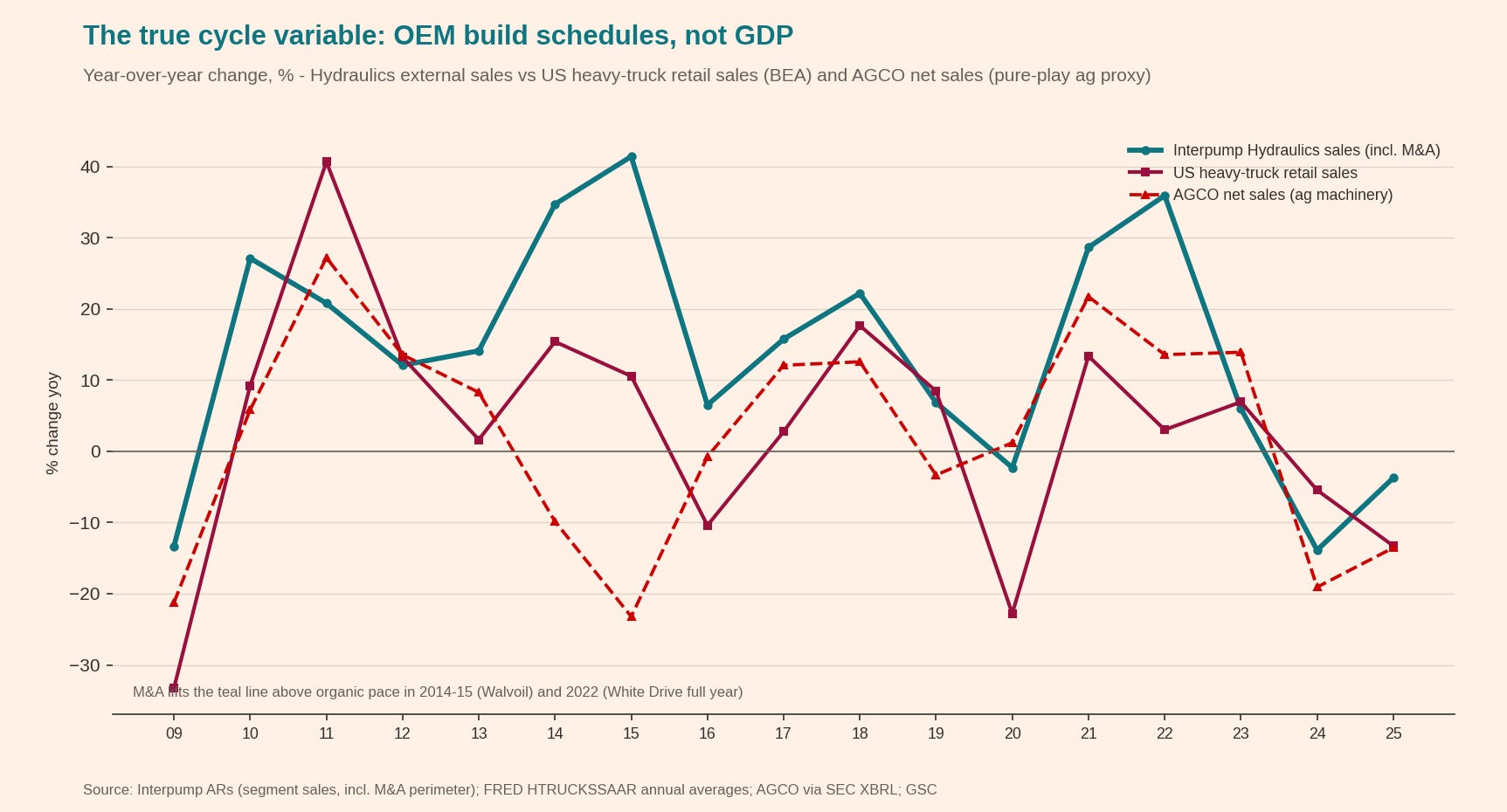
M&A Engine is Coiled. M&A has historically driven roughly half of Interpump’s growth: 8.4% revenue cagr over 29 years against 3% to 4% organic growth. Management is picky with M&A but Interpump is in a strong position to deploy capital. Leverage is now 0.6x EBITDA and should turn to net cash by 2027 with accelerating organic growth. The stated cadence of bolt-ons is €50–80m of acquired sales per year implies 3% to 4% M&A growth, all easily fundable from existing free cash flow.
What is the bear case?
Margins vs. Share. Interpump made a deliberate trade-off between margins and share. During the 2023-25 downturn, EBITDA margins held around 22% versus falling to low-teens in prior cycles. This raises a few questions. First, did Interpump’s premium pricing strategy trade long-term volumes growth in favor of short-term price recovery? Second, to the extent volume share was lost, does it impact structural growth as Interpump’s products get spec’d in into a product whose lifecycle might be 7+ years? The current trading suggests no.
Centralized M&A. Interpump’s strength has been its discipline around M&A. A steady 4% to 5% inorganic growth, only a handful of large deals, with a strong valuation discipline and a willingness to step back. One of the risks is that this isn’t Constellation Software with an institutionalized process. Marasi (CEO since April 2023, previously head of Walvoil — the group’s largest hydraulics subsidiary — and group M&A lead from 2016) is a highly credible replacement, but it will take several more years for Interpump to prove that the M&A engine can be sustained or potentially accelerate.
What is the market pricing in? What is an attractive buy price?
Interpump is not “aggressive” with M&A choosing to redeploy roughly 50% of FCF and keep leverage <1.5x but they ultimately play in more capital intensive and cyclical end-markets. However, Interpump has a strong organizational model, holds a <3% share in a massive TAM, and is owned and operated by a long-sighted founder with skin in the game so at the right price, is compelling.
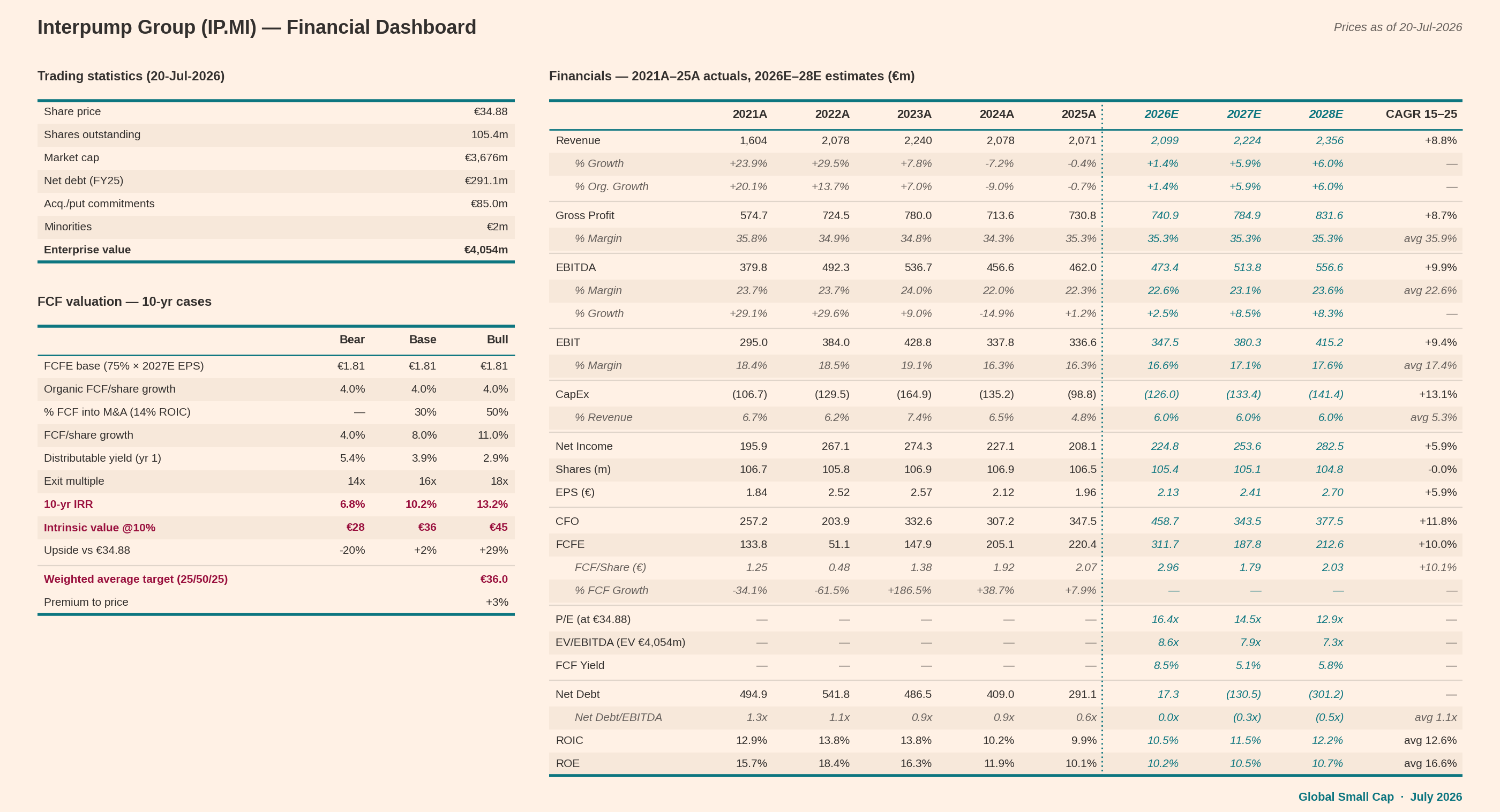
At €35 the shares trade at ~17x guidance-anchored NTM EPS (€2.05) and ~21.4x NTM free cash flow. The setup is similar to Judges: Interpump operates in cyclical end-markets but is trading at a reasonable range on what is arguably trough earnings with nothing baked-in for M&A.
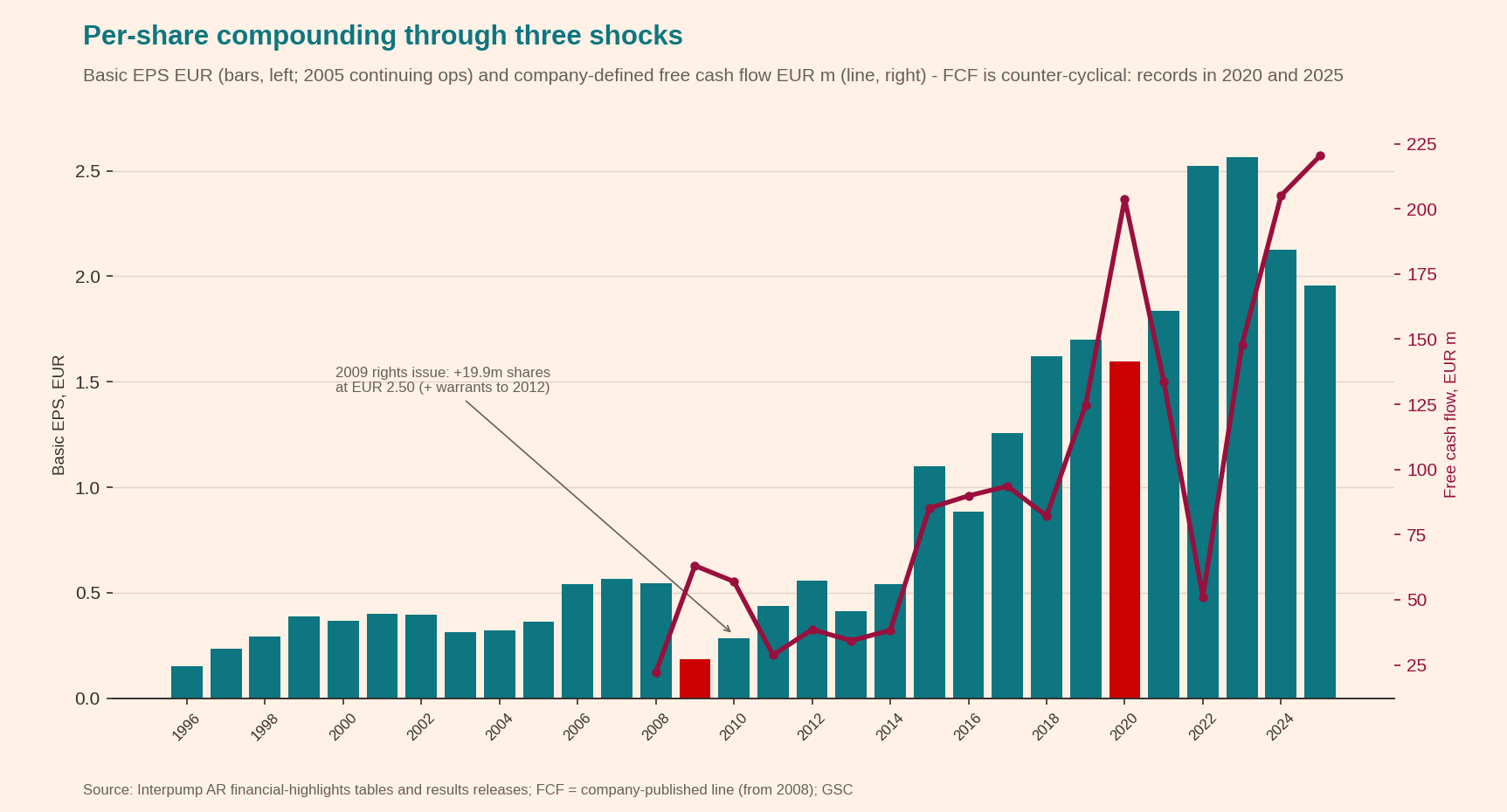
Across a 14–20x FCF exit range, the market is implying only ~4.7–7.5% annual FCF-per-share growth from trough levels to earn a market-like 9% versus the company’s own 2028 plan, which implies ~14% EPS growth from the 2025 trough driven by a cyclical recovery. It should be pointed out that from 2010, the first year off the GFC trough, Interpump compounded EPS at a 13.7% CAGR through 2025.
On the base case, I assume 8% growth in FCF/share: 30% of FCF deployed into M&A at a 14% ROIC which adds ~4% inorganic growth on top of 4% organic growth. The distributable yield falls from ~5.2% on the full FCF base (€1.81/share, normalized at 75% of 2027E EPS — a through-cycle conversion assumption) to ~3.9% in year one. At a 16x exit, these assumptions drive a 10.2% IRR and €36 intrinsic value at a 10% discount rate — roughly today’s price.
On the bull case, I assume 11% growth in FCF/share: 50% of FCF reinvested into M&A at a 14% ROIC adds ~7% inorganic growth on top of 4% organic. The distributable yield is ~2.9% in year one, but the M&A drivers faster compounded growth. At an 18x exit, this drives a 13.2% IRR and €45 intrinsic value at a 10% discount rate.
On a bear case, I assume 4% growth in FCF/share, a 14x exit, and no M&A, implying Interpump is basically a mature and cyclical industrial business. With nothing reinvested, the full ~5.4% (year-one) FCF yield is distributable. That implies a 6.8% IRR and €28 intrinsic value at a 10% discount rate — roughly 20% below today’s price.
To earn a 15%+ go-forward IRR on the base case, the entry price needs to be roughly €25 — 30% below today’s price or ~13.6x the normalized FCF/share. That entry carries its own margin of safety: even on the bear case. That is the level at which to size up aggressively into what I view as a long-duration steady and conservative compounder.
Organizational Structure
Background
Interpump thinks of itself as a “Federation” of 120 businesses.
The head office is small. Montipò (82) is the Founder and Executive Chair and is still involved with M&A. Marasi (49) is CEO. Otherwise, there is a CFO, a Deputy Chair (Giovanni Tamburi, the anchor investor), and a General Counsel. Below them sit six General Managers (similar to Sector CEO concept at Judges Scientific/Halma), a structure that was introduced around 2014. GM’s each oversee a few dozen subsidiaries, more as an advisor rather than a hands-on manager.
The CEO, Chairman and 6 GMs meet monthly to review a running screen of dozens of potential M&A targets and review the operating metrics of the six groups. To compare to Judges, Judges has three Sector CEOs mentoring 25 MDs on 4–6-week visit cycles. Interpump has ~6 GMs overseeing ~120 companies or ~20 each, roughly the same scope.
Below these GMs sit the subsidiaries themselves, each responsible for their own business. Subsidiary and GM bonuses run 30–50% of fixed pay, tied to sales, EBITDA and net-working-capital with stock options tied to sales, EBITA and net financial position. If there is criticism, similar to Judges, there is no explicit ROIC target despite having an acquisitive strategy. The alignment is driven by the Founder/Chair’s 24% ownership.
What underpins the model?
Decentralization. Similar to many serial acquirers, Interpump runs a decentralized organizational structure with an Italian-level respect for preserving heritage and locality. Executives are kept-in place, brands preserved, local supply chains unchanged, and IT systems left alone. Like Judges, Interpump understands that pursuing aggressive synergies creates short-term benefits but inhibit long-term scalability: integrations make acquirers less appealing to sellers and add bureaucracy. Montipò has articulated this philosophy as follows:
“I believe that inside every company there is a history of thought, of hard work, of mistakes and of successes; I consider this a heritage not to be lost but, if anything, to be integrated. Whoever buys companies and colonizes them throws away that heritage, and the acquirer is left forever alone with his own thinking. If instead you preserve, enhance and integrate, your thinking grows every time you acquire a history.” — Fulvio Montipò, Forbes Italia (June 2020)
Reputation. Related to the above point, in Interpump’s home market of Reggio Emilia, sellers are extremely sensitive to buyers who will disrupt the localized supply chain. Interpump has spent five decades demonstrating it does not restructure what it buys and has extended this reputation oversees. That is why family owners across Europe accept 4–8x EBITDA, often as the only bidder. Moreover, 90%+ of deals are internally sourced with the majority closing without any real competition.
Niches. Many of individual sub-TAMs where these businesses play are just a few hundred million euros, where the subsidiary can hold up to 50% share, which is why these small niche businesses Interpump acquires typically already have 20%+ EBITDA margins.
Acquisition Strategy
Given M&A is the core of the thesis, it is worth outlining the process in detail.
Who runs M&A. Sourcing, relationships and final negotiation was previously run personally by Montipò. Sourcing has now been pushed down to the GMs but Montipò is still involved. This isn’t Constellation Software. There is no corporate-development machine but rather a small support team. Marasi ran group M&A from 2016 until taking the CEO role in 2023 so is highly credible. He led Inoxpa, GS-Hydro, Hydra Dyne and White Drive (largest deal in Interpump’s history).
The M&A approach. Interpump does not buy from private equity and in almost all cases, sources the deal direct. Interpump sticks to their stated range of 4x to 8x and largely ignores broader market multiples. Interpump also does not buy turnarounds, choosing instead to focus on businesses with succession in place with Marasi stating “we are not a private equity or a financial institution, we are an industrial group”. While there are no ROIC thresholds, an 8x EBITDA translates into a mid-teens after-tax IRR assuming MSD growth and few synergies.
Typical Seller & Structure. The typical seller is a family owner. Historically, there were many family owned businesses in Emilia-Romagna, Italy’s rustbelt, searching for a permanent where Interpump was a natural fit. Interpump views control and consolidation mandatory but has flexibility to acquire below 100% and buy out minorities over time For example, Interpump’s Padoan deal was 65% ownership with the residual getting bought starting 2030. In 2025, the group carried €85.0m of contracted minority-buyout commitments. Interpump does use treasury shares as part-payment when shares are high, example being the Reggiana share consideration. While Judges is stingy with equity as policy, Interpump can be opportunistic.
Integration. “Soft does not mean integration does not take place.” Management claims 3–4 EBITDA points of improvement in acquired companies within 2–3 years through improvements in purchasing, production practice, and pricing. The one area where there is in fact some synergies versus a purely autonomous approach is how Interpump treats shared production resources.
Shared Resources. While Judges is trying to develop the concept of shared resources modelled off Halma (i.e. joint offices in China or a shared distribution center), Interpump’s approach to shared resources is more deliberate. Per CEO Fabio Marasi, “from an organizational point of view, we are highly decentralized… from an industrial point of view, many important companies within Interpump are highly integrated in terms of manufacturing process.”
Interpump standardizes the equipment used by its decentralized network of subsidiaries on general purpose machine tools that are fungible across ~120 companies so that capacity can move where its needed. For example, Interpump reallocated machine tools during the 2018 delivery crunch, GS-Hydro production moved to Italy, and White Drive’s German activities into its Polish plant. While you can argue this interferes with the “autonomous decentralization concept”, this fungibility means subsidiaries that need access to capacity can access it in short-notice whilst those with slack don’t get hit on margins, which ends up being a win-win in almost all cases.
High Level M&A Record
Over the last 29 listed years, Revenue compounded 8.4% CAGR, EPS 9.2%, CAGR, and depending on the starting date, the 10-year CAGRs have ranged from HSD to low-teens. Roughly two-thirds of growth has come from acquisitions with through-cycle organic growth 3% to 4%.
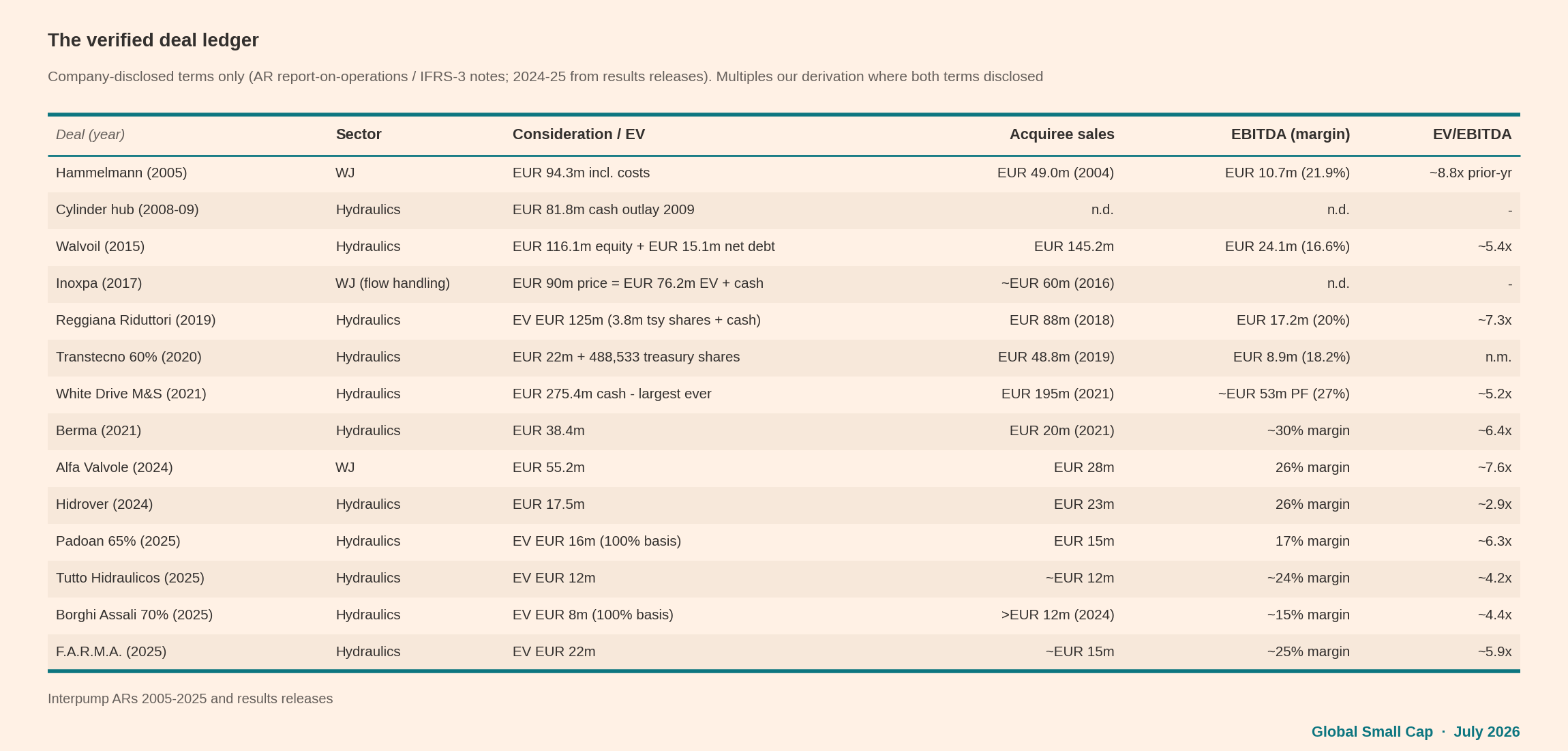
Over the last 10 years, Interpump generated ~€1.4bn of FCF of-which €0.3bn went to dividends, $0.2bn to buybacks, and with M&A absorbing the balance which includes the largest deal ever, White Drive (€275.4m). Roughly 50% M&A and 50% returned with net-debt stable to lower and typically <1x. Interpump has done roughly 40 deals since the 1996 IPO. Interpump is more conservative and returns more cash as compared to Judges 100%+ in M&A (which includes higher leverage).
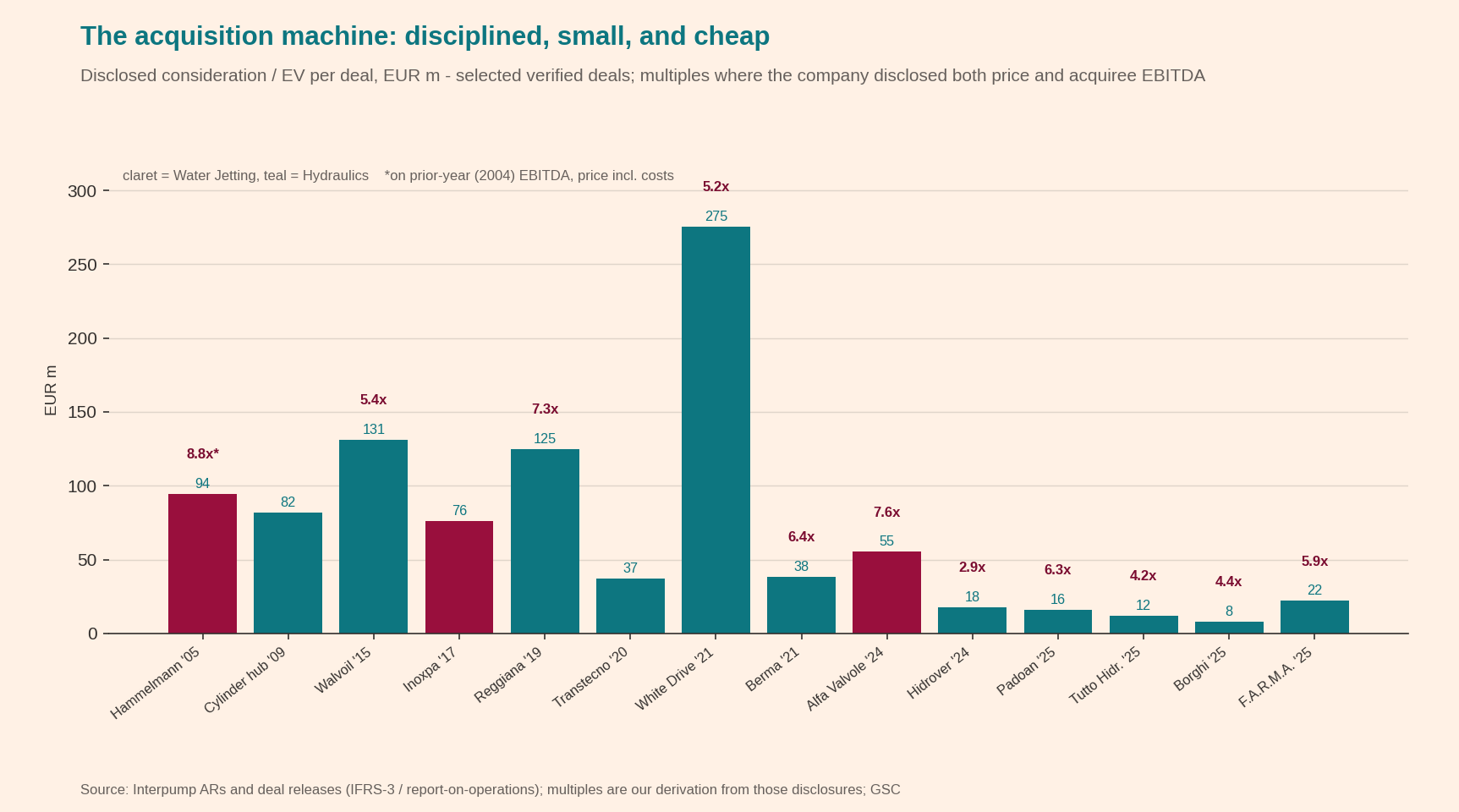
The cadence has been steady but lumpy. 2020 was a near-standstill as buyer-seller gaps widened, and a quiet period around 2018 raised investor questions. We are currently seeing a period of smaller deals bought at attractive multiples and the balance sheet is now primed for M&A. Management is opportunistic and the record back it up: the “cheap” acquisitions (Bertoli 3.2x, Hidrover 4.4x, White Drive 5.2x) cluster around someone else’s distress. About a quarter of recent deals are subsidiary-sourced tuck-ins, and the put/call architecture generates a continuous stream of minority buyouts— an embedded pipeline of capital deployment independent of new deals.
By management’s estimate, of the 40 deals, they’ve faced two seller fallouts but zero catastrophic acquisitions
Interpump did have a forced rights issue during the GFC. In 2009, Revenue declined –19.2% (–28.3% like-for-like), EBITDA margin fell to 13.7%, and a net-debt covenant was breached at 2.4x leverage, which forced two years of skipped dividends and a rights issue at €2.50 (~4.6x prior-year EPS). This experience made Interpump permanently more conservative with their capital structure (no hard limit but generally <1.5x)
Interpumps’ businesses are not capital-light like Judges Scientific where scientific instruments are built to order. Rather, Interpump’s products require vertically integrated manufacturing and working capital as the components themselves go into OEM products including trucks, excavators, and agricultural equipment. ROIC (fully taxed at 29%) has ranged between 12% to 15%.
Business Overview
Interpump is a serial acquirer of niche hydraulic and pneumatic components businesses. After listing in Milan in 1996, Interpump bought its way into hydraulics through PZB (1997), Hydrocar (1998) and Muncie (1999), which made it the world’s largest PTO producer. In 2005 it sold the Cleaning division (€48.0m gain) and spent the proceeds on Hammelmann, swapping a consumer business for an industrial pump platform.
The cylinder acquisitions of 2008–09 (€81.8m of cash out in 2009 alone) landed in the teeth of the financial crisis and forced the rescue rights issue — the group’s one near-death experience and the reason leverage is now always conservative (generally <1x). The 2010s brought valves (Galtech 2012, Hydrocontrol 2013, Walvoil 2015), hoses (IMM 2014 through GS Hydro 2018), flow handling (Inoxpa 2017), planetary gears (Reggiana Riduttori 2019), e-drives (Transtecno 2020). Finally White Drive (2021, €275.4m) completed the mobile-hydraulics range with orbital motors and steering (more on this later).
Water Jetting (35% of FY2025 sales; 27.2% EBITDA margin)
A plunger pump also known as a positive-displacement pump has ceramic coated pistons which can reciprocate at high-pressures, from 100 bar for a pressure washer to 3,000 bar for an industrial system that requires pressurized water.
Interpump’s Water Jetting segment makes all of the above components used to pressurize water. The core product is the professional high-pressure plunger pump, sold to industrial pressure-washer OEMs and the professional cleaning trade. Interpump supplies these pumps via several subsidiaries and brands: Interpump, General Pump (US) and Pratissoli. Adjacent products include ultra-high-pressure systems for descaling, surface preparation and cutting in refineries, petrochemical plants and shipyards, stainless-steel pumps, valves and mixers for food, cosmetics and pharma process lines, and severe-service valves.
The pump business is the original 1977 company stemming from Interpump’s original innovation around ceramic (vs. steel) pistons. Hammelmann (Germany, 2005) was the pivotal industrializing deal and took Interpump from bare pumps into engineered ultra-high-pressure systems sold as projects. Inoxpa (Spain, 2017) diversified the segment into process industries, and Alfa Valvole (2024) added severe-service valves. Geographically, Water Jetting is the group’s most US-exposed franchise (40% to 50%).
While this business is anchored to GDP growth, secular growth opportunities include robotized and automated cleaning systems, hygienic process skids for food/pharma (Inoxpa), and severe-service valves.
The main competitors include Italian-listed Emak (the closest listed comparable) which is roughly one-third Interpump’s segment size; Annovi Reverberi (another Italian rival), Cat Pumps (private, US), and URACA and KAMAT (private, German) who compete with Hammelmann in ultra-high-pressure industrial systems. In reality, Interpump plays in small niches with limited overlap across multiple product categories with competitors specific to each niche.
Hydraulics (65% of FY2025 sales; 19.6% EBITDA margin)
Hydraulic components basically apply pressure to confined fluids to transmit high amounts of force in all direction which is how a hand-sized piston can lift ten tons. Electric actuators cannot match the force density of hydraulics which is why hydraulics are exclusively used in heavy applications around digging, lifting, tipping, steering, and crushing.
Interpump’s Hydraulics segment supplies the pneumatic components used in heavy vehicles and agricultural and construction machinery. These components are typically sold to OEMs and/or bodybuilders that install these components on a heavy vehicle chassis. Interpump is well known globally within this niche and has the broadest independent catalog of mobile-hydraulics components across multiple subsidiaries. Interpump is #1 globally in PTOs and strong in cylinders, directional valves, hoses and fittings, planetary gears, orbital motors and steering, tanks and e-drives.
The Hydraulics sector was assembled entirely via M&A. Interpump entered in 1997–99 through PZB, Hydrocar and Muncie acquisitions which collectively made it the world’s largest PTO supplier. The Italian cylinder makers came in 2008–09; the valve hub in 2012–15 (Galtech, Hydrocontrol, then Walvoil in 2015); hoses and fittings in 2014–18 (IMM through GS Hydro); planetary gears and e-drives in 2019–20 (Reggiana Riduttori, Transtecno); and orbital motors and steering in 2021 (White Drive, the largest deal ever — covered below).
Interpump does not break out revenue by product but to give a sense of size (revenue as of the acquisition date):
Walvoil €145m in 2015
Reggiana €88m in 2018
White Drive €195m in 2021
Customer mix is roughly 60% small and mid-sized bodybuilders/OEMs and 40% large OEMs. Customers are often on multi-year contracts. Products are typically spec’d-in by the end-customer or OEM, after-which Interpump earns the sale for the life of that vehicle model or product. There is limited customer concentration with the largest group-wide customer at <2% of sales.
The main competitor is Parker Hannifin’s Diversified Industrial segment ($13.7bn, FY Jun-2025) which is ~7x larger than Interpump’s entire group but within the PTO niche, Parker Hannifin is the #2 brand behind Interpump. Others competitors include Danfoss Power Solutions (€4.1bn), and Bucher Hydraulics (CHF 626m). Interpump’s advantage is the breadth of its product range and its reputation for strong application-specific engineering established over decades which translates to 20% EBITDA margins.
White Drive Motors & Steering (2021)
On 1 October 2021 Interpump paid €275.4m in cash, its largest acquisition ever, for the three companies of White Drive Motors & Steering, which were carved out of Danfoss. White Drive had plants in Hopkinsville (Kentucky), Parchim (Germany) and Wroclaw (Poland) and did €195m of 2021 sales and ~€53m of pro-forma EBITDA (27% margins). Interpump paid roughly ~5.2x for White Drive in what looked like a great price for a high-margin niche supplier of orbital motors, hydraulic steering units and valves.
An orbital motor is a compact hydraulic motor that turns slowly but with enormous torque, so it can spin a wheel, an auger or a conveyor directly, without a gearbox. It is what drives the wheels of a skid steer, the reel of a harvester or the rotation of an aerial lift. Management described orbital motors and steering as the last major product line missing from Interpump’s mobile-hydraulics catalog.
White Drive was only available for sale because of a regulatory remedy. When Danfoss bought Eaton’s hydraulics business, the European Commission cleared it conditional on divesting exactly these operations allowing Interpump to be one of the only credible approved buyers allowing it to acquire the asset at just 5.2x EBITDA.
While the face multiple looked attractive, post-acquisition Interpump stepped into the 2023–25 market collapse. Management disclosed that its revenues “fell by almost 40%” in 2024, forcing a restructuring of the German plant — “while we may not be fond of restructuring story, we know how to execute them when necessary” (CEO, FY2025 call link). White Drive looks to be turning: the agriculture market inflected upward in late 2025 which in turn has driven the recovery in the Hydraulics segment.
Suppliers & Technology
Production is vertically integrated — machining, assembly, and testing is done mostly in-house. Importantly, Interpump’s one centralized directive is for subsidiaries to use standardized machine tools wherever possible with castings, forgings, steel, aluminium and copper alloys done in-house. The standardization is strategic: machine tools are fungible across ~100 companies, so capacity moves to where the group needs it. Capex to fund these tools peaked at €164.9m in 2023 (7.4% of sales) as capacity was added into the boom, and fell to €98.8m (4.8%) in 2025. IT on the other hand is federated by philosophy — no group ERP is imposed with a lean central data layer extracting monthly with full P&Ls from every unit.
The production footprint, especially for pumps, is 40%+ domestic. As a result, Interpump did see a ~€6m in Q1 2026 alone (≈1.1% of quarterly sales) of Section 232 tariff costs which it says it fully passed through. The good news is that Interpump’s relative position versus a Chinese supplier is arguably superior given the higher tariffs. Moreover, production sites aquired as part of White Drive (Hopkinsville) gives Interpump a brownfield option to migrate production to the US if need be but for now, Interpump has sufficient pricing power to pass-on tariff costs.
Competition & Moat
As I described, Interpump does not face a single competitor across multiple product categories. Rather, it is in reality competing against different competitors within every niche. Nonetheless, the major players are summarized below.
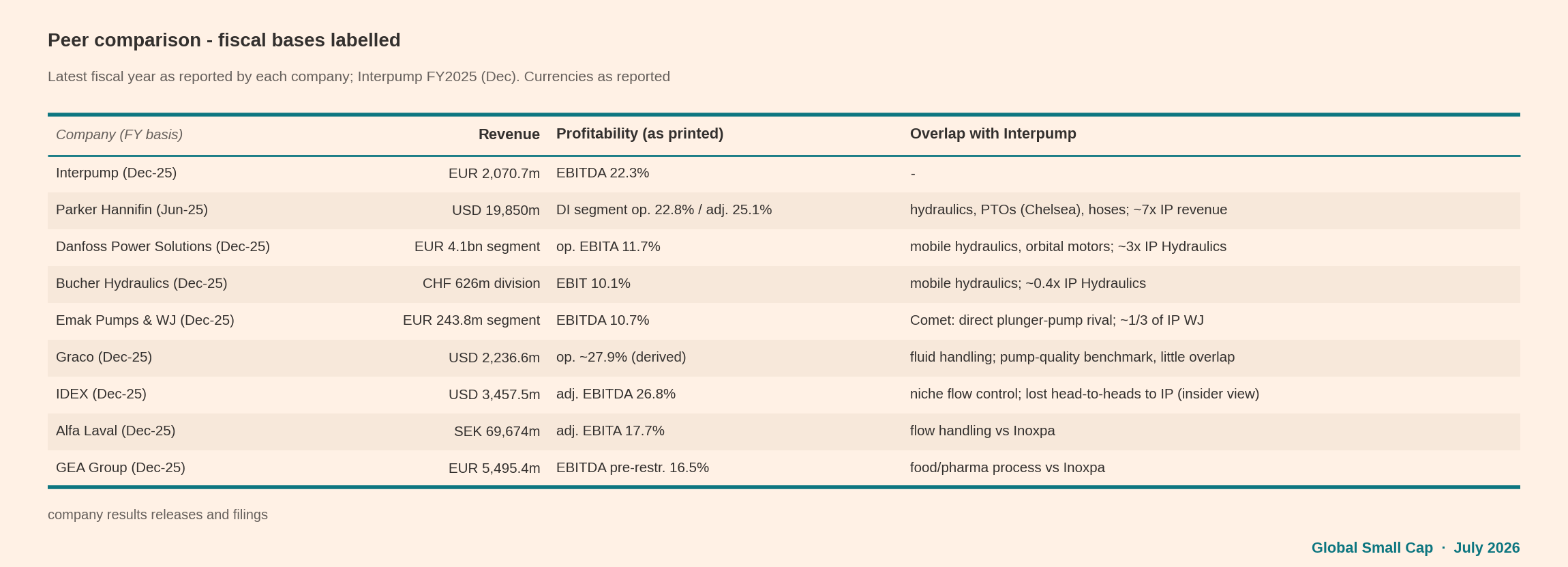
The moat within any niche is based on specialization, reputation and track record. A malfunctioning motor or value can sideline a $150k piece of farming equipment which is why OEMs don’t “cheap out” on small cost components that directly impact performance. The moat is aided by being “spec’d-in” which creates switching costs through the life of every end-product. Interpump will say that its culture and organizational structure adds to its moat. Interpump’s subsidiaries are autonomous so can be nimble responding to client needs or service requests unlike large integrated conglomerates like Parker Hannifin.
Economics
Water Jetting. On the Water Jetting segment, the end-customer is typically an OEM manufacturing an industrial pressure washer or some type of industrial equipment going into food, pharma or severe service. Sales are not “spec’d in” per se as the average product cycle might only be 1 to 2 years versus 7 to 10 years on the Hydraulics side. In Water Jetting, Interpump benefits from high-margin after market demand which accounts for roughly 1/3rd of segment revenue. Interpump’s components might cost $100 to $200 and account for <10% of the end-product’s costs which in-turn allows Interpump to earn gross margins that are likely in the 40% to 60% range depending on product and EBITDA margins consistently in the mid- to high-20’s.
Hydraulics. On the Hydraulics side, Interpump is selling to OEMs and body builders and the components themselves are higher priced at $1k to $3k albeit often <3% of the end-products costs. While Interpump is spec’d in allowing it to earn captive revenue for the life of a product, this also means longer contracts and lower-gross margins, likely in the 30% to 40% range. All-in, higher volumes offset by lower margins allows Interpump to earn 20% EBITDA margins. Products sold to distributors who serve the aftermarket are likely higher-margin but makeup a smaller portion of sales, like <10%.
Consolidated. Taken together, Interpump can generate low-20’s EBITDA margin and sustain these margins through a downturn by leveraging pricing and keeping costs in-line. Interpump does need relatively high levels of inventory as these are not build-to-order products. Net working capital has averaged 30%+ of sales which in turn means FCF conversion stands in the 70%+ range which moves closer to 100% during downturn but falls during periods of strong growth. Capex is 5% to 7% of revenue and as discussed, Interpump tries to standardize equipment to make capex as fungible as possible.
Working Capital & Capex. Over the last decade (2016–25), net working capital has averaged 38% of sales and has drifted structurally higher — from ~36% in 2015–18 to ~41% in 2024–25 — with inventory doing all of the climbing: stocks rose from ~27% of sales to ~33%, the deliberate cost of a never-out-of-stock service model, of preserving local supply chains at 120 un-integrated subsidiaries, and of post-COVID buffer building, while receivables and payables have largely offset each other. Capex averaged 5.5% of sales but ran in a clear cycle: 4–5% through 2016–20, stepping up to 6–7.4% during the 2021–24 capacity build and White Drive integration, then back to 4.8% in 2025 as spending normalized. The pattern that matters for the unit economics: each incremental euro of revenue absorbs roughly €0.40 of working capital, which is why FCF conversion collapses in booms (19% of net income in 2022) and spikes in downturns (over 100% in 2020 and 2025) — Interpump banks its cash on the way down, not on the way up.
Cyclicality. In terms of cyclicality, in 2009, revenue declined -28% like-for-like and EBITDA –46% to a 13.7% margin. In contrast, in 2022, revenue fell –5.4%, but margin held at 22.7%. More recently, following the post-COVID destocking cycle, 2024-25 revenue fell -7% while margins remained stable at ~22.0%.
Growth Algorithm
TAM. US fluid power is a roughly $30bn TAM of-which 2/3rds is hydraulics. The major hydraulics markets include construction, agriculture, material handling, heavy trucks, and automotive. Germany is the largest market within Europe at roughly $10bn of-which half may be hydraulics. The Europe market more broadly is int he $15bn to$ $20bn range. Triangulating the markets, the global tam is in the $50bn range of-which Interpump occupies a small <3% share within individual niches. Water Jetting is a far smaller and specialized market, perhaps <$3bn where Interpump could have a more meaningful 20% to 30% share.
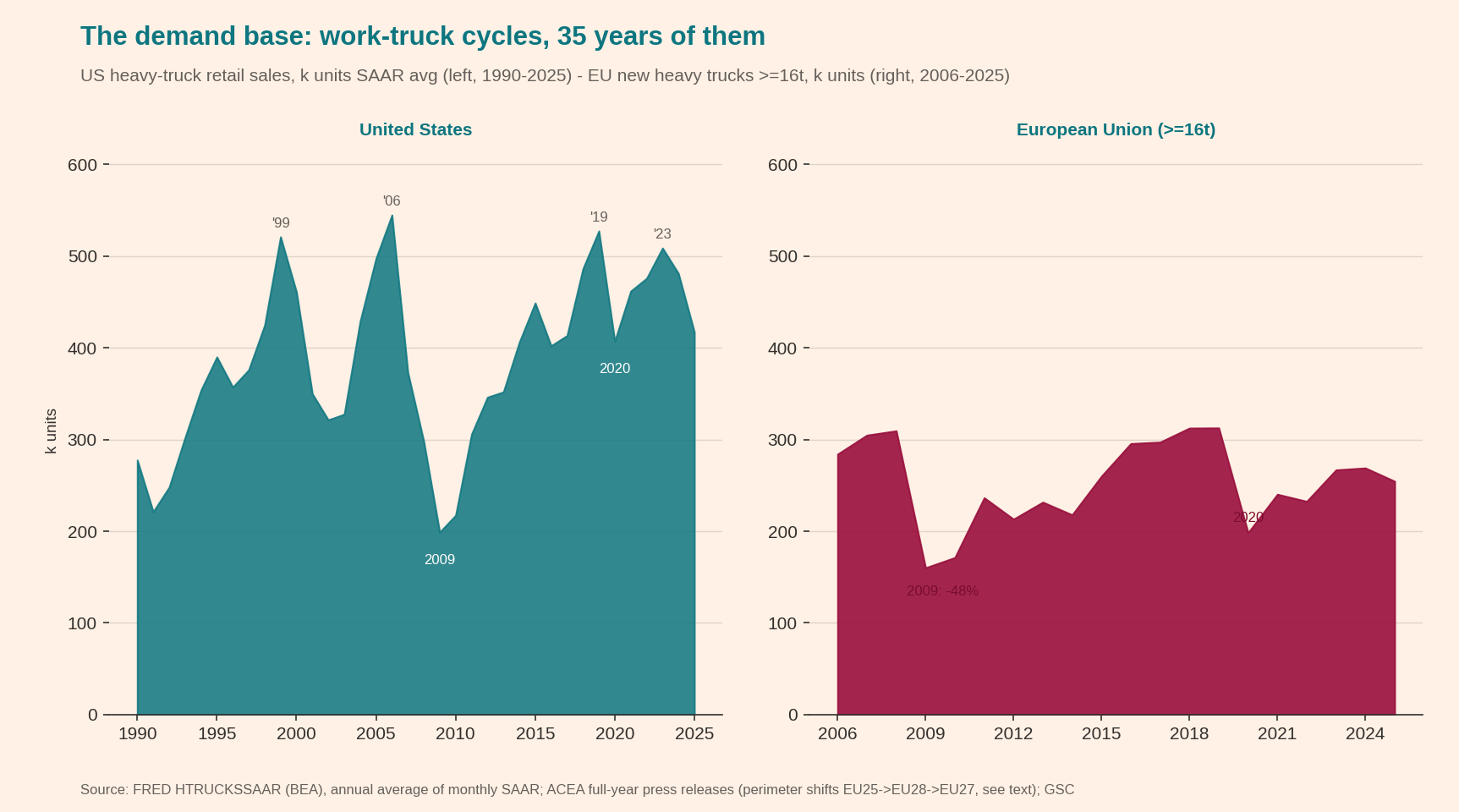
End-Markets. Heavy duty trucks, agriculture, construction machinery, and power washers are tied to GDP growth and industrial production and Hydraulics can be cyclical with US heavy-truck retail for example cycling between 200k to 550k. While Interpump calls out secular growth runways within niches, in aggregate, Interpump grows in-line with GDP. Water tends to be less cyclical and benefits from 1/3rd of demand coming from replacement.
Cycle. Near-term, after a 7 seven-quarter downcycle averaging –12% organic for Hydraulics ended in Q3 2025, end-markets are finally inflecting. The decline was exacerbated by inventory de-stocking which in turn should drive HSD+ organic top-line growth through to 2028.
M&A. I assume anywhere from 30% to 50% of FCF being redeployed back into M&A at a mid-teens ROIC which in turn drives 4% To 7% inorganic growth. The stated cadence of €50–80m of acquired sales per year at 4–8x EV/EBITDA adds 3% to 4% to revenue although Interpump does do larger deals like White Drive opportunistically.
EPS. When you look at the prior 2010 trough, EPS grew 13% cagr. A longer 30-year view suggests 9% EPS cagr. While M&A will determine at least half the longer-term growth, it is clear that on an organic growth runway there is room for EPS to grow at-least HSD/LDD near-term to 2028 before M&A.
Key Assumptions
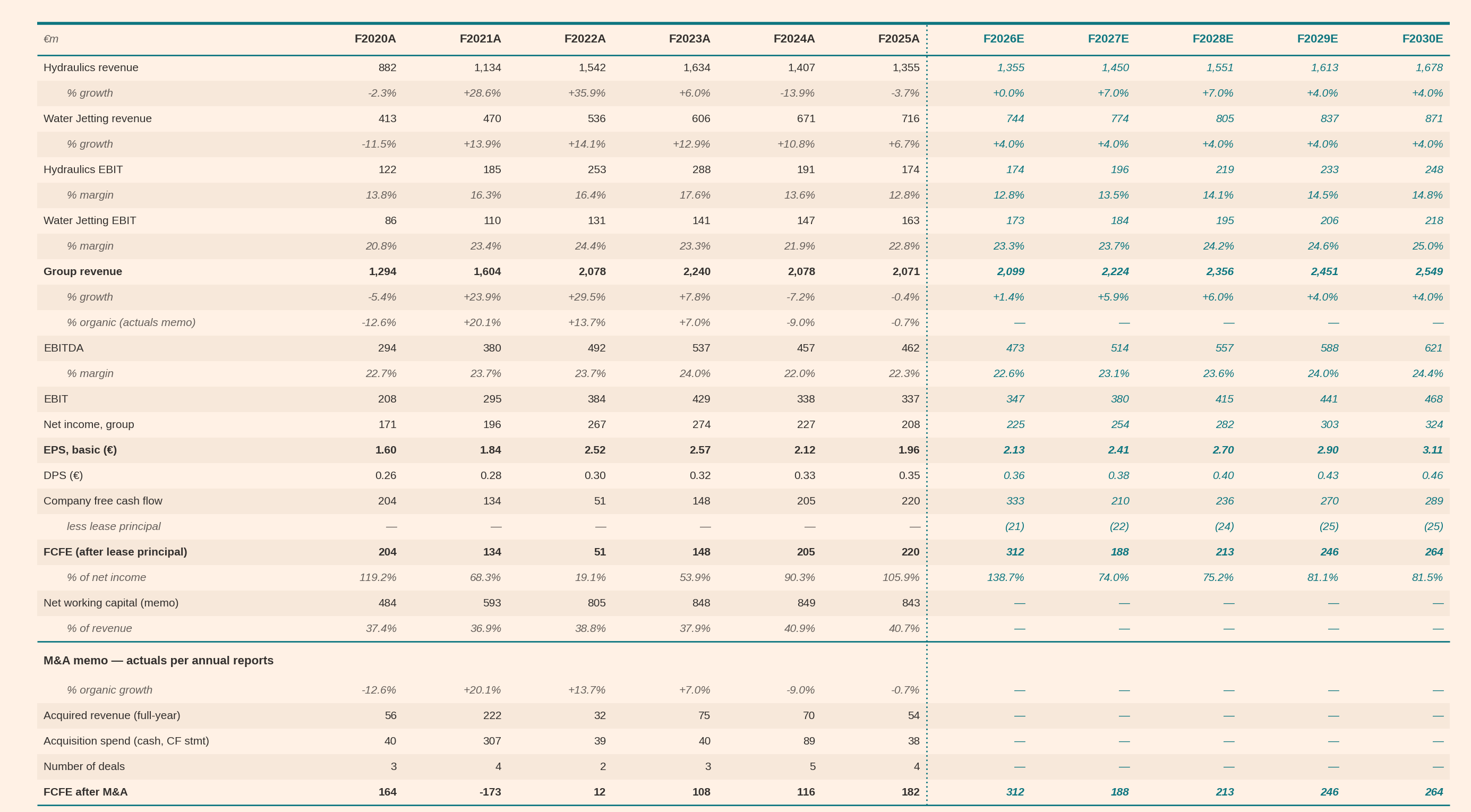
The model assumes Hydraulics revenue is flat in 2026, grows 7% in 2027 and 2028 on the cyclical recovery, and 4% thereafter; Water Jetting grows 4% throughout. Margins build off 2025 actuals at incremental EBITDA margins of 30% for Hydraulics and 40% for Water Jetting, and capex runs at 6% of sales. No M&A is baked into the operating model — that optionality is handled in the valuation. I am relatively conservative in my pace of margin recovery in Hydraulics with upside if they can revert back to a high-teens margins.
Valuation — What Is a Sensible Buy Price
All three cases work off the same base: €35 share price, a normalized FCFE/share of €1.81, set at 75% of 2027E EPS (€2.41) — a through-cycle FCF-conversion assumption that looks through the 2026 inventory unwind rather than crediting it, a 10-year hold, and a 10% discount rate for intrinsic value. The cases differ only in how much FCF is redeployed into M&A, the resulting growth, and the exit multiple.
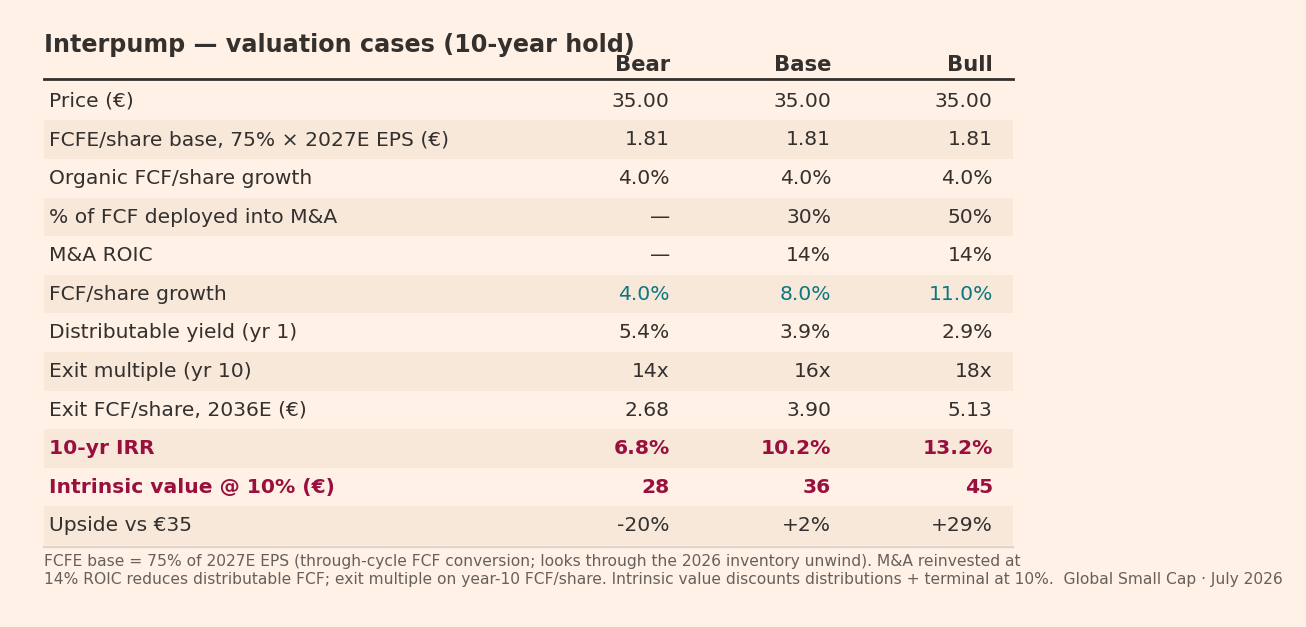
On the base case, I assume 8% growth in FCF/share: 30% of FCF deployed into M&A at a 14% ROIC adds ~4% inorganic growth on top of 4% organic FCF/share growth, driven by a near-term recovery and a stabilized organic growth rate of 3% to 4%. At a 16x exit, these assumptions drive a 10.2% IRR and €36 intrinsic value at a 10% discount rate — roughly today’s price.
On the bull case, I assume 11% growth in FCF/share: 50% of FCF reinvested into M&A at a 14% ROIC adds ~7% inorganic growth on top of 4% organic. At an 18x exit, this drives a 13.2% IRR and €45 intrinsic value at a 10% discount rate.
On a bear case, I assume 4% growth in FCF/share, a 14x exit, and no M&A, implying Interpump is basically a mature and cyclical industrial business. That implies a 6.8% IRR and €28 intrinsic value at a 10% discount rate — roughly 20% below today’s price.
To earn a 15%+ go-forward IRR on the base case, the entry price needs to be roughly €25 — about 30% below today’s price or ~13.6x the normalized FCF/share and ~10x 2027E EPS. That entry carries its own margin of safety: even on the bear case. That is the level at which to size up aggressively.
$IP.MI / $IPGYY / $IP