Japanese Elevator Services (JES) is Japan’s largest independent elevator maintenance company with roughly 10% share of the overall maintenance market and 50% share of the independent market. JES provides a high quality mission-critical service with recurring revenue with demand underpinned by regulations at significantly cheaper prices to its competitors. JES is pursuing the classic scale-economies-shared playbook. This compelling value proposition has driven a 2.3x increase in net income over the last 3 years (¥3.2bn in FY3/23 to ¥7.3bn in FY3/26) and should power 16% earnings cagr in a bull case.
JES was founded by current CEO, Katsushi Ishida, in 1994. In Japan, elevator maintenance was historically dominated by traditional OEMs like Mitsubishi, Hitachi, Toshiba, Fujitec, and Nippon Otis, who sold the initial elevator at a low margin but benefited from a sticky stream of captive high-margin maintenance revenue. Regulatory changes in the 1990s forced these OEMs to sell parts to independent repair companies and share repair modules (a 1993 Osaka High Court ruling found that OEMs refusing to sell parts to independents breached antitrust law, followed by a 2002 Japan Fair Trade Commission recommendation to the OEMs). Global markets ex-Japan have developed in a similar fashion.
In the ensuing 3 decades, JES has “cracked” the maintenance market by 1) taking an aggressive approach to pricing 2) developing a strong reputation amongst building owners and 3) investing heavily into training and innovation and most importantly 4) having an entrepreneurial owner-operator mindset. With just 10% share of the market and a compelling value proposition, JES has an opportunity to continue compounding for another decade. Today, JES maintains ~126,840 units under domestic maintenance contract (March 2026) via 1,452 technicians (2,286 employees in total) accounting for roughly 10% share of the overall maintenance market.
In the next sections, I describe
The investment case
Valuation scenarios
Business Overview
R&D, Innovation, Training & Recruitment
Competition & Moat
Growth
Key Assumptions and Buy Price
Key Risks
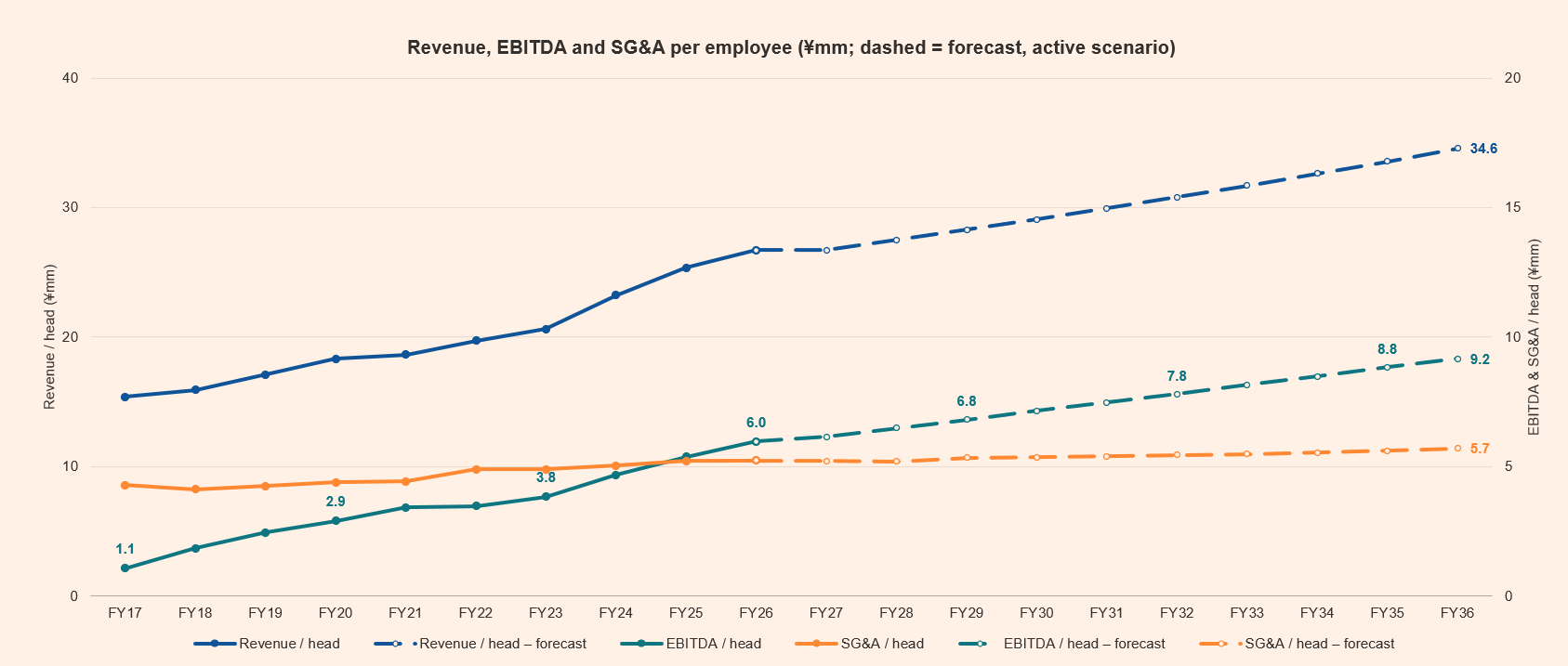
Chart shows how, once you reach scale and hit a certain route density, EBITDA/head can grow significantly faster than revenue. It doesn’t hurt that revenue is highly recurring and driven by regulations mandating regular elevator maintenance in the earthquake prone Japan.