

Judges Scientific is a serial acquirer of scientific instrument businesses with a long organic and inorganic growth runway. The long-run record speaks for itself: from 2010–2025 Judges generated £139m in free cash flow, deployed £146m into M&A and paid £56m in dividends whilst maintaining a 24% return on total capital. Leverage averaged under 1x and the payout ratio held near 30%. The last two years have been a different story. Adjusted EPS peaked at 369p in 2023 and has fallen to 281p, with management guiding 2026 to 200–250p — a mid-point roughly 40% below the peak.
The cause is temporary: Judges’ business is ultimately driven by academic and R&D spending which are powered by long-term secular drivers but a freeze in US academic and research funding has taken longer than expected to thaw. Moreover, a new business (Geotek) has introduced volatility year-to-year as revenues are dependent on one-time contracts where timing can materially impact revenue. The shares went from a 52-week high of £90 to £40. The question is whether the machine that compounded at 20%+ for two decades is broken, or merely in a temporary cycle.
Investment Case
Bull Case
Proven record. Over the last 15 years, Judges has deployed 100%+ of FCF at a 24% ROIC on total capital whilst growing organically by 5% CAGR yet Judges is still at <£150m in revenue and continues to have a long runway to do small deals in niche, specialized, and fragmented markets at highly attractive valuations.
Exceptional capital allocation. The Founder/Chair is disciplined, has a proven record, has skin in the game (~9% ownership), and has built a bench of like-minded executives — including two ex-Halma operators — around an entrepreneurial, decentralized culture that can scale.
Cheap against normalized earnings. Judges is small enough to redeploy most of its capital at high-teens for the foreseeable future. The debate is what “normal” earnings are. 2026 is guided to 200–250p against a 373p peak in 2023, with two identifiable, arguably temporary drags — no coring expedition (more on this later) and a US academic spending freeze. At ~£44 you are paying ~16x LTM earnings which are arguably near trough for a business that historically traded above 25x.
Short-term headwinds don’t touch the long-term thesis. Weaker R&D spending in the US and China, lumpiness at Geotek, and tariff exposure (85% of sales overseas, 28% to the US) are cyclical and don’t affect the core driver, which is M&A. US federal research funding has since been set at roughly prior levels, and similar to dynamics we see in bioprocessing, it is a matter of when funding thaws rather than if.
Bear Case
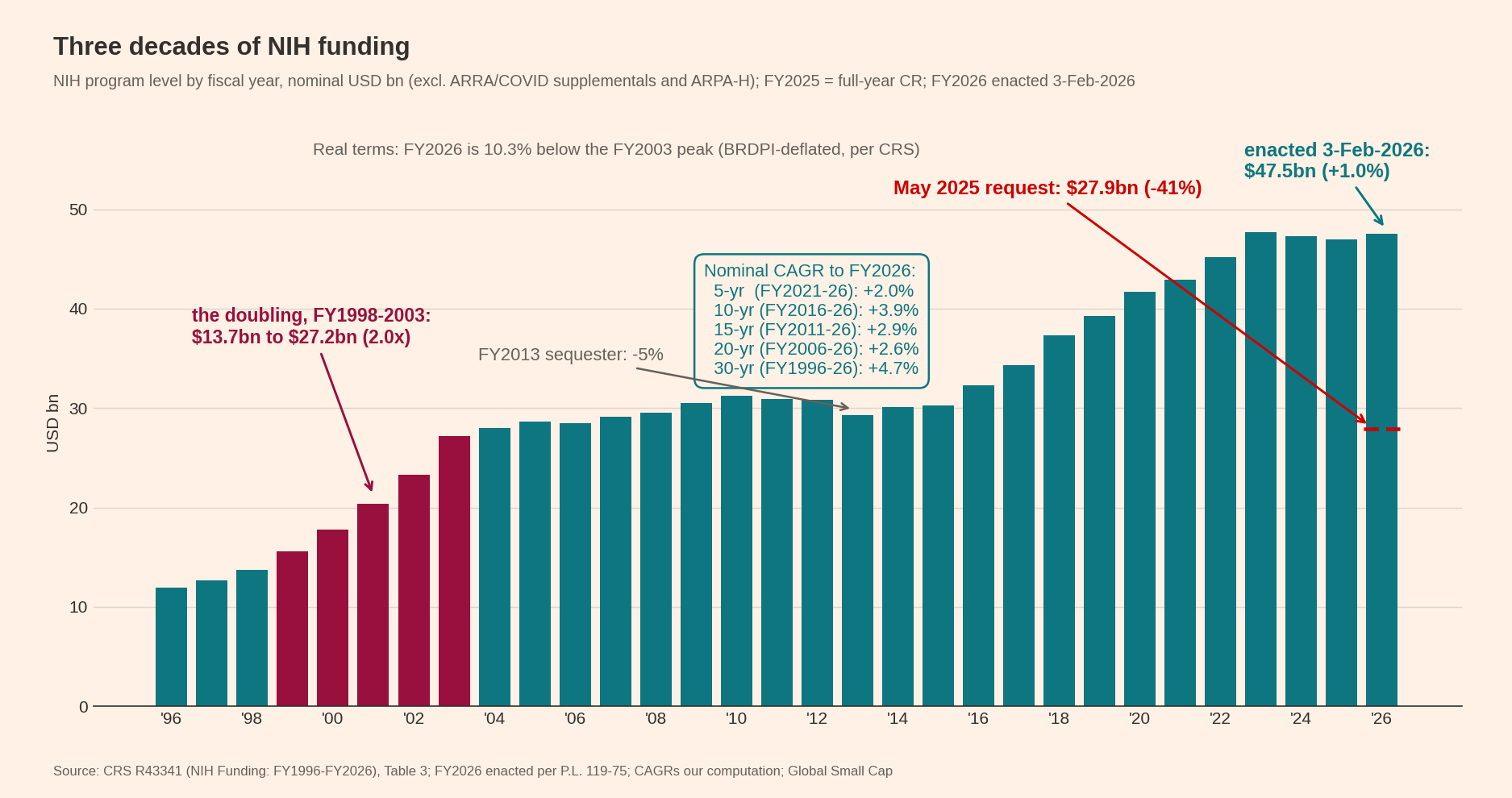
The 2023-2026 experience proves Judges faces tough end-markets. Judges products are ultimately discretionary and funded by the whims of government funding rather than real need or profits. As the NIH chart shows, funding can be flattish for a decade and we are coming off a particularly strong 2013-23 period. While government funding can be immune from economic cycles, the sudden freeze and the slow thaw have demonstrated that Judges end-markets are more frail than originally expected.
Operating leverage has inflated normalized margins. EBITA margin has gone 26.6% (2022) → 25.6% (2023) → 20.9% (2024) → 19.2% (2025) → high-teens (2026E). These are small businesses with fixed engineering and R&D bases; when volume falls, margin falls hard and prior margin performance was driven by “peak” secular growth. An alternative way to look at this is that Judges thinks and acts long-term so doesn’t cut critical R&D spending in response to shorter-term pressures.
Geotek was the biggest bet and is the lumpiest asset. Geotek was the largest deal ever (~£80m with earn-out) at the highest multiple ever (~7x), and it is ~21% of EBIT concentrated in the least predictable business Judges owns. Coring revenue depends on episodic expeditions — none is likely until early 2027. More uncomfortably, the two largest deals before it, Scientifica and Armfield, both disappointed. The pattern that Judges executes well on £5m deals and less well on £10m+ deals has not yet been disproven.
Key-man risk. Cicurel built this company over 20 years and personally led sourcing and diligence. He stepped down as CEO in February 2026. Tim Prestidge is well-credentialed but has three years at Judges and has never run it — and he takes over into the worst trading conditions in the company’s history. Mark Lavelle, the COO who drove the margin improvement since 2017, is also retiring. That is a lot of institutional knowledge leaving at once.
Valuation & Key Assumptions
In my view, the key driver is ultimately capital allocation. While the businesses have proven more cyclical to VMS or distributors, they do in fact benefit from longer-term structural drivers and the end-market exposure is globally diversified so this cyclicality is more than priced-in today. Judges delivered 275p of adjusted EPS in 2025 and guides 2026 to 200–250p. That is the trough, not the run-rate: guidance assumes no recovery in US academic spending through 2026 and no coring expedition. The company pays out roughly 30%+ as dividends (2025 DPS of 104.5p) and needs ~10% of earnings to fund working capital and capex, which runs above depreciation as it funds growth investment in recently acquired subsidiaries. Net debt is £42.6m, or ~1.2x EBITDA — comfortable.
With zero M&A, Judges is worth about 15x P/E — a GDP+ organic grower with high-teens-to-mid-20s EBITA margins, a sound balance sheet and an experienced team, but cyclical and lumpy end-markets. Spectris and Oxford trade at 15x–17x. On trough 2026 earnings of 250p it is ~£38, which is in the range of what today’s share price is pricing in. With a structural recovery in end-markets and again assuming no M&A, normalized EPS may be closer to 350p (which assumes a coring expedition) which at 15x earnings would imply £52.5, 15% upside to today’s price. In summary, the market is pricing in zero M&A and limited earnings recovery.
The real driver is M&A, and this is being ascribed zero value. Judges historically redeployed 100% of FCF at a 24% ROIC, with an average deal size of £6.4m. Assuming 5.5x–6.0x EBIT and the historic 30% dividend payout, Judges needs to redeploy roughly £300m over a decade (~60% of FCF) to grow earnings roughly 15% — three to four £4m–£6m deals a year near-term, rising to £8m–£12m in years six through ten, or, following the Constellation model, more deals rather than bigger ones. Those sizes remain small and achievable; Halma where Judges draws inspiration from deploys £200m–£300m a year, roughly Judges’ entire ten-year requirement.
Where that leaves the price. At ~£44 you pay ~16x LTM EPS and for a business that has historically traded at 25x+ and whose shares touched £90.60 within the last year. The base case doesn’t require heroics — it requires that 2026 is the trough and that coring and US funding normalize. If EPS simply recovers to the 2023 level of 373p on that same 15x, that is ~£56 before any contribution from M&A. The bull case then assumes 60%+ of FCF redeployed at 18% which drives a 15% IRR (basically equal to EPS growth) and a £68 intrinsic value (54% upside). That leaves plenty of additional upside as management has historically significantly over-delivered on these assumptions.
“The Group remains well positioned to continue its strategy of delivering growth in earnings via the selective acquisition of, at sensible multiples, strong niche businesses in the scientific instruments sector, coupled with long-term growth in cashflows from its existing portfolio of businesses.”
— Brad Ormsby, CFO, Judges FY2025 results (March 2026)
Background
Judges Scientific is a UK-based serial acquirer of niche scientific-instrument businesses. Its instruments serve testing and measurement applications at universities, R&D departments and labs across life-sciences/semis (~55%), geotechnical (~20%) and industrial (~25%) end-markets. Growth is driven by secular spending on education and R&D and is diversified by subsidiary — only 2020 (-12%) and 2024 (-8%) have seen meaningful organic declines. Revenue spans North America (28%), Europe (25%), China (14%), the UK (11%) and ROW (23%).
Judges reports through two segments: Vacuum (~£74m of 2025 revenue) and Materials Science (~£72m). Vacuum has been the steadier of the two; Materials Science — which carries the Geotek and academic-instrument exposure — is where the recent volatility sits, with segment EBITDA falling from £22.9m (2023) to £14.6m (2024) before recovering to £18.6m (2025).
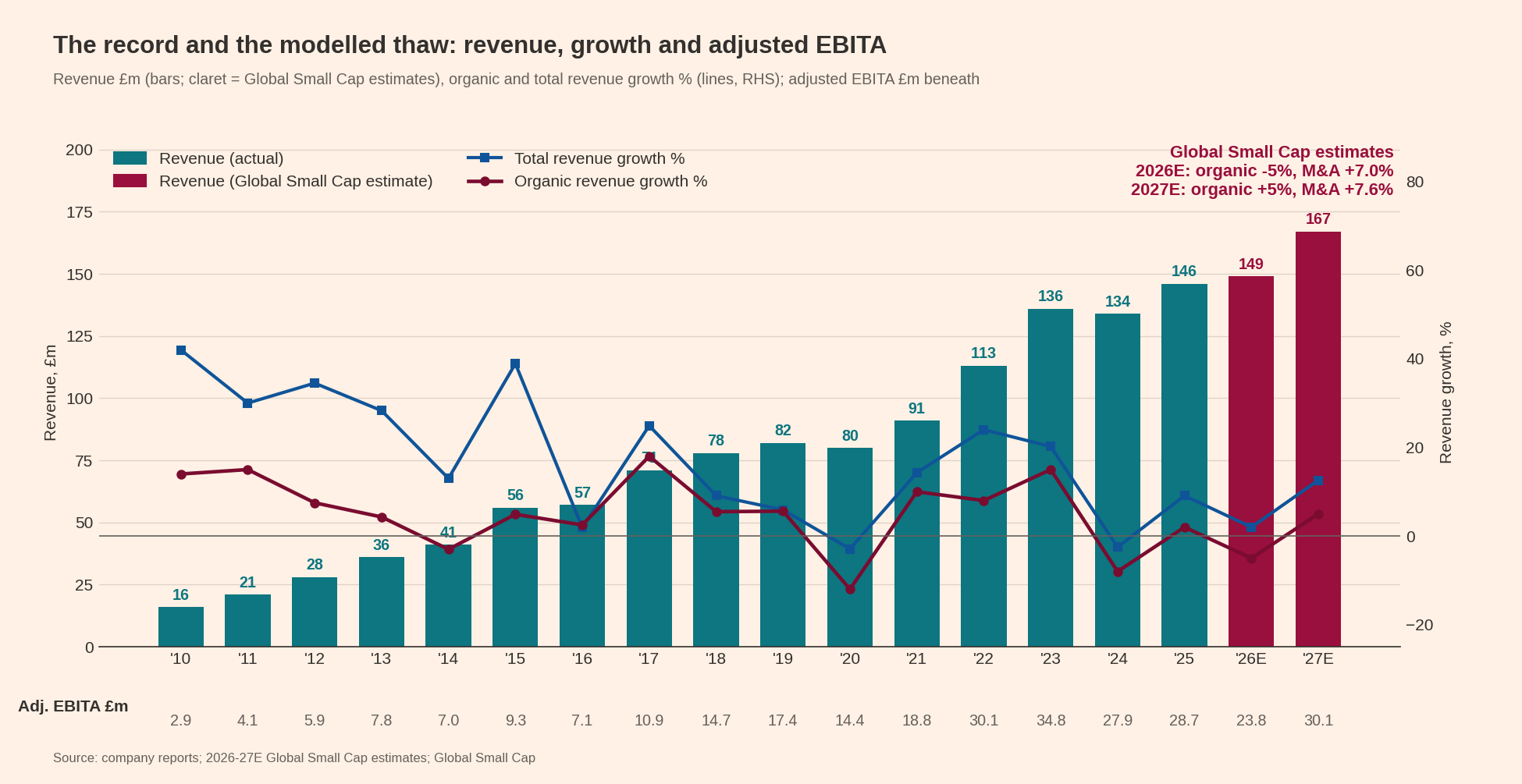
The chart below tells the story in three parts: a strong run into 2023 (revenue +24% and +20% in 2022–23, margins peaking at 26.6%), a flat 2024, and a 2025 where headline revenue grew 9% to £145.8m while EBITA was flat at £28m and margins fell to 19.2% — masking an order book that deteriorated all year. Global Small Cap models a -5% organic decline offset by 7% contribution from M&A (normalized run-rate M&A spend at 60% of FCF at ~6x EBITA).
Judges began as an investment vehicle, Judges Capital, founded by David Cicurel (CEO from inception until February 2026, now chair) and Alex Hambro, and listed on AIM in 2003. The original plan was to buy small undervalued public companies, shake them up, and sell them to private equity. When the UK small-cap index nearly doubled from 2003–2005, that strategy became unviable, and Cicurel began looking elsewhere. He found one deal that stood out — FTT, a Halma-like fire-safety business that became Judges’ first acquisition.
David Cicurel, The Telegraph, December 2013
“It had £3m turnover and £750,000 operating profit, with 19 staff. It looked too good to be true. The owners were an engineer and a scientist, who were both looking to retire. They explained they had a dominating position in a tiny world niche and that the drivers of the business were regulation and globalization.”
After FTT, Judges pivoted to buy-and-build and has since focused exclusively on niche scientific instruments, completing 25 acquisitions since 2005.
Why Judges Is a Successful Serial Acquirer
Decentralization. Judges runs a decentralized organization. While it requires strong financial controls and may help hire a controller, it does not force ERP upgrades, does not target synergies, and tries not to meddle — a philosophy on full display in Judges’ video for prospective sellers. Instead it adds value through capital, mentorship, shared-use capabilities and back-office relief. Synergies can create short-term gains, but they undermine the serial-acquirer model over time: integration makes an acquirer less appealing to sellers and adds the bureaucracy that makes scaling M&A harder. Judges has been explicit that it will stick to its decentralized model.
“We empower subsidiary management teams with the autonomous running of their businesses. This has been a successful operating model for the Group, as management teams are given responsibility for their own destinies, as well as an environment in which they can thrive and share best practice.”
— David Cicurel, Judges FY2025 results (March 2026)
Attractive end-markets. Judges focuses on niches where a small company can lead its field. These businesses don’t benefit from scale and typically already earn 20%+ EBIT margins — ideal for the “accumulator” serial-acquirer strategy, where Judges buys established leaders and supplements growth by recruiting salespeople, opening distributor relationships, entering new geographies, and mentoring on working capital, R&D, S&M and G&A. An estimated 2,000 scientific-instruments companies exist in the UK alone, ~200 with £5m+ in revenue; they are typically founder-led and last 20+ years before the founder retires, providing a steady stream of targets Judges has historically bought at 3x–7x EBIT.
Strong capital allocator. David has skin in the game (9% ownership) and is disciplined — willing to step back from M&A entirely or lean in, depending on the environment. He has studied the greats — Berkshire, Halma, Constellation Software. A decade ago the thesis rested on David alone; today he has built a deep bench: Mark Lavelle as COO in 2017 (17 years at Halma, former head of M&A, retiring 2026), Tim Prestidge as Business Development Director in 2023 (14 years at Renishaw, 8 at Halma), Ian Wilcock as Group Commercial Director in 2024 (Renishaw, Experian, Danaher, Oxford Instruments), and Rik Armitage as Group Acquisition Executive (Oxford Instruments). Judges appeals to these operators because David’s culture empowers people without bureaucracy, because an entrepreneurial “mini-Halma” offers more organic and M&A runway than a large incumbent, and because AIM listing carries an inheritance-tax benefit (nil vs 40% above £325k) that appeals to some.
Organizational Structure
The foundation of any serial-acquirer strategy is its organizational structure. A roll-up like Berry Global or Couche-Tard must be laser-focused on integration and cost synergies; an accumulator or platform must instead be committed to decentralization, to attract sellers and scale the number of subsidiaries.
Judges runs a highly decentralized structure. Its six-person head office — CEO, CFO, COO, Group Business Development Director (GBDD), Group Commercial Director (GCD) and Group Acquisition Executive — oversees 25 subsidiaries, each with its own MD. The COO, GCD and GBDD act as “Sector CEOs,” each overseeing a cluster of ~15 subsidiaries loosely grouped by scientific specialty. Their job is to mentor MDs and optimize R&D, S&M and G&A — usually in pursuit of growth rather than cost savings.
Judges encourages higher R&D spending, in part because the risk can be diversified across subsidiaries; R&D typically rises from ~4% to ~6% of revenue, echoing Halma’s playbook. Because many targets were run by scientists, simple moves — hiring a Sales Director, doubling down on product development, funding forgone capital projects — can pay back in under a year.
Judges CFO — company website video
“The businesses we tend to acquire are generally retirement sales and consequently have been used to being in a slightly more low-risk environment because the owners are very keen to keep a successful business. When the businesses join Judges, we tend to take a higher-risk view of investment in the business, particularly when we look at R&D where we spend across the group 5% to 6% of revenue investing in new product development. New products generate revenue growth, so we have a good track record helping businesses grow since they join our group.”
Sector CEOs visit each company every four to six weeks and run week-long leadership workshops twice a year with MDs. Modelled on Halma, the workshops provide leadership training, foster a collaborative culture, and benchmark businesses on good/better/best metrics. The most obvious improvements are new salespeople or distributors, but they extend to reallocating resources and finding capital efficiencies. Judges is also building shared-use capabilities, encouraged but not forced.
Judges COO — company website video
“Occasionally there are initiatives that are too big for one company to do. So if you are a company with 12 or 15 people, it’s ok to send someone to the US or someone to Europe, but China is pretty scary. There are situations where we have a group of companies clubbing together and opening a small office in China between them, which any one of them may find too intimidating. They can share legal costs and accounting. Again, this is something we encourage but not force.”
Together, decentralization, proactive mentoring, shared-use capabilities and de-risked capital and R&D investment make Judges an attractive permanent home for sellers — and give it real levers to accelerate organic growth. If there is a criticism, it is that Judges may not be aggressive enough. It prefers MDs to stay long-term, paying a high base and a small bonus (perhaps 25% of salary on custom metrics), reasoning that most MDs are scientists motivated by the product rather than money. Halma, by contrast, pays MD bonuses of 150%+ of base and replaces managers who miss stretch goals (typically 20%+ EBIT margins and 10% growth).
Acquisition Strategy
M&A is the core of the thesis, so it’s worth detailing the process. M&A is led by the Chair and CEO with help from the executive team; the hiring of Rik Armitage gives Judges someone dedicated to it. Of Judges’ 25 deals, seven have been tuck-ins. The key advantage is that Judges is still small enough to buy very niche companies and often earn a high-teens return in year one. Over time it will need to source deals more proactively and build a funnel — precisely what the recent hires are designed to do.
The main negative is that many subsidiaries sell products that are capex to their end-customer, with no reliable stream of services or parts revenue, so sales can be lumpy and the risk of overpaying rises. Judges offsets this with a diversified portfolio (top three subsidiaries are 33% of revenue), which improves as it scales; the lumpiness also deters some private-equity buyers. Despite it, Judges has had only two years of negative total growth — 2020 and 2024 (potentially 2026).
Cicurel frames the discipline simply:
“Judges follows a strict acquisition discipline and is highly selective in relation to both the long-term quality of any potential addition to the Group and the acquisition multiple ultimately paid. We are trusted to act decisively and to complete deals under the initial terms agreed.”
— David Cicurel, Judges FY2025 results (March 2026)
Typical target. Founder-led niche instruments companies with high margins (20%+ EBIT) and strong organic growth (MSD+). Targets are often global leaders in their niche, and exports account for 85% of Judges’ revenue. For most products accuracy and quality matter more than price — some Judges vacuum instrumentation is used at particle accelerators like CERN — and products are typically sold to universities and R&D departments. Judges avoids turnarounds and synergy-driven deals. Because UK small companies file financials for tax purposes, we can more or less verify that Judges has stuck to its knitting.
Typical seller. Usually a founder — an engineer or scientist — looking to monetize or retire while finding a good home for the business. Private equity may lever up, cut costs or merge units; strategic acquirers may keep the IP but strip the company, moving manufacturing to China and R&D to India. Neither appeals to most founders. Judges invests in the business and prefers to keep all employees.
On why quality-at-a-sensible-price beats a synergy hunt, Cicurel has said:
“Our main concern is to buy a good company with a lot of staying power and sustainable profits which we can buy at a sensible price. If the company happens to have some synergies with other portfolio businesses, it adds to the plus side, but it is not usually the main motivation.”
— David Cicurel, Bluebox Corporate Finance interview (2018)
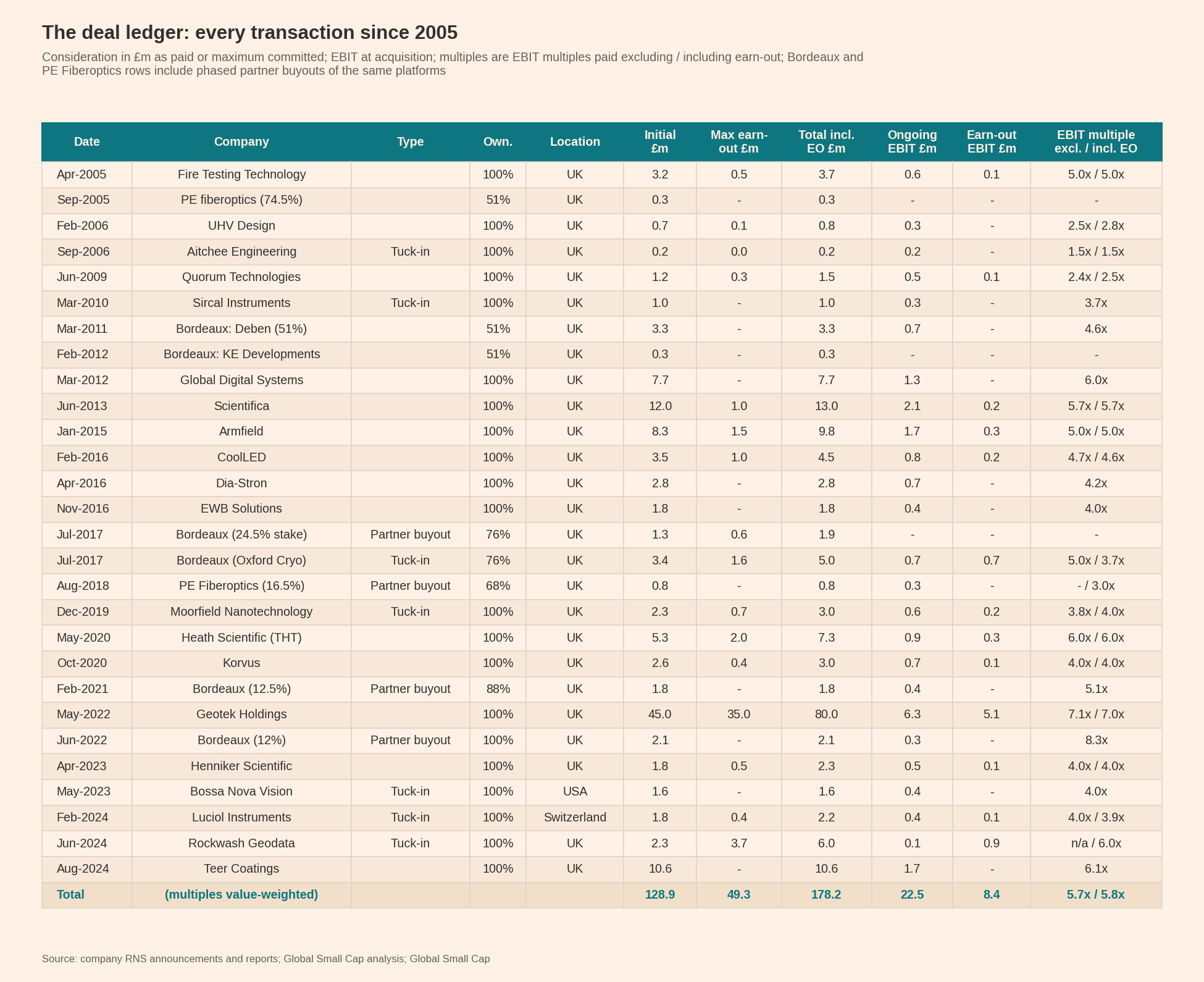
Typical structure. Judges pays 3x–7x EBIT, usually without complex structuring, primarily in cash. From 2014–2023 it issued just £3m of equity against ~£101m of total consideration (Geotek’s 2024 earn-out adds ~£18m in shares, at the sellers’ preference). Management is explicit about being as stingy as possible with equity. Some acquirers frame issuance in accretion terms — issue at 12x EBITDA to buy at 6x — but the goal here is a 15%+ IRR, so any equity issuance costs at least 15% versus 3%–8% for debt, and Judges thinks the same way. It is flexible on structure and can take a minority stake (e.g. Oxford Cryo) or acquire in phases (e.g. PE Fiberoptic) to enable a phased retirement.
Long-term multiple. Judges believes 3x–7x is sustainable; by volume the average deal has been 4.3x, by value (skewed by Geotek) 5.8x. The multiple hasn’t moved with the economy or interest rates. Small deals allow diversification, since succession transitions can be volatile. Judges will lever to 3.0x for the right deal — implying it could do a ~£100m deal for a £17m-EBIT business — but leverage has stayed below 1.0x for most of its history. For context, Halma deploys £200m–£300m a year on M&A across four to six deals, targeting £25m–£50m-EBIT businesses (about the size of all of Judges) at 10x–12x EBIT — perhaps a low-teens IRR before synergies. Judges only needs to deploy ~£300m over the next decade.
The multiple gap versus larger peers is where Judges’ small size pays off. Cicurel:
“We acquired Geotek at a multiple of seven, which was a fantastic deal. Especially considering one company in our sector regularly pays 12 times for businesses of this size. Another one recently paid 14 times prospective EBIT plus synergies plus an earn-out.”
— David Cicurel, Compounding Quality interview (April 2025)
Deal sourcing. The immediate opportunity is the UK, with ~2,000 potential targets (~200 doing £5m+ in revenue). Four deals a year would clear only 20% of the target list over a decade — before any overseas opportunities. Judges does look globally (it has done a deal in Switzerland) but the UK is the focus. The Chairman/CEO leads sourcing, though the new GCD should spread the load. Deals come via inbound interest, MD referrals of competitors or suppliers, board members and brokers; ~25% are tuck-ins. Many targets cluster around a region or university, letting Judges build a strong reputation among sellers.
Due diligence. Judges is known for a smooth process and a clean sale. Acquirers often make an offer before diligence, then cut it afterward; Judges absorbs diligence costs upfront despite closing only a minority of deals, building trust with sellers. (In 2008 it wrote off £300k of diligence expense when bank financing dried up.) It conducts scientific diligence using technical directors from expert subsidiaries — vacuums, electroscopes, cryogenics — and a network of consultants, often retired founders. Judges is highly picky, arguably too picky: David implies he bids on fewer than 25% of the deals he evaluates.
Succession. A flexible succession plan is one of Judges’ main value propositions to sellers. Judges takes on the succession risk but diversifies it across subsidiaries and keeps a backup plan — the founder stays a few more years, a senior employee steps up, a strong MD from another subsidiary takes over, or Judges recruits a new MD, with the Sector CEO as the ultimate insurance.
Financial Track Record
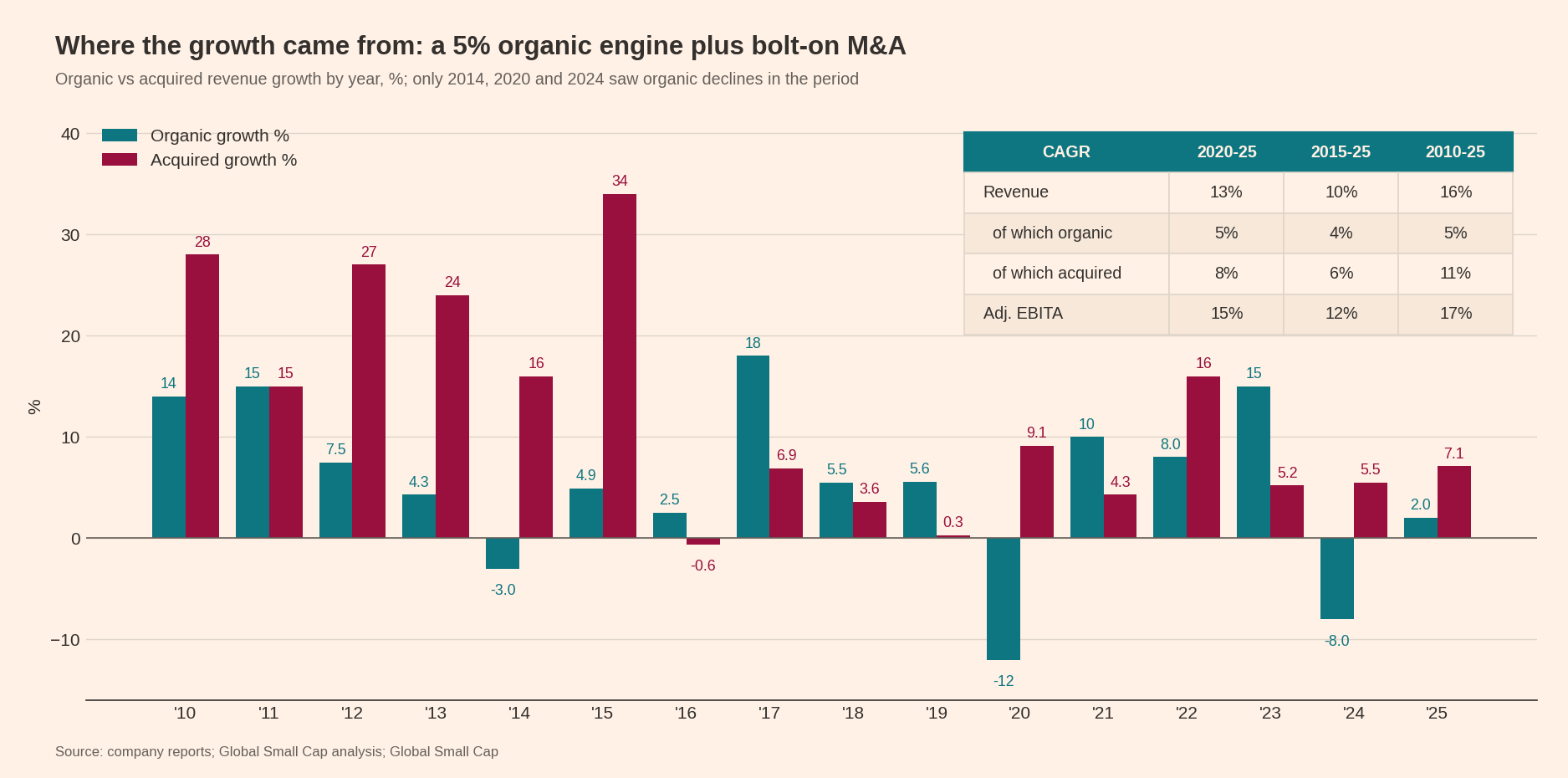
High level. Since 2010, Judges has grown organically at 5% CAGR and inorganically at 11%. A major appeal is inherent diversification. The three largest subsidiaries are 33% of revenue; the rest is spread widely, including by geography (North America 28%, Europe 25%, China 14%, UK 11%, ROW 23%). Judges had only three years of negative organic growth between 2006 and 2024 — 2014 (-3%), 2020 (-12%) and 2024 (-8%) and now likely 2026 (I model -5%) — and while we are in the midst of the worst cycle, the business is resilient.
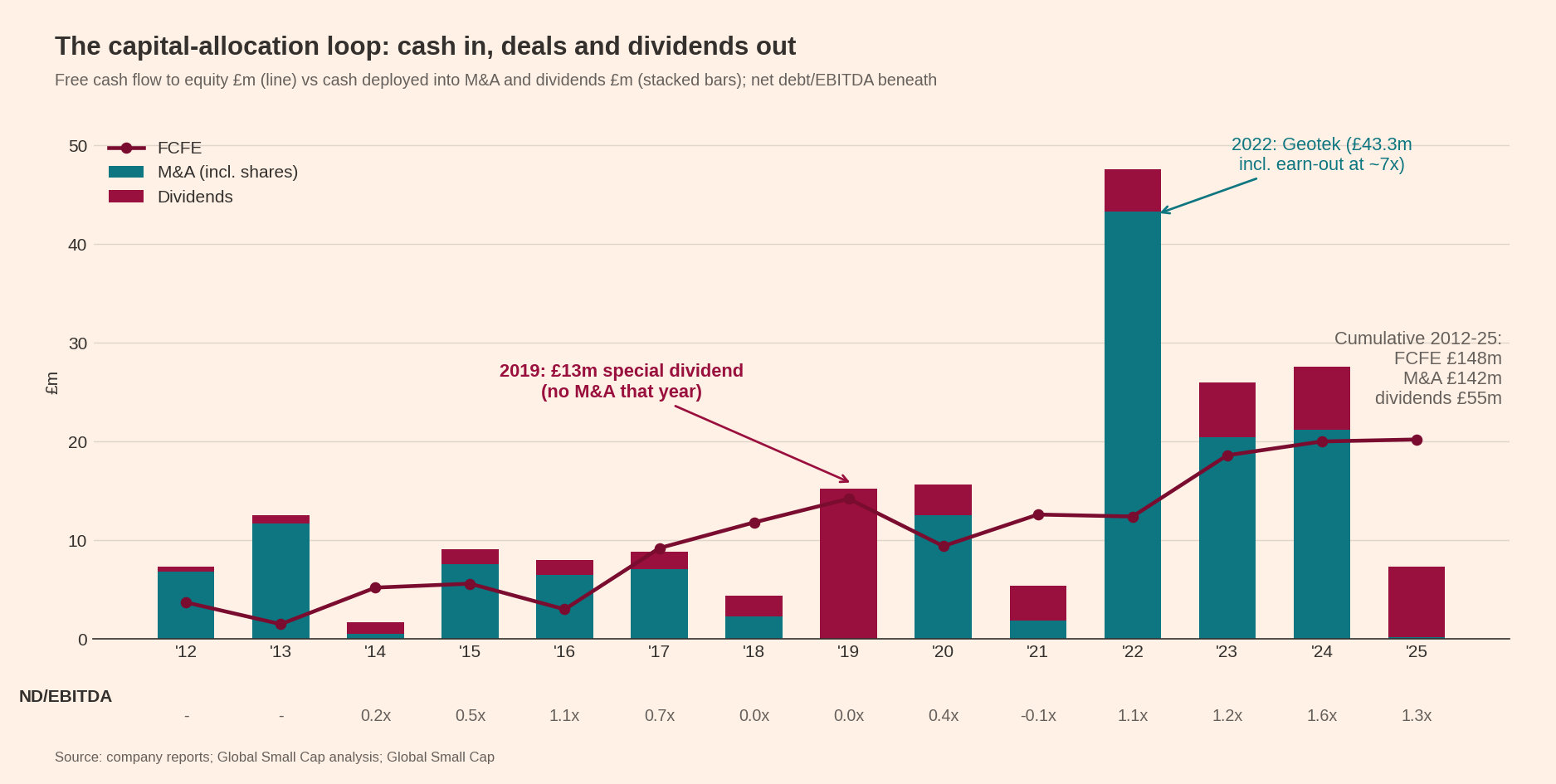
Judges has used 100% of FCF for M&A, with debt low (under 1.0x on average). The payout ratio is skewed by a £13m special dividend in 2019 — a year with no M&A and a threatened dividend-tax hike under a possible Labour government; excluding it, the payout ratio has been 30%.
ROIC averaged an exceptional 24% including all goodwill through the decade to 2023. Pay 6x EBIT for a business growing 6% and you get a 17% pre-tax return plus 6% growth — a 23% pre-tax ROIC and a high-teens post-tax ROIC — and Judges tends to pay less than 6x and accelerate growth. ROIC on tangible capital is even higher, 39%, reflecting how attractive these businesses are: subsidiaries focus on design and development with manufacturing outsourced. The honest update is that returns have compressed with the cycle: ROCE was 23.4% in 2023, 16.3% in 2024 and 17.6% in 2025, and I model 13.6% for 2026. Whether 24% or ~16% is the through-cycle number is the single most important open question in this write-up. Separately, taxes were low pre-2021 thanks to SME R&D credits (for businesses under 500 employees); Judges crossed 500 employees in 2021, lifting the effective rate to 21–23%, and it is modelled at 25% going forward — a permanent ~2% headwind to EPS CAGR.
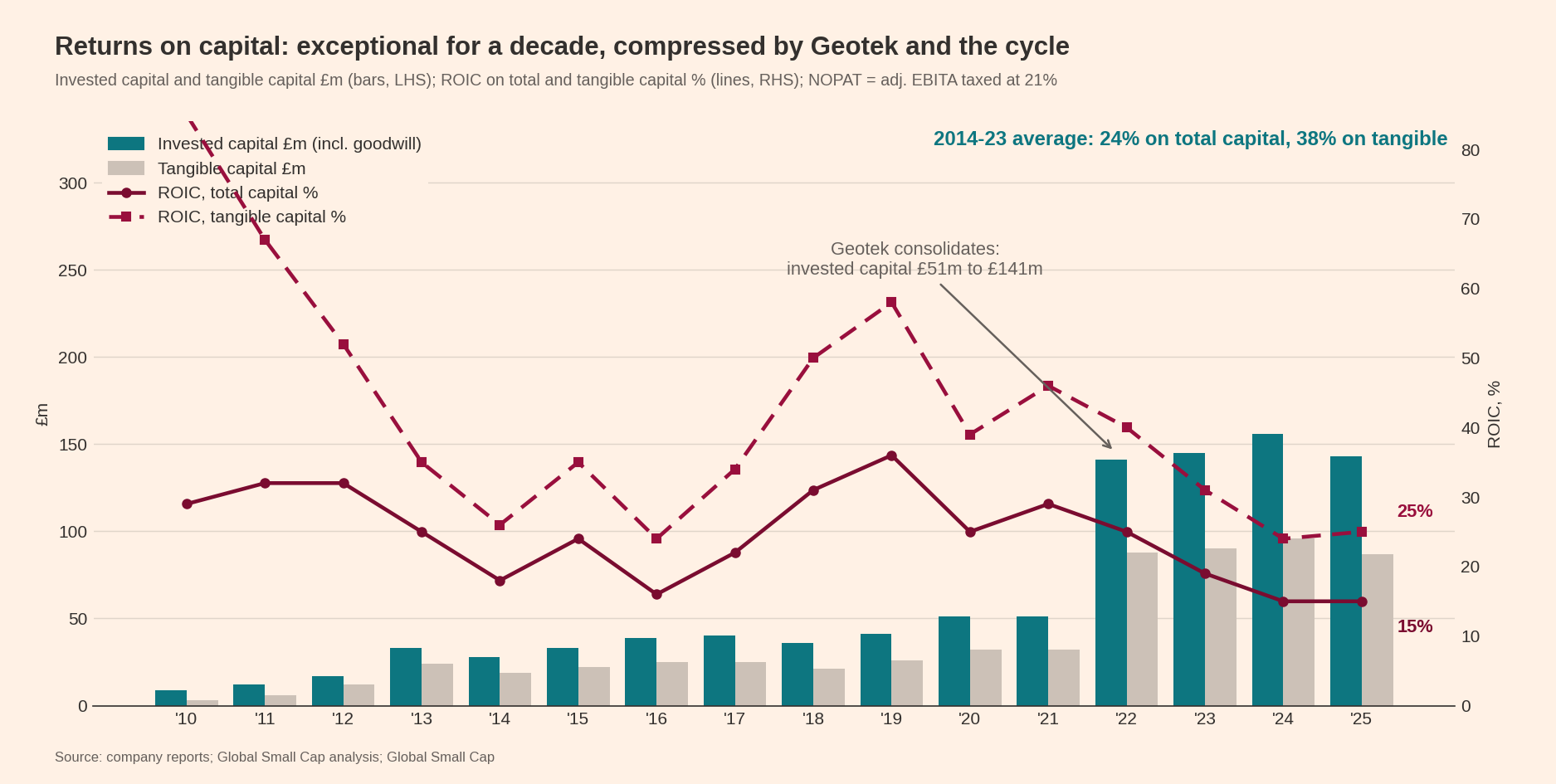
The table below shows management calculations.

M&A track record. Judges has done 25 deals for £178m of total consideration including earn-outs — a 5.8x value-weighted and 4.3x volume-weighted average multiple. Over the last three years the pace has steadied at two to three deals a year, and I expect the GBDD and GCD hires to accelerate it. There were slow stretches — 2005–2008 (macro and tight financing), and 2014 and 2019 (attributed to randomness) — which tend to be attractive times to buy the shares, as Judges builds cash and then deploys when better deals appear. About 25% of deals are subsidiary-led tuck-ins (three in the last two years). With Bordeaux and PE Fiberoptics, Judges built its stake over time by buying out partners — a mark of its flexible approach.
Subsidiary-level track record. For UK subsidiaries, Companies House tax filings are available; the data isn’t always exact but is directionally correct, and my derived revenue closely matches reported results. The tables below run through FY2024, the latest year with filings available.
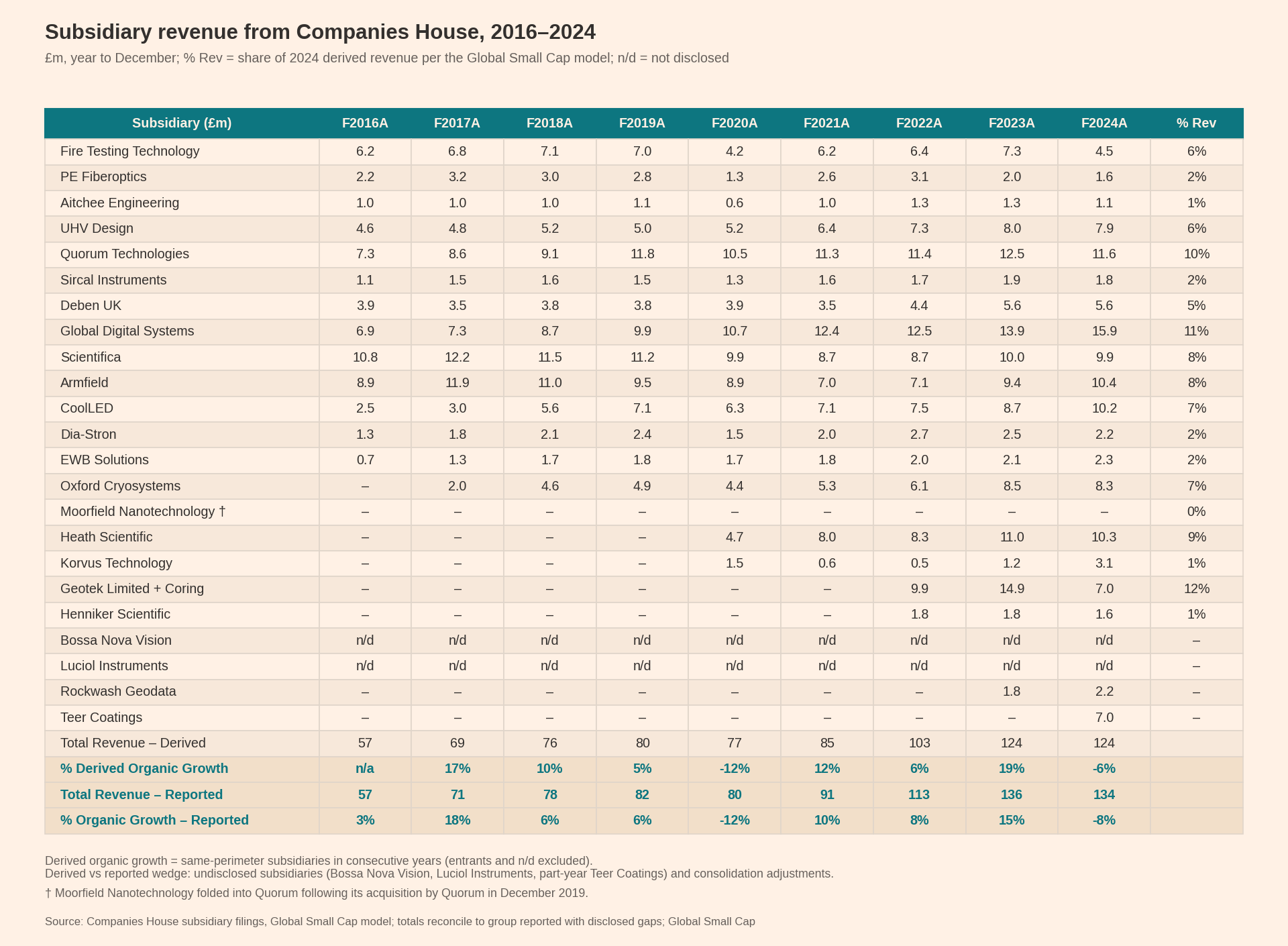
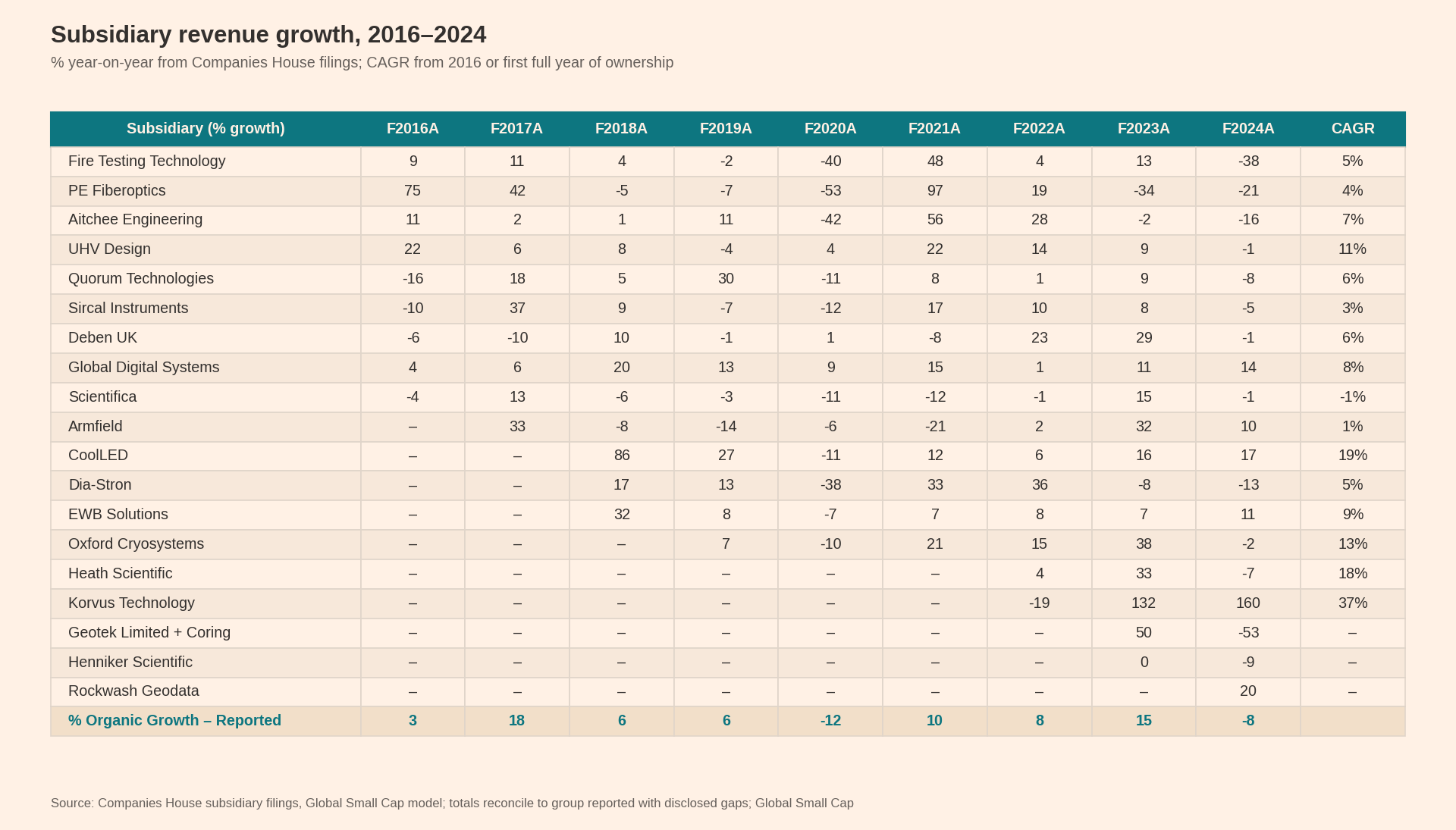
All-in organic growth is 5%, but the subsidiary range runs from -1% (Scientifica) to 19% (CoolLED), averaging 9%. The three largest subsidiaries (33% of revenue) have averaged MSD. Organic growth was high-teens from 2006–2011 on a post-GFC recovery, volatile in 2014 and 2016 (European macro, strong sterling, discrete Armfield issues), and has averaged 7% since 2016 — including COVID. Management’s stated target is HSD organic growth, so once the lumpy post-COVID period passes, growth above 5% is plausible. Notably, the number of Sector CEOs has doubled while subsidiary count hasn’t, which should increase the number of growth opportunities identified.
The 2024 filings show just how wide the dispersion within the portfolio can be in a single year. GDS grew 14% to £15.9m — in a year the group shrank 8% organically — and is now the largest subsidiary. CoolLED remains the organic star of the portfolio (19% CAGR since acquisition, £10.2m at a ~30% margin), Heath Scientific keeps compounding (£10.3m at a 31% margin), Oxford Cryosystems held up well (£8.3m at 23%), and Korvus recovered sharply off a low base (+160% to £3.1m). Against that, Fire Testing Technology — Judges’ first acquisition — had a terrible year (-38% to £4.5m and a £0.8m loss, its first in my dataset — fire-testing lumpiness at its worst), PE Fiberoptics also swung to a small loss, and Geotek gave back most of its coring-boom revenue, as detailed below. Teer Coatings, acquired in 2024, contributed £7.0m of revenue and £1.5m of EBIT in its first year.
Margins. Judges targets 20%+ EBITA margins. Across subsidiaries owned before 2017, the average margin was 15.5% pre-2017, improving to 16.5% since — 17.5% excluding 2020, when some margins went negative under COVID lockdowns. (These are EBIT, not EBITA, margins from UK filings, since amortization data isn’t fully reliable; on an EBITA basis Judges is 20%+.) The improvement reflects Mark’s work as COO, and the margins exceed scaled players like Oxford Instruments (~15%) and Spectris (~13%), reflecting Judges’ niche focus.
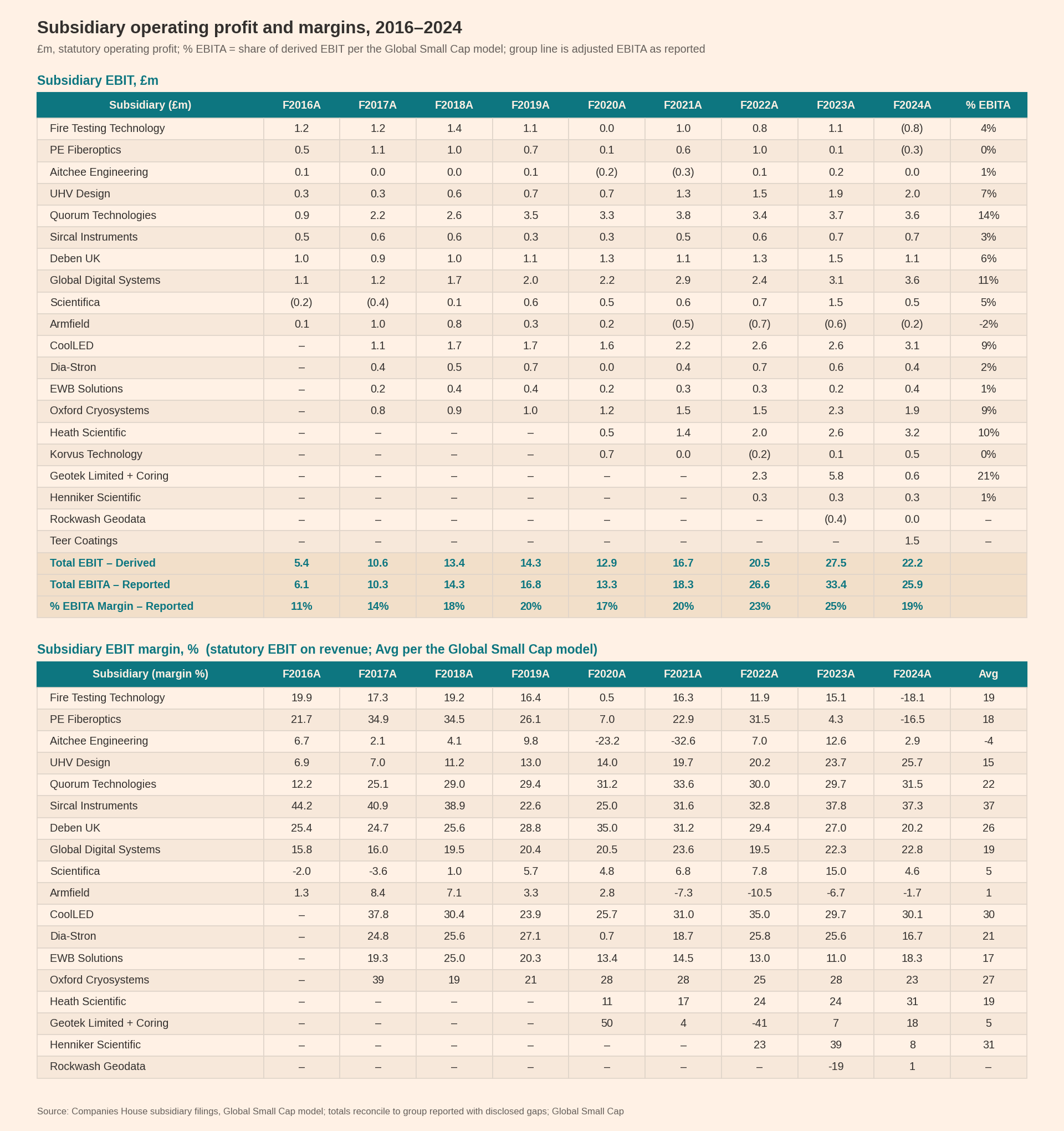
Since Mark joined in 2017, subsidiary-level margins have trended higher — though 2024 dented the progress, with FTT and PE Fiberoptics swinging to losses and Scientifica giving back most of its 2023 gains; I read that as cyclical volume rather than a change in trajectory. He sees room for further gains over time, driven by culture and high-ROIC investment rather than cost-cutting. He had two years with the subsidiaries before COVID hit, and with two more HQ executives added, I expect margins to resume their upward trend. Tuck-ins help too: Aitchee was a key subcontractor for FTT (its biggest customer at acquisition), and four Judges companies are now among Aitchee’s top five customers — which is why Aitchee runs at low profitability, since most sales are related-party. Scientifica (8% of revenue, 5% of EBIT) and Armfield (8% of revenue, -2% of EBIT) are the underperformers, discussed below. EBIT is reasonably diversified, with the top three (Geotek, Quorum, GDS) at 46%.
Key Risks
US research funding is now the dominant risk — and it materialized in 2025. Both actual funding cuts and proposed funding cuts freeze US research spending and even when funding resumes, it can take time to normalize. Tariffs and a volatile funding environment have hit Judges hard. H1 2025 looked fine with orders up 4% and Geotek expected to go on a coring expedition but H2 2025 fell apart when order intake declined mid-teens with the US in particular declining 20%+. At the time, the US administration publicly proposed ~40% cuts to research funding. The NIH and NSF terminated a large number of grants between March and July; most were restored by September. But the uncertainty stopped customers spending — universities don’t commit to a £100k instrument when their grant pipeline might be cut in half. The result speaks for itself: 2025 adjusted EPS of 275p (-2.5%), and guided 2026 EPS to 200–250p, ~18% below 2025 at the mid-point, explicitly assuming no US recovery during the year.
The hard data supports the freeze-not-collapse framing. NIH — the world’s largest funder of biomedical research and the key end-market driver for Judges’ academic instruments — was doubled from $13.7bn to $27.2bn between FY1998 and FY2003, ground sideways for a decade (the FY2013 sequester cut it 5%), then compounded again from $30.3bn in FY2015 to $47.7bn in FY2023. The scare came in May 2025, when the White House requested just $27.9bn for FY2026 — a 41% cut — alongside the grant terminations described above. Congress ultimately rejected the cuts: the FY2026 appropriation signed on 3 February 2026 set NIH at $47.5bn (+1.0% year-on-year) and NSF at $8.75bn against a proposed 57% cut. So the funding picture is a nominal freeze (FY2024–26: $47.3bn → $47.0bn → $47.5bn) rather than a structural break — though NIH now sits roughly 10% below its FY2003 peak in real terms, and it was the uncertainty, not enacted cuts, that stopped universities committing to £100k instruments. The long-run series is charted in the Bull Case above. (Sources: CRS R43341; NIH almanac appropriations history.)
There is also a lag between appropriations and actual grant funding, and it cuts both ways. Most NIH research project grants are multi-year commitments paid out annually as noncompeting continuations — in CRS’s words, “most NIH research project grants have been committed for multiple years, but funding for the grant has been obligated each year of the grant period as a noncompeting grant continuation” link — so the bulk of each year’s budget is spoken for before a single new project is funded. New awards are the swing variable, and they moved violently while the headline stood still: new competing research grants fell from 10,086 in FY2024 to 6,095 in FY2025, and the May-2025 request would have funded just 4,312 — partly a policy shift toward fully-funded multiyear awards, which Congress capped in the FY2026 act. Instrument purchases key off new projects and new labs, not the continuing-award base — which is why Judges’ order intake fell 20%+ in the US while appropriations were flat, and why the recovery, when it comes, should lag the budget headlines by the same one-to-two years.
Choppy end-markets. Beyond the issues around research funding, structurally, Judges sells instruments that last 10+ years with minimal maintenance parts, so revenue can be lumpy — the opposite of a Constellation Software with highly recurring revenue. We’ve seen deceleration to -4% in 2014 (Euro crisis), -12% in 2020 and -8% in 2024 (China weakness, de-stocking) — though Judges grew 15% in 2008.
Coring and Geotek lumpiness. Geotek is ~21% of EBIT and the least predictable business in the portfolio. Coring revenue depends on episodic expeditions, and no expedition is likely until early 2027 — a direct headwind to the 2026 comparison. Judges bought Geotek for ~£80m including earn-out at ~7x, its largest deal and highest multiple, and to be clear, was fully aware of this lumpiness when it bought it, but the asset that most needs to work is also the one with the least visible revenue.
Management makes a major M&A mistake. Mistakes are inevitable — from succession (Scientifica) or misjudging a business (Armfield) — but Judges now has the scale to absorb them. A £15m deal at 6x EBIT implies ~£10m–£15m of revenue, about 10% of the total, and the average deal over the last two years was £4.5m. The two larger deals that stumbled (Scientifica and Armfield) didn’t derail overall performance, underscoring the diversification benefit.
Operational issues. The Armfield and Scientifica problems largely predate 2017. With the COO (2017), GBDD (2023) and GCD (2024) in place, oversight of each subsidiary is stronger, which should reduce operational issues and capture near-term growth. Judges is also now large enough that inevitable issues won’t badly dent results.
Succession — now executed. On 26 November 2025 Judges announced that David Cicurel would step down as CEO on 9 February 2026, moving to non-executive chair after consultation with major shareholders; Ralph Elman moved from non-executive chair to non-executive deputy chair. Dr Tim Prestidge, group business development director since February 2023 and previously at Halma and Renishaw, became CEO. Cicurel continues to support the group’s acquisition processes, where his experience matters most. The risk is now transition execution. Three points cut in Judges’ favour: the succession was telegraphed over three years rather than forced by a health event; Prestidge spent those years overseeing portfolio companies rather than arriving cold; and the bench has been deliberately broadened with Ian Wilcock (group commercial director), Rik Armitage (group acquisition executive) and John Dunne (portfolio chief executive). One major offset: Mark Lavelle — the COO who drove the margin and working-capital improvement since 2017 — is also retiring, so two of the three people most responsible for the track record are leaving within roughly a year of each other. Brad Ormsby (CFO since 2015) is the main continuity.
Subsidiary Overview
Below is a summary of the largest subsidiaries. Judges gives subsidiary-level commentary only on Geotek; the thesis doesn’t rest on any single one. The goal here is a high-level feel for the kinds of businesses Judges buys.
Geotek (12% of revenue, 21% of EBIT). Judges acquired Geotek in May 2022 for £45m plus a £35m earn-out (fully paid June 2023), implying ~7x EBITA — six times larger than the next-biggest deal (Scientifica, £13m) and the highest multiple Judges has paid. It was sourced by board member Charles Holroyd who got paid a founders fee; two founders signed one-year contracts and an MD stayed on.
Founded in 1989 in Daventry, UK, Geotek designs and manufactures Multi-Sensor Core Loggers (MSCL) for geoscience, plus related services. MSCLs enable high-resolution, non-destructive analysis of geological cores — cylindrical rock and sediment samples extracted from below the surface — used by university researchers, miners and oil-and-gas operators to analyze, record and digitize core data. Geotek has served 40+ countries, with 90% of revenue from exports. Core analysis supports climate research and helps resource companies run feasibility studies and optimize extraction (e.g. building 3D reservoir models for simulation).
Geotek runs three roughly equal divisions:
Instruments. MSCL instruments using geophysical and geochemical sensors and custom software to measure and log core characteristics rapidly and automatically — with lumpiness similar to Judges’ other subsidiaries.
Services. Fee-based core-logging services that improve revenue visibility via long-term contracts rather than one-off equipment sales, sometimes delivered in the field with a fully equipped lab and staff beside the customer’s operation. More recurring than instruments.
Geotek Coring. Specialized coring for gas hydrates, underpinned by proprietary technology that brings hydrate cores to the surface without changing pressure or temperature, so they can be stored and analyzed intact. These expeditions (typically academic or government, running about once a year) make coring revenue profitable but very lumpy.
In June 2024, Geotek made the tuck-in acquisition of Rockwash (rock-cuttings digitalization) for an initial £2.3m plus up to £3.7m earn-out, described as strongly synergistic. The Companies House filings quantify the lumpiness: Geotek’s revenue went £9.9m (2022) to £14.9m (2023) and back down to £7.0m in 2024, with EBIT collapsing from £5.8m to £0.6m, because Geotek only secured a coring contract in the summer of 2024 for a 2025 start — part of why management flagged a 2024 miss versus market expectations at H1. (Rockwash added £2.2m of roughly breakeven revenue on top.) That expedition ran in H1 2025 and underpinned the first half, which is precisely why the 2026 comparison is so difficult: no further coring expedition is expected until early 2027 (call it a £6m or ~6% revenue headwind at attractive margins). Geotek earned its full earn-out, but with three expeditions in five years of ownership, it remains too soon to call the deal.
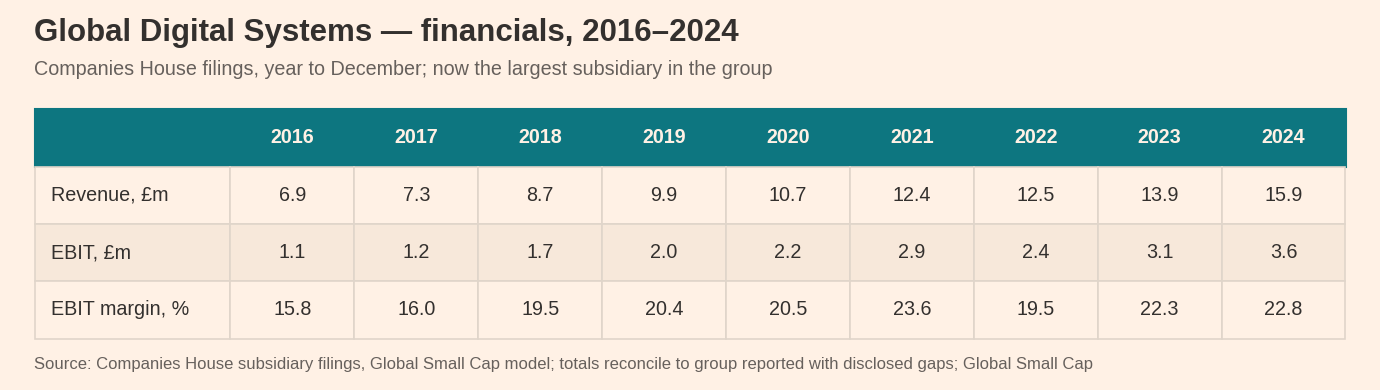
Global Digital Systems (11% of sales, 11% of EBIT). Acquired March 2012 for £7.7m (~6x EBITA) from two founders, who transitioned the company over five years to two younger managers still in place. Founded in 1979, GDS designs, manufactures and sells instruments that test the physical properties of soil and rock (strength, stiffness) for geotechnical and earthquake engineering — used at the Three Gorges Dam, the Millau Viaduct, Heathrow Terminal 5 and Crossrail. There’s a services element (on-site installation, instruction and support), machines run £25k–£150k and are long-lived, with add-on potential. GDS is the quiet compounder of the portfolio: it has grown revenue at an 8% CAGR and EBIT at 12% since 2016, and in 2024 — a year the group declined 8% organically — it grew another 14% to £15.9m with £3.6m of EBIT at a 22.8% margin, making it the largest subsidiary by revenue. By these rough numbers, a clear success. GDS has complementary technology to Geotek, though management isn’t pursuing explicit integration. Note that GDS-type geotechnical work carries the group’s offshore wind exposure, an end-market that has become more challenging.
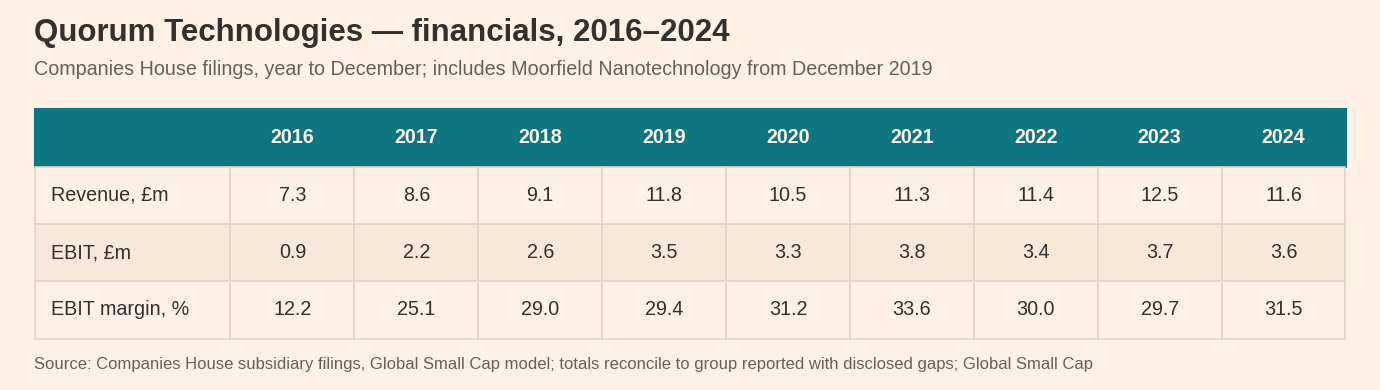
Quorum Technologies (10% of revenue, 14% of EBIT). Acquired from its founder in 2009 for £1.5m including earn-outs (~3x EBIT); the founder stayed a year as MD, then consulted. Formed in 2001 as the MBO of Polaron and merged with Emitech in 2005, Quorum designs and distributes sample-preparation instruments for electron microscopy: samples must be electrically conductive for image clarity, so they need cleaning, drying, coating or freezing. Quorum sells coating systems for non-cryogenic samples and freezing/transfer systems for cryogenic ones, priced from ~£4k to £20k. In 2019 it made the £3m tuck-in of Moorfield Nano (physical/chemical vapor deposition, etching, annealing). Since 2016, Quorum has grown revenue at 6% CAGR and EBIT at 14%, and it is one of the steadiest businesses Judges owns: 2024 revenue of £11.6m at a 31.5% EBIT margin, its fifth straight year at or around 30% — a success by these rough numbers.
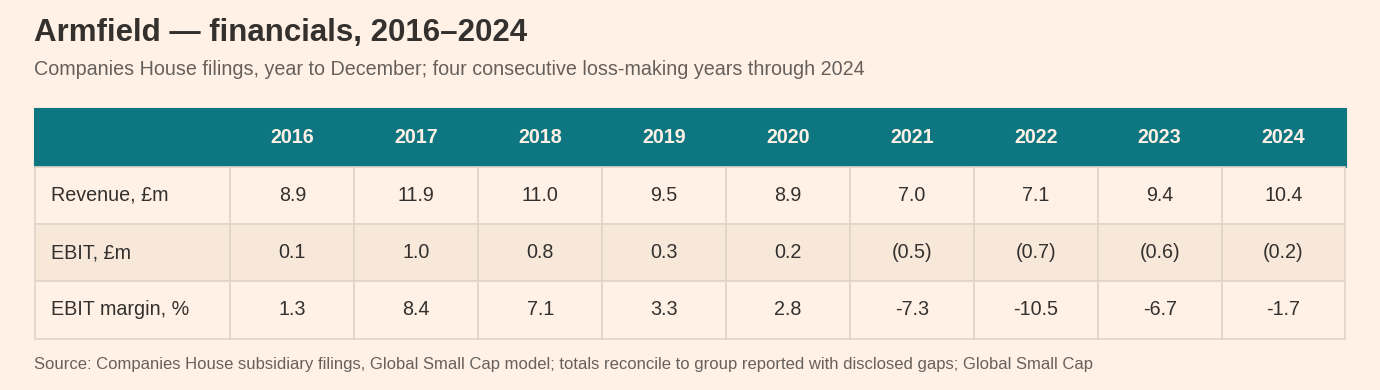
Armfield (8% of revenue, -2% of EBIT). Armfield looks like a mistake. Judges acquired it in 2015 for £9.8m including earn-out (~5x EBIT), then the second-largest deal (behind Scientifica). Founded in 1875 (educational instruments from 1963, MBOs in 1981 and 1994), Armfield designs engineering and teaching instruments focused on food handling for education and research. Sales fell 27% in 2015 on lower oil and commodity prices that hit its emerging-market customers (55% of sales were ROW, heavily Africa and the Middle East) — a drop large enough to knock 6% off Judges’ total revenue. Sales bounced back the next year, but total growth has averaged a tepid 1% CAGR since 2016, and Armfield has now been loss-making in each of the last four years. Judges may have bought it while it was over-earning on large new Middle Eastern university orders. Management attributes the trouble to end-markets rather than the business, but there were management changes around acquisition and again in April 2023, and German competitors like GUNT may have matched Armfield’s quality at a lower price. Despite a 2% recovery in 2022, 32% growth in 2023 and a further 10% in 2024 to £10.4m, Armfield still lost £0.2m — 2024 was its ninth year under Judges’ ownership without a meaningful profit. Judges clearly misjudged either the competitive position or the normalized earnings; absent a material improvement in margins to match the recovering top line, a good ROIC is hard to see. Management indicated at the FY2025 results that measures to improve underperforming businesses are starting to take effect — Armfield is the obvious test of that claim, and so far the revenue line is responding well before the profit line (though the 2024 loss was the smallest of the four).
Scientifica (8% of revenue, 5% of EBIT). Scientifica also looks like a mistake. Judges acquired it in 2013 for £13.4m (~6x EBIT), then its largest deal, from three founders (1996 vintage); one left at close, two stayed as MD and Sales Director. Scientifica designs instrument rigs for research into neurons, neuronal circuits, animal behavior, electrophysiology, multiphoton imaging and optogenetics — micromanipulators, optical microscopes, mounting solutions and imaging systems, modular so labs can upgrade over time. It runs Centres of Excellence at Université Laval (Montreal), Cold Spring Harbor (New York) and King’s College London, with consultants in Germany and China; exports are 75% of sales. Large multinationals like Olympus and Nikon focus on life sciences, while Scientifica is bespoke to neuroscience, where it ranks top-three alongside Micro Control Instruments (UK), Sutter Instruments (US) and Thorlabs (US).
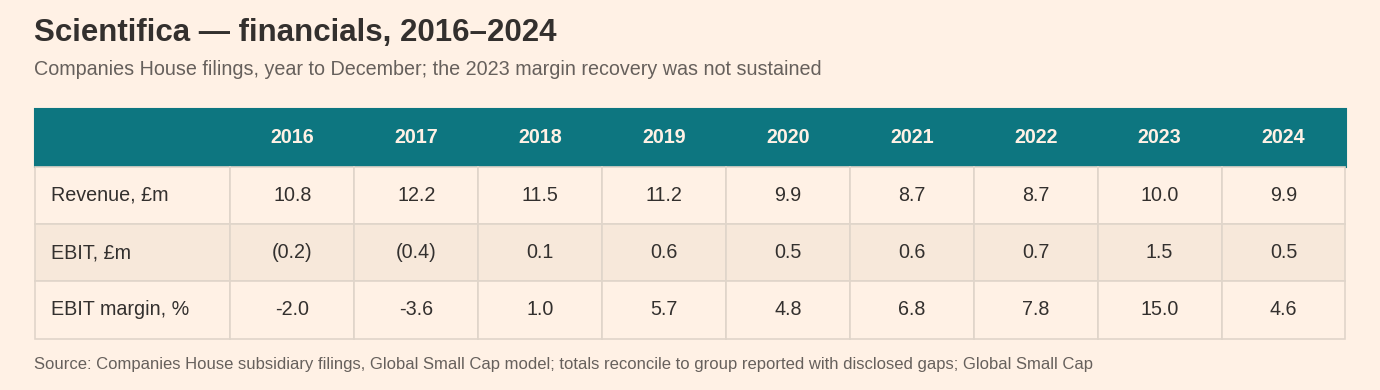
After acquisition, Scientifica grew above average in 2014–2015 but couldn’t execute its order book, hitting margins hard. Management attributes this to succession: the MD/co-founder (Plan A) meant to stay indefinitely but decided to retire, while the Sales Director/co-founder (Plan B), a strong leader, was forced to step back at 40 due to health issues — the two departed the same day. A Plan C recruited from Halma couldn’t manage the transition, so the then-COO (Plan D) was parachuted in with Plan B’s part-time help. Plan B, now recovered, was reinstated as MD in January 2020. After five straight years of decline, Scientifica rebounded 15% in 2023, with EBIT margins recovering to an all-time-high 15% (unlike Armfield, which ran negative). 2024 answered the sustainability question badly: revenue slipped back to £9.9m and the margin relapsed to 4.6% (£0.5m of EBIT), so the 2023 margin now looks like a spike rather than a new level. There may still be a path to an attractive return, but it requires holding a margin Scientifica has managed only once in the last nine years — and as a neuroscience supplier to academic labs, Scientifica sits directly in the path of the US research-funding freeze.
Management & Board
Judges has an exceptional management team for its size, but it is in the middle of the most significant transition in its history. David’s ownership is significant and Mark holds a meaningful position from options. The criticism is that ownership beyond the two isn’t large, and — given Judges’ non-aggressive compensation — the thesis leans on their stakes as the key incentive.
The 2025 annual report spells out how pay works, and it confirms the point (Annual Report 2025, remuneration report). Salaries are benchmarked against similar-sized AIM companies with no external remuneration consultants — Prestidge moved to £350k on promotion to CEO, Ormsby sits at £281k — and pensions are 5% of salary, the same as the wider workforce. The annual bonus is capped at 50% of salary; in 2025 half was tied to the adjusted-EPS target in the budget and half to individual and ESG objectives (from 2026: 50% EPS, 40% individual, 10% ESG).
The system has teeth: with 2025’s results, only the ESG element paid out, leaving Cicurel’s total compensation at £289k (£270k salary, £13k bonus), Ormsby’s at £307k and Prestidge’s at £377k. Long-term incentives are market-priced share options rather than a nil-cost LTIP — three-year vesting, exercisable to year ten, conditional on at least 5% compound adjusted-EPS growth (all options granted in 2023 lapsed) — and executives must build a shareholding of at least 1x salary before selling vested option shares. Prestidge received 60,000 options at 5200p on promotion in January 2026, on top of 60,000 at 7690p from January 2025. Nobody gets rich here on salary or bonus; the wealth is in the equity, which is the point.
David Cicurel (74; ~10% stake — shares worth ~£30m at the current price, options ~£1m). Founder. CEO from inception until 9 February 2026; now non-executive chair. A student of successful serial acquirers, happy to emulate Halma and to poach its people. He believes the COO and MDs must be empowered “to the point of abdication,” and saw his role as creating a culture founders want to join and never leave. He continues to support the group’s acquisition processes. An engineer by training with an INSEAD MBA; his record speaks for itself.
Dr Tim Prestidge (53). CEO since February 2026; joined 2023 as Group Business Development Director and a board member. After his PhD he became Divisional CEO and then Executive Committee Director at Renishaw, then spent eight years as a Divisional CEO at Halma chairing portfolios of technology companies across the UK, Europe, US and China. A physicist by training. Three years overseeing Judges’ portfolio companies before taking the top job is a reasonable apprenticeship — but he takes over into the toughest trading of the company’s history.
Brad Ormsby (49; shares ~£0.4m, options ~£0.7m). Joined 2015 as CFO, after three years as a CFO (including an IPO) and six as controller of a public tech-focused investment firm. Beyond finance he helps with M&A, appears well aligned culturally, and is now the primary continuity in the executive team.
Mark Lavelle (66; shares ~£0.1m, options ~£6m). Joined 2017 as COO, a role akin to Sector CEO; now retiring. Seventeen years at Halma, including CEO of two operating groups and head of M&A, and led innovation such as Halma’s India shared-use capabilities. David ran a long COO search across Oxford, Spectris, Thermo Fisher and others, narrowing to three candidates — all from Halma — and chose Mark for his longer CEO experience and shared background (engineering, INSEAD MBA). The subsidiary-level margin and working-capital improvement since 2017 is largely his.
Ian Wilcock (58). Joined 2024 as Group Commercial Director and a board member, in an M&A-oriented role. He began at Renishaw, then helped lead two investor-backed SMEs acquired by corporates (Footfall by Experian in 2006, Irisys by Danaher in 2012), spent four years at Danaher, and most recently eight years on the management board of Oxford Instruments. A chemical physicist with an MBA.
Rik Armitage (Group Acquisition Executive, ex-Oxford Instruments) and John Dunne (Portfolio Chief Executive) round out a head office that has roughly doubled in senior capability in three years — deliberately, to add both bandwidth for the acquisition strategy and oversight of underperforming businesses.
I don’t believe Judges’ decentralized structure, entrepreneurial culture or disciplined capital allocation change under Prestidge: two senior executives come from Halma (very similar DNA), Brad has a decade at Judges, and Cicurel remains on the board as chair. Judges’ AIM (rather than main-market) listing is intentional — AIM shares held two-plus years are exempt from the UK’s 40% inheritance tax above £325k — so David, and perhaps Mark, are incentivized to hold the shares indefinitely; even if the rules change, the older executives have strong reason to think long-term. The board comprises the CEO, CFO, GBDD, GCD and five independent directors, chaired by Cicurel with Ralph Elman as deputy chair; three non-executives own £2.5m–£4.0m of stock, creating strong alignment.
LON:JDG, LSE:JDG, JDG.L, JDG:LN and $JDG. ISIN: GB0032398678; SEDOL: 3239867.
Thanks for the detailed comments. As a high-level, yes, they are clearly under-earning, its just a matter of how much. The coring expedition issues are probably worse than what they originally thought when they acquired it so that has to be acknowledged and I'm reluctant to capitalize some R&D unless I start seeing real growth acceleration.
I do agree on management. I believe David has been very thoughtful on succession and I like their new management. I was disappointed that Mark decided to retire but it is clear that they have a strong team. Its just a matter of getting through this cycle which everyone thought would last 1 year but may last 3 or even 4 years confounded by Geotek volatility.
Thank you for your excelent detailed write-up. I learned a lot.
I would also add the possibility that the company under the new management could do as well as or even better than David did, because they have learned from other great companies + David. I think David chose them very well. Just by listening to them speak during earnings calls, it is easy to tell they are of extremely high quality.
Another point I wanted to touch on is whether their adjusted EPS is the proper metric to calculate owner's earnings, because (1) it doesn't take SBC into account (-1.4mn) and (2) it doesn't consider that some of the 10.2mn R&D is actually growth Capex (if you consider let's say 50%, then 5.1mn is growth capex which should be considered into owner's earnings). Those two factors combined add ~50 to EPS, depending on your assumptions.
The main point is what normalized earnings are. It is difficult for us to say whether it would be a 200 (+50) EPS or 300 (+50) EPS. My best guess is based on what management said about it during the Full Year Presentation March 2026 video (between 57:40 - 1:00:15) where the 3 of them said that their "2026 guidance was 200-250 EPS based on non US recovery and no Geotek coring expedition, but they would definitely not consider it as the new normal.". How to come up with what would coring add in a normal situation? I would say if they paid 80mn for a 7x EBIT and coring is roughly 1/3 of that, we may be talking about 3.8mn EBIT coming from coring (~40EPS). What about the US normalized demand? That's where probably the most relevant upside will come from in the future, but I really think it doesn't matter that much at current valuation, because if you add let's say current EPS of 200 (adjusted reported) + 50 (R&D adjustment) + 40 (coring) we are talking about ~300 owner's earnings per share (15x earnings valuation) without taking a US recovery into account. Also, in the long term, if there is a decrease of research spending coming from the US, it means the US is shrinking while other countries will fill the gap.