

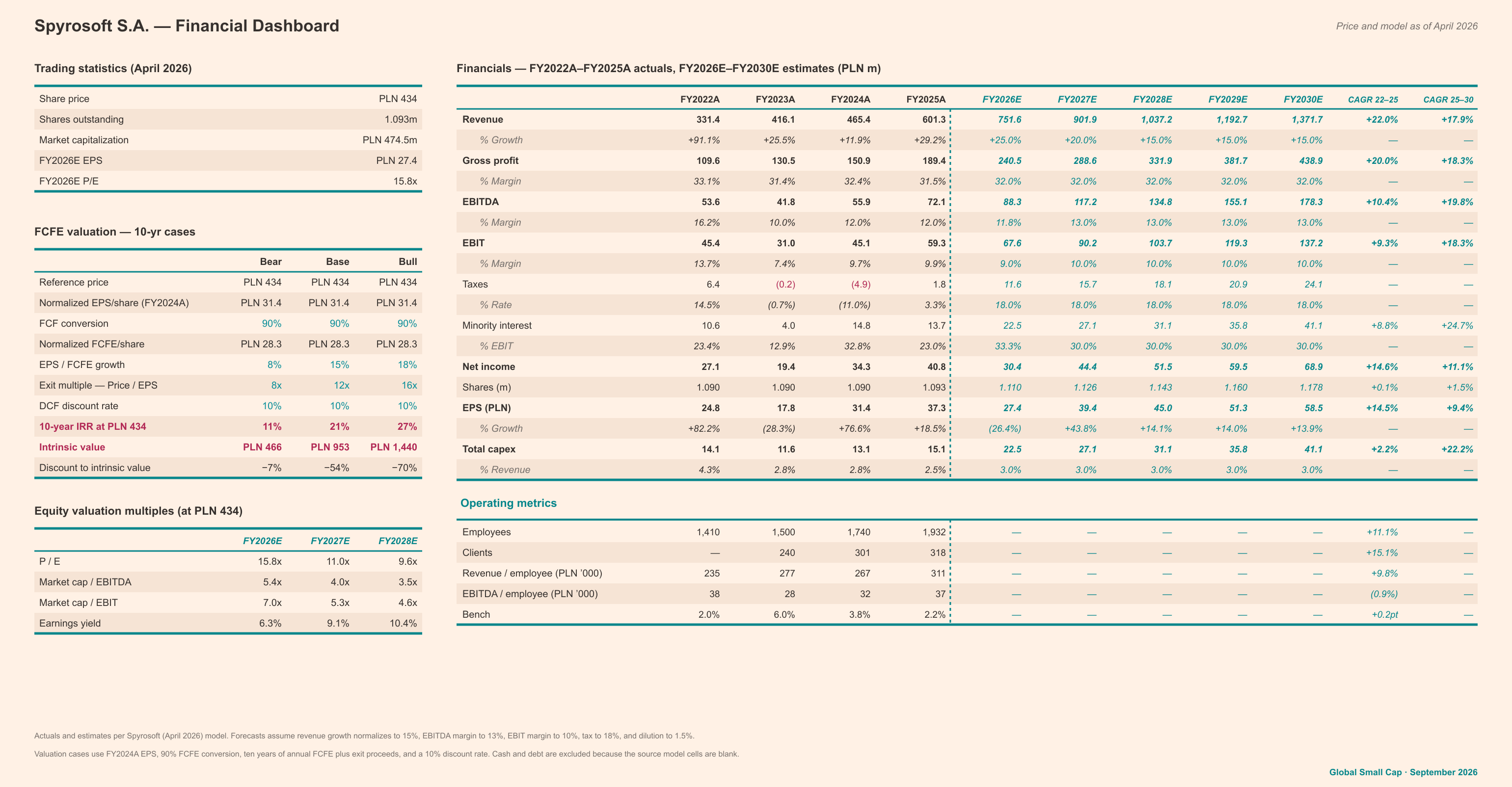
I don’t spend much time on Polish microcaps but several unrelated people told me to check out Spyrosoft. Spyrosoft stood out as it had characteristics of one my favorite IT services companies: Reply Spa (a future deep dive). I then had a chance to listen to the Founder/CEO Konrad speak on a YouTube video and the business model, culture, and overall approach jumped off the page.
As a result, I’ve dug-in and I think I’ve found a nice little gem that could 3x over time. Now there is one very important caveat: Spyrosoft made a strategic decision to try and re-list onto a larger exchange to make it easier to raise capital, incentive employees, and gain more credibility. This was not deemed feasible given the current market environment so Spyrosoft has since said they are looking for a partner. What does this mean? Well, Spyrosoft could become a take-out which would be a decent short-term return but would eliminate the long-term compounding I would be looking for. This is still a TBD and things could change.
Spyrosoft has very limited volume so is very much a personal account or “PA” idea. Spyrosoft stands out for being an IT services upstart with a unique organizational design accompanied by a passionate and entrepreneurial management with skin in the game.
History Part 1
Spyrosoft was founded by Konrad Weiske (CEO) and 3 co-founders Wojciech Bodnarus (CFO), Sebastian Lekawa (Board of Directors), and Andrew Radcliffe (CEO of Spyrosoft UK) in 2016. Spyrosoft was bootstrapped with £200k of capital and two offices. An office in Bournemouth, UK, did sales to mid-sized UK companies whilst an office in Wroclaw, Poland, focused on delivery and benefited from access to engineering talent from the local Wroclaw University of Science and Technology.
Konrad grew up in communist Poland, studied I.T. and held various consulting and project management roles at larger companies like Siemens, Nokia, Vodafone, and Microsoft. Konrad eventually became an Executive Board Member at intive, a Polish IT-Services company that reached PLN100m in revenue. Konrad admits that whilst he was a good programmer, his interests always lied with the “people side”. When private equity acquired intive, Konrad wasn’t pumped with PE’s strategy. He was in his late-30’s and had saved enough to try to forge his own path.
Konrad had a specific vision and organizational design in mind from Spyrosoft’s inception (more on this next). Konrad saw himself as someone good at sales and leadership but knew he had to plug gaps in his abilities so sought out a CFO, CTO, and an additional partner. The co-founders were all former colleagues or clients and collectively own 83% of the business. Before going deeper into the history, it is worth understanding Spyrosoft’s organizational design.
Organizational Design
Konrad had a very specific vision for Spyrosoft’s organizational design.
Interview with Konrad on Xquadrant - Aug 2021
“I had a solid plan of what I wanted to achieve and it was quite detailed and it was really under the assumption that the company is going to be relatively big. So I had the target organizational structure for example even when the company was just five people. When we had five people, I already knew what I would be doing when we have 100, 500, 600, 700 people. So we had a clear strategy, a clear goal.”
Spyrosoft’s strategy is to be a decentralized “platform” for IT services entrepreneurs. Rather than hire senior consultants and engineers, Spyrosoft’s approach is to seed entrepreneurs in order to incubate standalone “daughter and sister” companies. In a typical scenario, Spyrosoft finds an ambitious executive who has an entrepreneurial bent. Spyrosoft then forms a new subsidiary which is majority owned by Spyrosoft (typically 50% to 80%) and minority owned by the entrepreneur. Alternatively, Spyrosoft is willing to acquire a controlling interest in an existing business and plug-them into Spyrosoft’s platform.
Konrad at the Microcap Leadership Summit - Oct 2023
“This is not actually a company. We are a group of companies. What we have created is a plug and play platform, to which we connect new companies and new people who want to do something we are not already doing. The goal is to provide complementary services to serve our customers end-to-end”.
The typical entrepreneur is someone in Spyrosoft’s existing network who is in their 40’s who brings experience, a network of clients, and a network of potential hires, who can leverage Spyrosoft’s platform and their entrepreneurial energy to grow their business. They may be disenchanted with their corporate employer and want to pursue a more entrepreneurial path.
Cofounder Andrew Radcliffe on a Podcast - Feb 2024
“So we collaborate with people wanting to run their own business. We look to our network, and we understand if they have an idea and they’re really driven to create a company, then we work with that person to help them fulfill their dream. But also, they add their competence to the Spyrosoft Group. So our motivation is really based on ambition and the desire to really achieve success together.”
Spyrosoft backs this entrepreneur with back-office support like HR, Finance, and Legal, and provides an operational and financial safety net via loans if needed. Importantly, while Spyrosoft will provide advice and help facilitate cross-sales, decentralization is a core principle at Spyrosoft. Spyrosoft lets entrepreneurs run their business as they see fit, even if Spyrosoft disagrees with a particular strategy.
First Page of Spyrosoft’s 2022-26 Strategy Document
“Our business model is based on decentralization and a clear distribution of responsibilities amongst the companies. This approach allows for rapid scaling of the group achieved both with organic growth of each company and adding new entrants to the group”
Konrad making the point that even if they degree with a subsidiary CEO’s approach, the principle of decentralization overrides that.
Konrad Weiske on Xquadrant - Aug 2021
“So sometimes, to be absolutely honest with you, I think I would do that differently but I’m not really telling them that. Even if they fail, well then it’s their decision unless it is something terribly stupid, but it never happens. So we give them this opportunity and then they join us. Otherwise I don’t think they would have ever joined”
From the perspective of an acquiree or an entrepreneur, Spyrosoft allows them to build their own business, have real equity, but have the backing and support of a larger group. At a minimum, this provides welcome relief from back-office tasks but ideally, Spyrosoft can help these subsidiaries find new clients, find collaboration opportunities, and grow faster than they could have by themselves.
Interview with CEO of Better Software Group (acquired 2022) on benefits of being part of Spyrosoft
In Spyrosoft’s structure, BSG is an individual business unit complementing the group’s competence in the media area. Through this cooperation, Spyrosoft began to explore a little-known niche. We entered this cooperation with our clients, our realisations, and our portfolio, which broadened the range of services offered by the entire group. For BSG, working with Spyrosoft is an opportunity to expand its network and sales channels. Being a part of an international group also means access to specialists and competencies that the frontend company lacked, including dev-ops, UX, and back-end competencies.
Pros & Cons of Spyrosoft’s Model
There are several reasons why this model is attractive relative to the traditional approach of hiring senior and middle managers on the payroll.
Alignment. The CEO of the subsidiary is extremely aligned from both a revenue and cost perspective. Spyrosoft doesn’t need to worry about motivation, incentives, cost management, execution, or attrition as the CEO’s livelihood is based on all of the above.
Scalability. Growth is not constrained by Spyrosoft’s managerial bandwidth. Rather, growth is based on whether Spyrosoft can attract new entrepreneurial CEOs. In that regard, Spyrosoft’s CEO looks to be committed to the decentralized model, even when he disagrees with a subsidiary CEO’s approach, which is critical if Spyrosoft wants to continue scaling.
Diversification. While individual subsidiaries face customer and industry concentration, when it all rolls-up to Spyrosoft, the revenue is diversified by geography, end-market, and customer. This is in contrast to more centrally managed IT services startups who generally scale off the back of a single large customer.
Agility. Because Spyrosoft is a collection of entrepreneur-led boutiques, it does not need a big salesforce and MBAs to execute on projects. Rather, the subsidiary CEOs are intimately involved in the projects which translates into a leaner more agile team with better execution.
Cofounder Andrew Radcliffe (Feb 2024)
“Our structure inside Spyrosoft all the way up to the board members is very very flat. Our organization chart is upside down. It all starts with a project and a customer and then working our way up from that, a project team, they report into a project manager, who reports into a business unit engineering director who reports to a board member and that’s it. So very very very flat structures.”
With any deliberate organizational design, there are always trade-offs.
Equity. Spyrosoft takes the risk but gives up anywhere from 5% to 50% of the equity to the entrepreneur to “acquire” this alignment.
Scalability. While Spyrosoft can scale the number of boutiques, they are structurally disadvantaged when it comes to winning larger contracts relative to more centralized competitors who can better coordinate resources.
Margins. Spyrosoft has focused on secondary markets to avoid competition and has been open to expanding internationally into new markets without pursuing critical mass. This approach makes it harder to scale centralized capabilities, meaning margins will be structurally lower to peers.
History Part 2
Shortly after founding, Spyrosoft created a JV in Germany called GOD GmbH, a German boutique focused on the auto sector. By 2018, Spyrosoft had reached 100 people and created a dedicated automotive software division. By 2019, Spyrosoft opened more “daughter companies” in Germany, Croatia, and the US and more offices in Poland. Some of these subsidiaries were empty shells set-up as placeholders until Spyrosoft could identify the right person to run them.
In 2020, Spyrosoft went public on the junior NewConnect market in Poland. By 2021, Spyrosoft had centers in India, Romania, and Argentina. By 2022, Spyrosoft grew to 1,000 people and transferred their listing to the main Warsaw exchange.
Since 2022, Spyrosoft has started using M&A as a growth lever to its plug-and-play approach.
In April 2022, Spyrosoft acquired a 60% interest in Better Software Group for PLN20m, a Polish IT Services player focused on the media sector (this business has since won a PLN150m contract with the BBC).
In June 2024, Spyrosoft closed on its acquisition of a 57.5% stake in Codibly (terms not disclosed), a Polish IT services company with 82 people focused on custom software for the renewable energy and electric mobility sectors.
In Nov 2024, Spyrosoft acquired Carimus, a North Carolina-based IT Services firm with 40 people for PLN16.4m delivered over 2.5 years and additional Spyrosoft shares tied to Carimus’s 2027 performance. Carimus focuses on brand strategy, UX design, web and mobile development, and IT consulting.
From 2020-25, Spyrosoft has compounded Revenue, EBITDA, and EPS by 40%, 23%, and 22% cagr, respectively, whilst share count has only grown 1% cagr. This growth rate is reminiscent of Reply’s early success. Reply went public in December 2000 at EUR32m of revenue, which is roughly the revenue Spyrosoft was doing in 2021. Over the next 5 and 10 years, Reply grew revenue 35% and 28% cagr, respectively.
Business Overview
Today, Spyrosoft has 20+ offices and subsidiaries across the world and 2,000 employees.
Offices
Argentina - Buenos Aires
Denmark - Copenhagen
Croatia - Zagreb, Osijek
Germany - Stuttgart, Brunswick
India - Chennai
Norway - Bergen
Poland - Wroclaw, Cracow, Warsaw, Bialystok, Szczecin, Lodz
Romania - Timisoa
UK - London, Manchester, Bournemouth, Newcastle, Edinburgh
USA - Ann Arbor, Pittsburg, Raleigh
Capabilities
Capabilities by Subsidiary. Spyrosoft is primarily focused on custom software development, consulting and smaller systems integration projects. They do not have the scale to do large-scale systems integrations and do not participate in any meaningful way in BPO work. Spyrosoft does not have a proactive sales outreach effort. Rather, the subsidiary CEO’s source clients and often bring pre-existing relationships when they join which leads to referrals over time. Spyrosoft often leverages its consulting capabilities to drive up-sell of custom software projects.
“We don’t have a sales division per se. As you know, we have a number of subsidiaries which are quite diversified in terms of the segments they deliver to the services they provide. So the people that run those companies, the business units they have are responsible for sourcing clients. We support them of course by delivering a number of leads, references for business with marketing initiatives of course outbound marketing conferences that also generate new leads for us. We have a partnership with technology companies as well. So our approach is different from others because we don’t really have sales people per se. Our sales are based on consulting really. So we are actively looking for AI consultants in the US because that’s our main thrust rather than sales people. That’s how we are different from our peers who work under the old-fashioned sales model with a large group of salespeople.”
Examples of projects include the design and implementation of data platforms, web applications, mobile applications, data science systems, and business intelligence systems.
Some of Spyrosoft’s larger brands include:
Spyrosoft Solutions. Focuses on embedded software in verticals like Industry 4.0 (IOT), Healthcare and Life Sciences (i.e. software for medical devices) and automotive.
Spyrosoft Synergy. Focuses on Robotics and computer vision used for applications like production line and automation. An example is robots to help service offshore windmills.
Better Software. Focuses on video-on-demand and streaming platforms. This has a large contract with the BBC in the UK.
Spyrosoft E-Commerce. Focuses on helping customers build out e-commerce platforms.
Spyrosoft Connect. Focuses on ERP, particularly Salesforce and CRM
GOD. Joint Venture focused on the automotive sector.
Unravel. An in-house design agency focused on user research, user design, and UI prototyping.
Impact of AI
It is important to address what the potential impact of AI will be. AI is a clear risk to the IT services sector with front page articles on the FT and WSJ all pointing to AI driving significant pricing pressure as customers demand more for less.
My house view is as follows. Firstly, AI is most likely to disrupt the low-end of the IT-services value chain, specifically managed services and BPO-type work as a lot of these labor-intensive services will be replaced entirely by AI. We have already seen this with the rise of AI-native customer support start-ups which have rightly decimated the stocks of Concentrix and Teleperformance as they represent an existential risk.
There is an obvious flip side to this. Companies that still run on legacy on-prem or in many cases mainframe-based systems need to modernize their infrastructure. Data has to be cleaned-up and organized and to the extent “meat and potatoes” companies want to build in-house models, leverage AI, do change management, migrate customer support to AI, etc. they need help which is not readily available in-house. So on the systems integration and consulting side, I expect there to be a wave of new projects in the next 5 years as traditional enterprises rush to get their data and infrastructure in order to defend themselves against AI-native upstarts and specialist and agile boutiques like Spyrosoft are best positioned.
We are frankly already seeing this trend with “forward deployed engineers” which is another way of saying “IT Consultant”. Palantir pioneered this model after realizing that embedding an engineer into the end-customer allows Palantir to get a deeper understanding of customer pain points which in turn allows Palantir to design and implement the software to maximize ROI. This is in effect what an IT consultant like Spyrosoft does and because Spyrosoft is at a small scale versus an Accenture with $1m headcount, it can navigate this AI wave with agility rather than an Accenture or Cognizant which has to make an elephant dance.
Spyrosoft has been relatively quiet on the impact of AI. Their results speak for themselves but they have explicitly said revenue directly related to AI (does not include using AI for coding, etc.) was still in the single digits.
Customers and End-Markets
Spyrosoft is generally targeting mid-sized enterprises. They consciously stay away from mega clients and in fact, the locations they originally chose for offices were mid-sized cities rather than larger capital cities, although they are now opening offices in London and Manchester (2024) to support a large contract with the BBC. As a result, they’ve traditionally side-stepped competition from larger services players like EPAM and the Indian players. Spyrosoft has c.300 customers implying it generates approx. USD125k/customer. This makes sense. EPAM is the largest nearshore player and about 25% of their customers are in the $0.5m to $1m range. Spyrosoft’s model works best for smaller projects and in addition, Spyrosoft is targeting mid-sized cities so their average project sizes fall under what EPAM would target. They may bump heads with Endava where 80% of clients generate GBP1m in revenue.
BBC (c.15% of 2025 Revenue)
In 2024, Spyrosoft’s Better Software subsidiary (60% stake acquired 2022) was awarded a multi-year contract to help the BBC with their digital-first strategy. Better Software is acting as an on-shore staffing provider supplying architects, DevOps specialists, and QA testers. The total contract value is £75m of-which Spyrosoft’s share is £33m from 2024-27 with an option for 2 annual extensions. The other supplier is Accenture for £42m who is supplying the near-shore labour component.
Better Software had extensive prior experience creating media platforms across Europe, which gave it credibility against other bidders. The BBC accounted for 5% of revenue in 2024 and is trending towards 15% in 2025. There is risk that this contract gets significantly reduced in 2027 as renewals are dependent on government budget approvals and procurement processes. With that said, this award is a major win for a relatively small player and could lead to more success with larger contracts with other media customers.
Customer Vertical
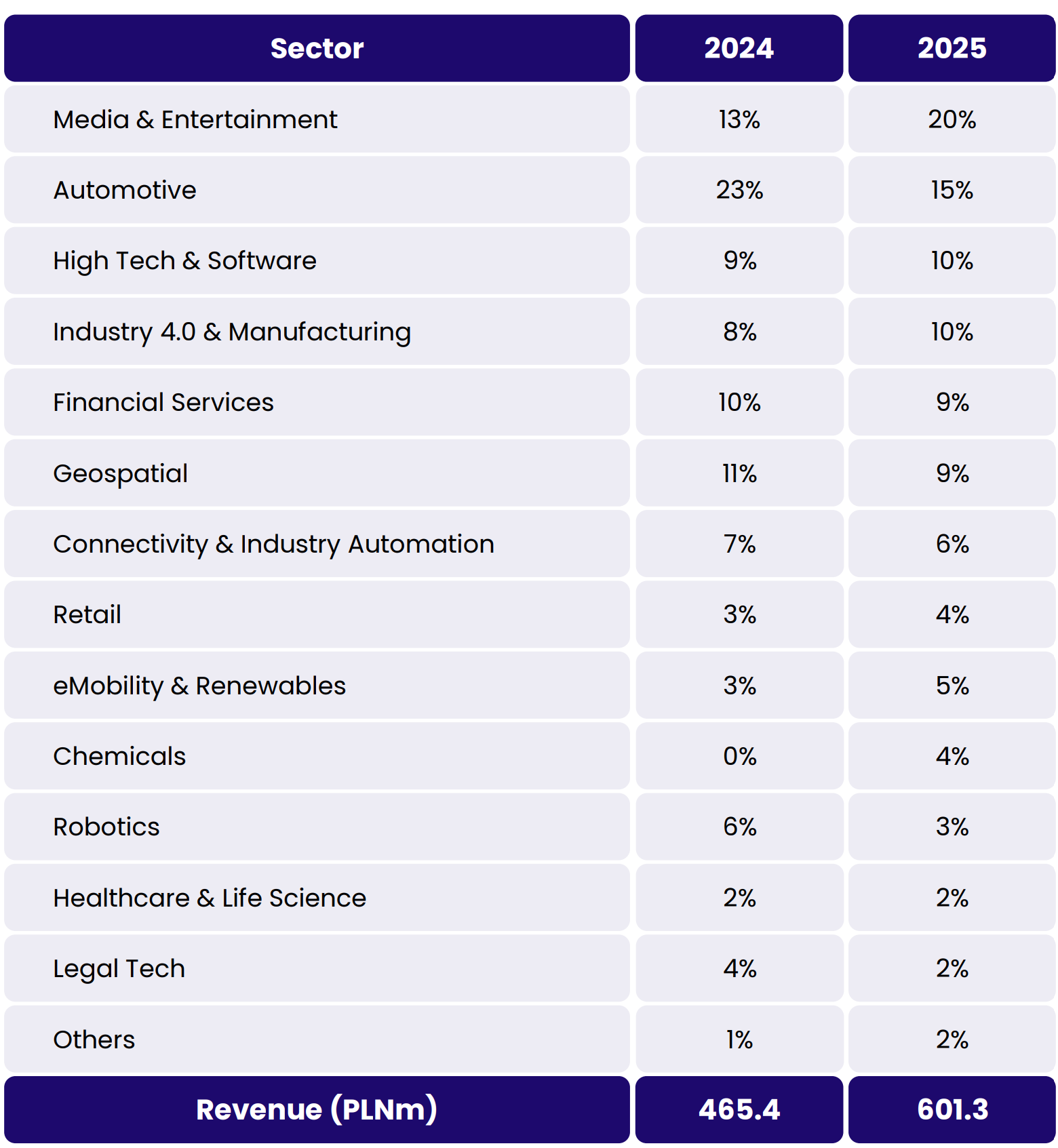
Spyrosoft is unusual for a relatively small player for having diversified end-market exposure. Players of similar size are typically concentrated to a single industry (often financial services). This is due to Spyrosoft’s decentralized model which is reliant on multiple boutiques that have specialized expertise rather than achieving scale with a single vertical.
The original focus verticals were Financial Services, Geospatial, Media and Automotive. Over time, the number of verticals has expanded. The two areas of concentration are automotive and media. In 2024, Spyrosoft saw the loss of a large auto contract which resulted in a 27% half-year revenue headwind in H2 2025. That same year, Spyrosoft landed the BBC contract allowing Spyrosoft to grow-through this headwind (12% F2024 growth). As part of this, Spyrosoft had to restructure its German operations. Spyrosoft now believes the auto business has been stabilized.
Auto and Media are collectively 35% of Spyrosoft’s revenue and likely just a handful of customers, so Spyrosoft does have some customer concentration. Beyond that, the revenue is diversified. Spyrosoft has said priority verticals for growth are Defense, Security, Aerospace, and Advertising/Marketing tech.
Geography
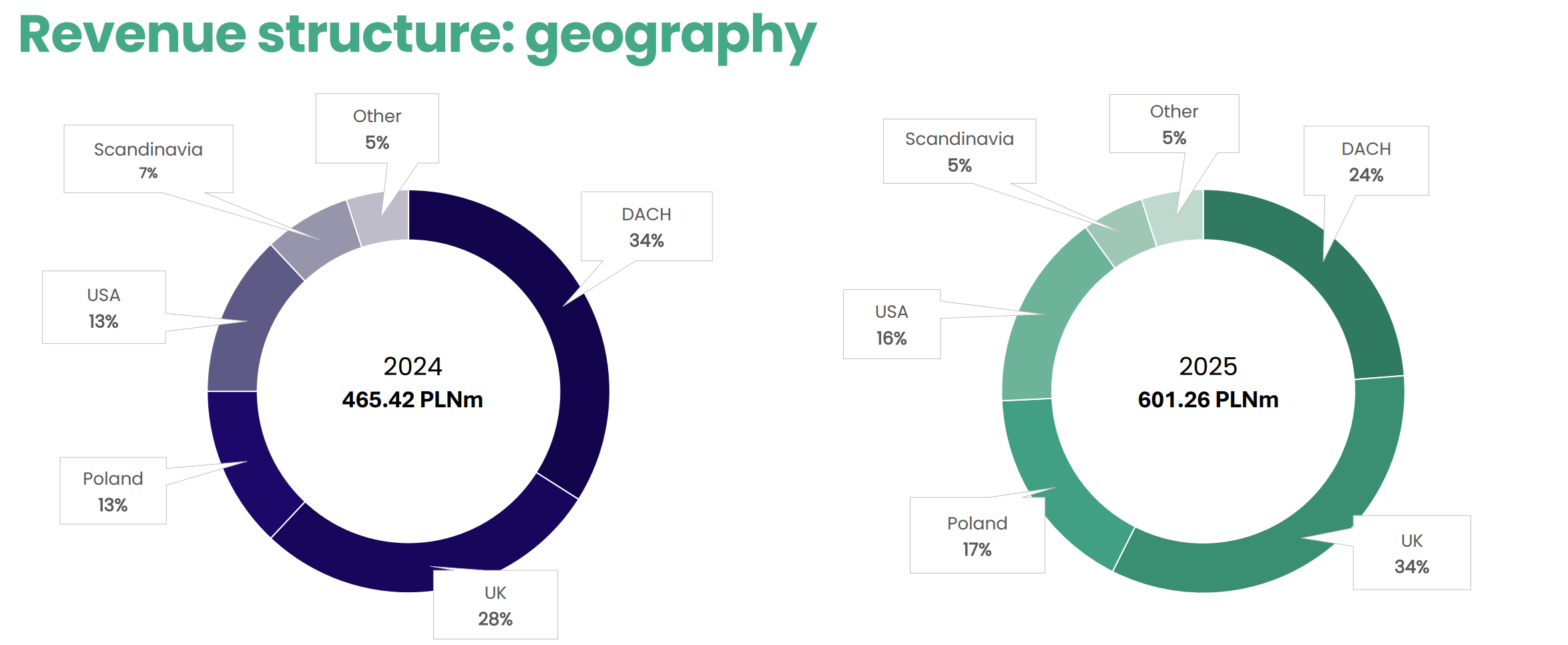
Geographically, Spyrosoft primarily services developed Europe and the US. Within Europe, Spyrosoft has been able to develop a customer base of mid-sized enterprises with the occasional large-enterprise win. Spyrosoft is trying to expand into the US and the Gulf States. While I would normally be skeptical of a Polish IT-services company managing global operations, Spyrosoft’s decentralized model means it isn’t necessarily “managing” them. Rather, the beauty of the model is that Spyrosoft just has to make sure that it gets the initial subsidiary CEO right allowing that entrepreneur to build a business in a market they already know well. As long as Spyrosoft does not do transformational M&A, the risk of a mistake is also manageable as Spyrosoft can simply part ways with an individual subsidiary CEO. The reduction in DACH revenue relates to the reduction in auto revenue.
Below are some examples of projects Spyrosoft has completed:
Ordinance Survey is UK’s Mapping service. Spyrosoft worked on analytical systems to model underground geospatial data as well as develop applications allowing consumers like runner and cyclists to engage with the data.
Benefex is an employee well being software company. Spyrosoft helped Benefex create a module that helps drive greater employee engagement.
Simply Health is an Insurance Company. Spyrosoft helped Simply Health manage storage and data retention to reduce cost exposure to its CRM vendor.
Recruitment, Training, and Delivery
As I’ve described, Spyrosoft’s organizational design is to back experienced executives to run their own boutique on a decentralized basis. In fact, Spyrosoft has said 50%+ of new hires come from referrals, likely people a subsidiary CEO already knows from a prior role.
Unlike EPAM or large players like Accenture or Cognizant, Spyrosoft’s model is not predicated on hiring junior talent and building a bottom-pyramid to manage margins. As a result, Spyrosoft’s unused bench is just 2% of its workforce as opposed to EPAM which runs 20%+.
The bench spiked to a still reasonable 6% in 2023 owing to softness in the IT Services market. Having such a small bench makes it difficult to go after larger projects. On the other hand, large projects are not Spyrosoft’s core focus and it certainly has not hampered Spyrosoft’s growth.
Employees in high-cost markets like the UK and US have customer facing roles such as Project Managers, UX Designers, Scrum Masters, Business Analysts, etc. Employees at those subsidiaries than collaborate with nearshore subsidiaries for software development and testing. The vast majority (60% to 80%) of employees sit in near-shore locations like Poland.
Given Spyrosoft’s relatively nascent reputation, they are happy to win new logos on price, build trust, and land-and-expand over time. As a result, their target EBITDA margins are 11% to 14% despite focusing on higher-end custom software and despite having a nearshore model.
In my view, the relatively low margins are an appropriate trade-off. As Spyrosoft’s reputation grows and as it becomes easier to land and expand, pricing should increase over time so margins may normalize from the lower-end of the 11% to 14% range towards the higher-end as Spyrosoft scales. As I will detail in my “Economics” section, Spyrosoft still achieves reasonable Revenue/head and EBITDA/head.
Competition
There is no structural moat for a small IT services player. Spyrosoft does not have a cost advantage relative to any players and does not have the breadth and depth of Accenture. Rather, the moat comes from Spyrosoft’s organizational design. It’s unique decentralized plug-and-play model gives Spyrosoft an advantage recruiting entrepreneurial IT services executives to come join. Having a portfolio of small entrepreneurial boutiques allows Spyrosoft to be agile, closer to the customer, and ultimately deliver better execution to the end-customer. While individual subsidiaries will have customer concentration, at the group level, there is adequate diversification which will get better over-time.
Economics
Contracts. The nature of Spyrosoft’s work (consulting, custom software, smaller systems integration) means Spyrosoft is primarily selling T&M contracts on relatively short-duration (<1 year) projects. Spyrosoft did say as of Q2 F2025 that classical “team extensions” or staffing were 15% of revenue, although that seems low given the BBC contract (c.15% of revenue) should primarily be Team Extensions so I suspect management meant 15% excluding BBC. Either way, Spyrosoft is primarily doing a project rather than simply providing engineering headcount.
Revenue. Out of the 2,000 employees, somewhere between 60% to 80% are in near-shore centers so excluding UK (roughly <200 employees) and US. Revenue/Head for Spyrsooft is USD72k for Spyrosoft, roughly 8% lower than Endava at USD78k and 13% lower to EPAM at USD83k.
This discount is consistent with what Konrad has publicly said. Spyosoft has a weaker reputation to established players like EPAM, operates in more secondary or tertiary markets, and is using price as a lever to help drive growth and get the referral flywheel going.
Konrad at the MicroCap Leadership Summit in 2023
“When it comes to our customers our work is our advertisement and we quite often are happy to work for lower rates, if we think the customer is worth it, because we know they they will recommend us to somebody else. So we lower the prices and we just do what we do best because we know this customer has a huge potential.”
EBITDA. When you look EBITDA/Head, unsurprisingly, Spyrosoft is below direct peers. A large part of this is simply scale. With that said, at an EBITDA/Head of USD9k, Spyrosoft is just 22% below EPAM and running at a ballpark similar rate to Endava pre-COVID despite Endava being significant larger, so while Spyrosoft is discounting their price, is sub-scale, and operating in secondary cities, their overall profitability levels are fine.
Capex and Working Capital. Capex was slightly elevated between 4% to 9% of revenue but has normalized to 3% of revenue the last 2 years. This is driven by the opening of new offices. Nothing stands out about working capital. They run approx. 60 days A/R and 30 days A/P, standard for the industry. Reply for example stands out given it operates in Italy where customers are slow to pay (120 days A/R). Spyrosoft’s net-cash is roughly 5% of their market cap, and I don’t expect them to take on any meaningful debt.
Shares. Strategically, Spyrosoft previously said they wanted to move their listing to a major US or European exchange around 2027. The main reason is to make it easier for Spyrosoft to reward and incentivize their non-CEO employees around the world with employee share plans and potentially raise capital. Moreover, the founders have approved a stock option plan (c.5% dilution over multiple years) for key employees (not including the founders themselves) to encourage non-CEO employees to get aligned with Spyrosoft’s overall strategy. Spyrosoft has historically had c.1% dilution and I would expect 1% to 2% type dilution going forward.
As I mentioned, this changed after a strategic review which concluded that this would not be feasible in the near-term. Per the March 2026 announcement.
“When we announced our previous strategy in 2022, we indicated that after 2026 the company may debut on an international stock exchange,” said Konrad Weiske, CEO of Spyrosoft S.A. “But since then, our business environment has changed significantly, along with valuations of foreign companies, as well as the faster pace of changes in our industry connected at least with the rapid growth of AI and the tense geopolitical situation. After conducting an analysis, we concluded that currently, in terms of flexibility and potential valuation factors, the preferred option for the company and its shareholders will be to obtain a strategic investor from the private market which ultimately could take a controlling stake in the company. We assume that this should occur within the next three years, and thus within the execution of our new strategy.” As of now, obtaining a strategic investor is the main direction for the group’s further growth. A potential IPO on a major international stock exchange, contemplated previously, remains under consideration but is no longer the primary path.
For shareholders, this creates some uncertainty. To the extent Spyrosoft earns a strategic investor but remains public, it could give Spyrosoft stronger financial backing and access to capital setting the stage for multiple years of compounding. On the other hand, the founders own 83% of the business and could basically facilitate a sale or take-private at a less than compelling valuation, likely still above today’s share price, which at a worst case would mean a healthy but short-lived return.
Management & Capital Allocation
The 4 co-founders all have skin in the game.
Konrad Weiske (CEO) - 31%
Wojciech Bodnarus (CFO) - 25% (held in spouse’s name)
Sebastian Lekawa (Board of Directors) - 25% (held in suse’s name)
Andrew Radcliffe (CEO of Spyrosoft UK) - approx. 2%
Free Float - 17%
The UK CEO was previously a client of intive when he was the Head of Development of the Ordnance Survey (UK mapping service) and owns c.2% of the listed entity, but likely has a higher share of the UK subsidiary specifically (Spyrosoft owns 81% of its UK subsidiary). The Polish co-founders have their compensation disclosed which is just a base salary of roughly USD200k with no bonuses. The incentives are purely based on their large equity interest in Spyrosoft.
There is clearly some M&A risk as the co-founders don’t have a significant M&A track record. The M&A they have done thus far has been small. Management has spent in total roughly PLN24m (excl. Carimus) of-which Better Software was the largest at PLN20m. Better Software was a smashing success given the award of the BBC contract. Otherwise, the acquisitions are small and more acqui-hire in nature.
I think the risk is favourably biased as Spyrosof’s reason for M&A is to bring in smaller entrepreneurs who want to “plug and play” into the Spyrosoft platform in a VC-like way rather than acquire something bigger like Reply in a PE-like way.
Per H2 2025 Call
“Three [M&A] priorities. One, clients in the US and production, delivery of services. That’s our top number one priority. Second priority, something we could do but we are not doing but because we are not knowledgeable enough. So if you find a company that is great about Microsoft dynamics. Then I think we could talk third priority. Sebastian talked about our opportunism. If the fit is right, we will invest. And so these are our goals. But what we are not going to do? I think, is we are not going to invest all the money we have and get a bank loan to buy one big company and have a big merger, spectacular merger, that’s not something I would expect us to do. But when it comes to companies in India for instance, we will be looking at bigger companies with hundreds of stuff. But in the US, in contrast, dozens of staff, we want to open up new markets instead of uh touching up our EBITDA to seem bigger.”
Per Q4 2024 Call
“We have a small but a very agile M&A team which is capable of reviewing dozens of companies a month. We have the appropriate process. We have the appropriate people. We cooperate with external companies. that are on the lookout for such companies. There are several such entities below 10 but more than two or three and those entities are looking for such targets. We also have an internal team that is looking for companies for instance in the German market where we can also go for asset deals. We have several such teams, internal teams, external robust external providers and then the preliminary selection is done. But it’s not that the process is fully outsourced. We do it internally because it’s our key strategic decision to be made. I think we’re doing this in the right way. And just to show you that we we’ve been able to avoid mistakes. I believe this is one of the company’s secrets.”
Overall, small deals of <20 people are effectively the same as hiring a new subsidiary CEO. It is too soon to tell whether Spyrosoft can add value with larger M&A deals but based on what they’ve said so far, there is limited risk of Spyrosoft doing a very large deal, They are likely to focus primarily on “acqui-hire” and tuck-in type deals in-line consistent with Spyrosoft’s overall business model.
Growth
Given Spyrosoft’s size, the overall industry growth is less relevant. The overall IT services market is expected to grow MSD to HSD and Spyrosoft should be able to comfortably exceed this given it focuses on the higher-growth custom software and consulting sub-segments and more importantly, as it continues to scale-up and form or acquire new subsidiaries.

Spyrosoft also had an explicit 2026-26 strategy which lays out its medium term ambition of reaching 3,000 consultants, 33% revenue cagr, and 11% to 14% EBITDA margins which would imply 2026 revenue of PLN1bn (new strategy to be announced 2027). Given the loss of the auto customer in F2024 (mid-teens headwind) and overall softness in the IT services market in F2023, Spyrosoft has grown below the 33% rate the last 2 years, but grew 29% in 2025 and is trending towards the mid-20% growth in 2027.
Longer-term, there are several tailwinds. First, as Spyrosoft gains a stronger reputation in the market, it should get a better referral flywheel. Second, Spyrosoft’s services are currently underpriced relative to peers but the discounts it offers subside over time. Finally, Spyrosoft will very likely find new entrepreneurs and acqui-hires and which could further accelerate as Spyrosoft’s model becomes better known amount peers. Spyrosoft’s Carimus acquisition, for example, was a US acqui-hire and more of these types of deals could follow.
I think a growth rate in the high-20% range in the next 2 to 3 years followed by a mid-teens rate thereafter is achievable and below what Spyrosoft is explicitly targeting. The governor is not managerial capacity, but rather, Spyrosoft’s ability to source and attract entrepreneurs or acquire small boutiques onto Spyrosoft’s platform.
Key Assumptions
My assumptions are fairly straightforward and laid out below.
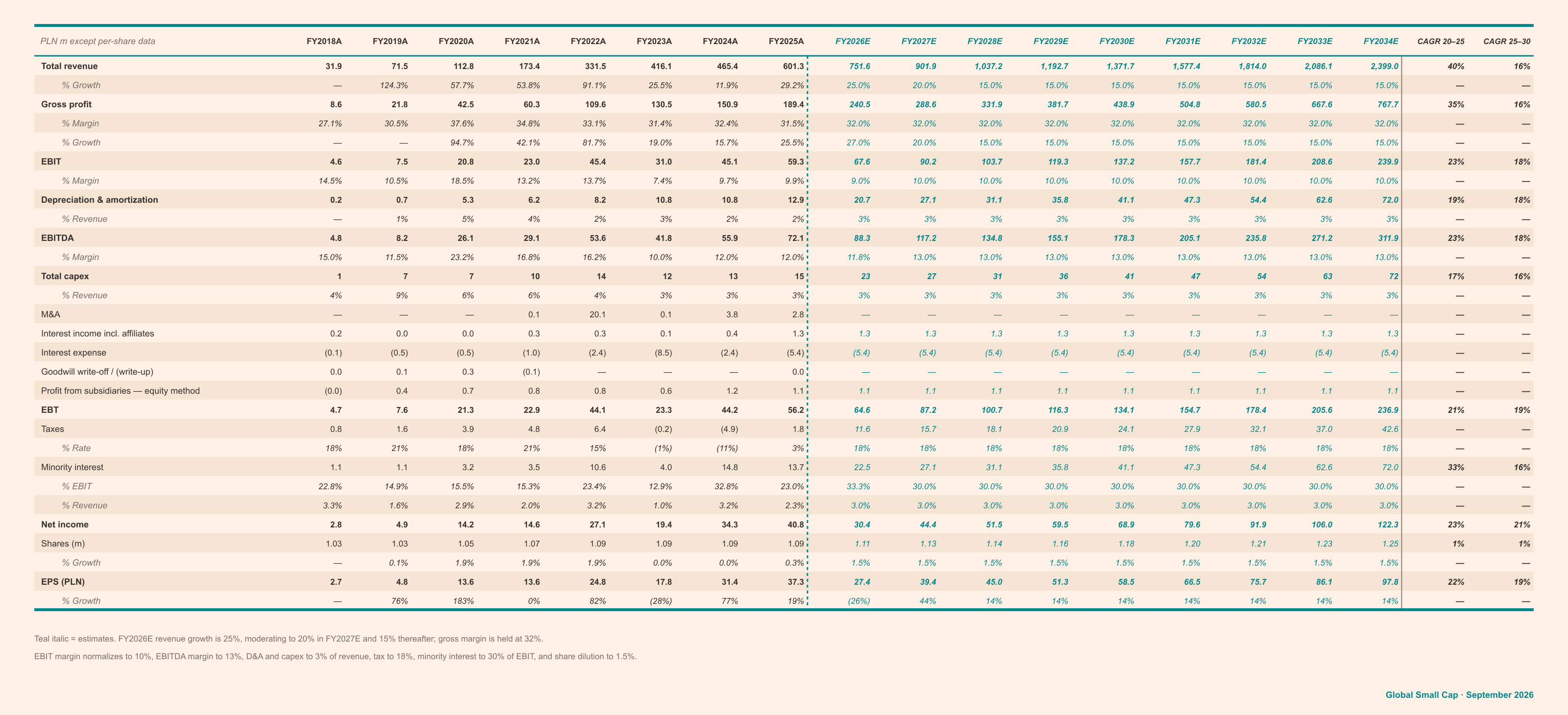
I conservatively assume Spyrosoft becomes a mid-teens grower by 2028. I do not give them the benefit of the doubt on margins, but rather, assume they become a normalized 10% EBIT and 12% EBITDA margin business, on the middle-end of their guidance of 11% to 14%.
Given Spyrosoft’s model, minority interest in relatively high and ticked up meaningfully to 33% of EBIT in 2024, likely helped by the BBC contract. It is trending around 22% of EBIT as of H1 2025. I model it flat at 33% of EBIT going forward declining to 30% over-time.
Spyrosoft is benefiting from a Polish R&D tax credit meaning it currently pays very minimal tax, but I normalize taxes at 18% of revenue. I also assume 1.5% share dilution. These assumptions drive a 19% EPS cagr during my forecast period.
Valuation and Quality Score
I value Spyrosoft very simplistically. Spyrosoft currently trades at 15x 2026 and 13x NTM P/E. Given there are always risks associated with buying a Polish business (vs. developed market business) and a microcap, I assume a relatively modest exit P/E multiple of 12x. The main risk to this multiple is AI disruption.
Assuming 15% EPS growth, 90% FCF conversion, and a 12x exit multiple, I arrive at an IRR of 21% and an intrinsic value of 950 zloty, more than double’s today’s share price.
Of course, I feel that the exit multiple is grossly understated and that there is potential for Spyrosoft to compound well beyond the 2030s. By the mid-2030s, even after compounding mid-teens Spyrosoft would still be a sub-USD700m revenue business, or in other words, still a small boutique.
Conclusion
Spyrosoft has a unique organizational design, which should be able to scale rapidly. While their track record is short, it has been impressive so far. I believe Spyrosoft looks a lot like what Reply looked like back in 2000 when they first IPOd. Reply ended up being the best performing stock in Italy for many years running. I believe Spyrosoft has a similar potential making it a very attractive investment at today’s price.
Nice write up - very interesting case! Some questions on valuation: How has the valuation multiple changed since the SaaSpocalypse trend ? What does the ~13x fwd PE multiple look like relative to other similar companies ? Do you believe this reflects a trough multiple?